As a tribute to the refugees from Katrina, IMBB and Paper Chef have joined together in asking you to stay home this weekend and cook, donating what you would have spent on dinner out to the relief effort. Owen has chosen tomatoes, sausage, shrimp and beer as the ingredients. I do not eat pork or shellfish, so I will substitute beef sausage and chicken. I have included both breakfast and lunch, as well. Enjoy your “day in New Orleans,” in remembrance.
Breakfast
Beignets or
Brioche or Croissants (with jam and real butter)
Café au lait
Lunch
Paté de Campagne
Crusty baguette
Cornichons
Brie or Camembert
Fresh fruit
Bottle of wine
Supper
Chicken & Okra Gumbo (Thanks to Jan and Donna from Metarie, LA, who helped me perfect my roux)
1/3 c flour
1/3 oil
1 chicken, cut up, (back, wings and neck reserved for stock at later date)
½ pound smoked beef sausage, diced or in thin slices
1 onion, diced
1 bay leaf
1 teaspoon dried, crushed thyme
2 teaspoons Louisiana hot sauce (not Tabasco®, but one more vinegary than hot)
1 can okra with juice (frozen or fresh okra will not impart the tang of canned—critical to my version)
1 can diced tomatoes with juice
salt and cayenne pepper to taste
filé powder
water or chicken broth
1 1/3 cup white rice
Make a nut brown roux with flour and oil in a cast iron (enameled Dutch oven) . When done to your taste, add diced onion to hot roux, along with thyme and bay leaf, sausage and chicken, stirring and browning onion and chicken in the hot roux (Adding the chicken and browning it in the hot roux prior to adding liquid will set the flesh of the chicken—it will stay together—flesh on the bone.). Add canned okra and tomatoes, stirring constantly to prevent scorching. Add 2 quarts boiling water or broth and Louisiana hot sauce and simmer for at least one hour. Add salt and cayenne to taste. Keep hot.
Add 1 1/3 cups uncooked rice, 3 cups cold water and ½ teaspoon salt to a saucepan and bring to a boil--do not stir! Turn down to low and cover; simmer for 15 minutes or until rice is done and fluff with a fork.
Stir filé powder into gumbo and serve immediately over rice in soup bowls. Have extra hot sauce and filé powder on the table to add for taste.
Serve with crusty bread and a glass of cold beer
Dessert
Cream Cheese Ice Cream
Your favorite dessert wine

Saturday, September 03, 2005

Monday, August 29, 2005
Grilled Goat Cheese Sandwiches with Chutney or Jam
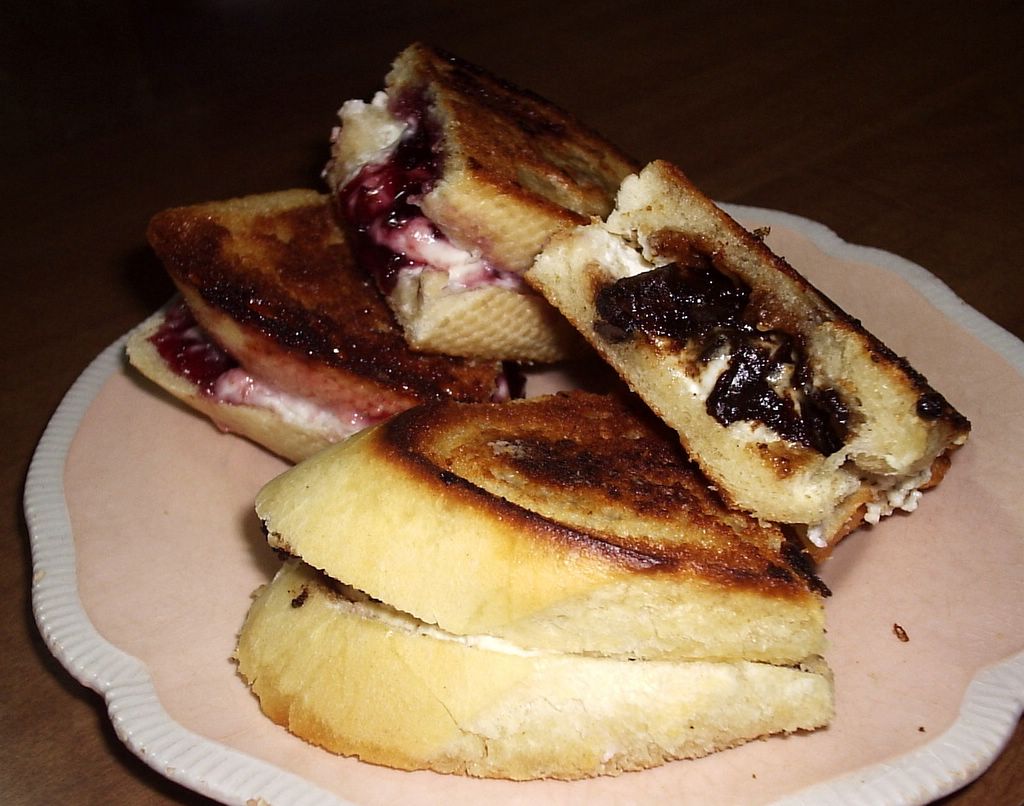
Today is Grilled Cheese All Day. Goat cheese lends itself to either savory or sweet uses. Grilling the cheese helps it meld with the flavors used.
Here are two: a savory morsel with green walnut chutney--dark, gooey and tangy; and a sweet cherry jam--ooh, cheesecake as fingerfood.
Sunday, August 28, 2005
Beignets
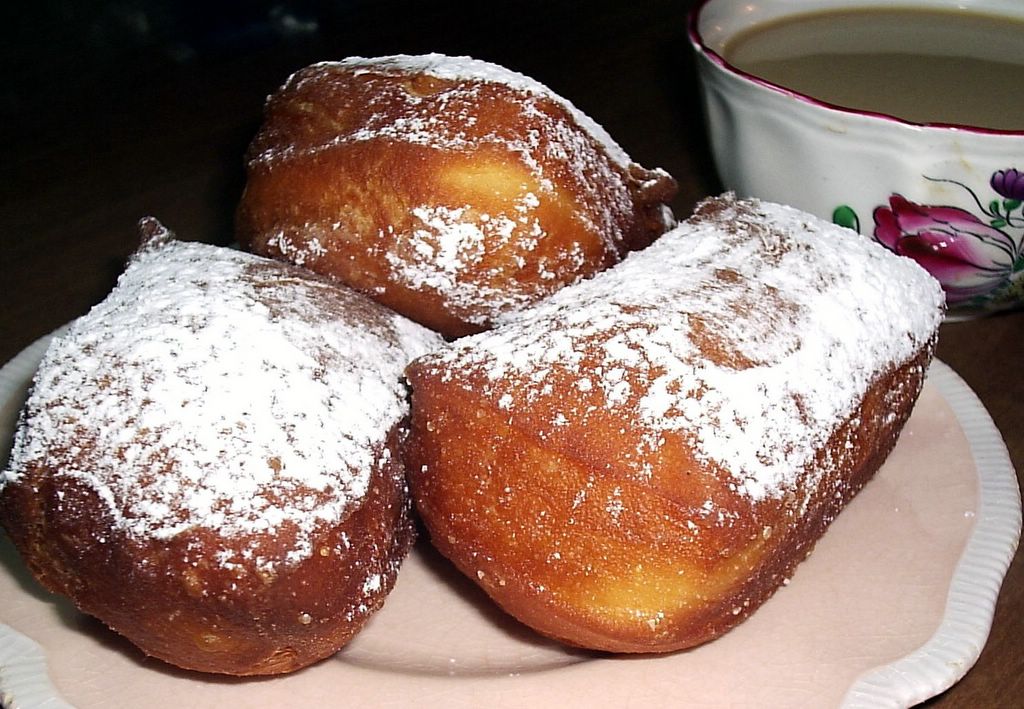
Frying. this month's IMBB, allowed me to brush up on my beignets--they are now picture perfect.
Danno from New Orleans Cuisine stopped by the other day to help me with my beignets recipe. I had not been letting my beignets rise after rolling them out and cutting. I had been relying on the hot oil to make them puff up, which they did, but I had very large holes and little dough in my beignets.
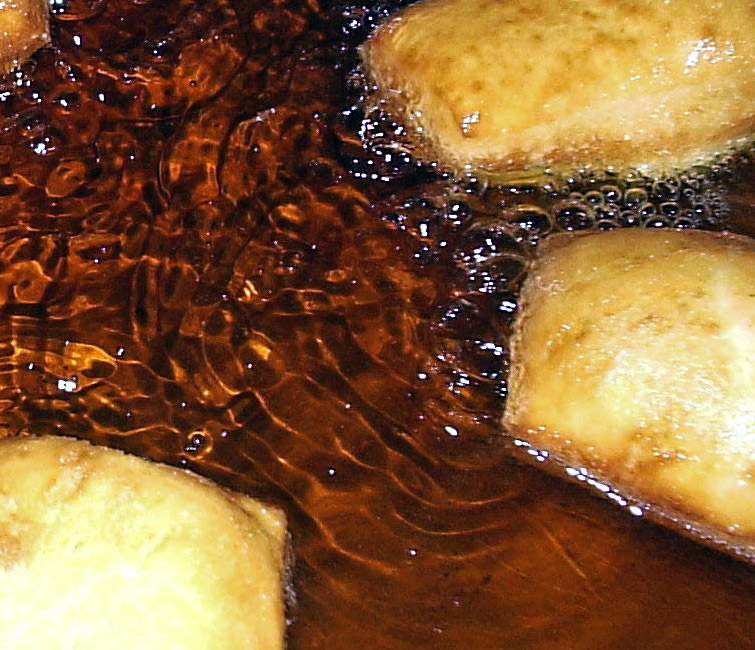
By letting them rise double in bulk before frying, I now have puffy and fluffy beignets.
When I feel truly decadent, I grate some chocolate into my café au lait.
Tuesday, August 23, 2005
Sassafras and Filé Powder
Now is the time to gather your sassafras leaves to dry for filé powder. Danno has a great post on filé powder at NolaCuisine.
Gather your leaves on stems in the early evening in mid-August in mid-America--hang upside down in paper bag to help keep them free of dust and to catch any leaves that may fall. When the leaves are dry, remove from stems and crush. Store in an air-tight container--the leaves contain a volatile oil. Use in stews and gumbos to add a certain thick richness to the broth. Do not add until the stew is almost done, and do not boil after the addition of the filé. Enjoy.
As an aside--sassafras roots are an ingredient in modern rootbeer.
Gather your leaves on stems in the early evening in mid-August in mid-America--hang upside down in paper bag to help keep them free of dust and to catch any leaves that may fall. When the leaves are dry, remove from stems and crush. Store in an air-tight container--the leaves contain a volatile oil. Use in stews and gumbos to add a certain thick richness to the broth. Do not add until the stew is almost done, and do not boil after the addition of the filé. Enjoy.
As an aside--sassafras roots are an ingredient in modern rootbeer.
Monday, August 22, 2005
Clafoutis
This summer I tried experimenting with clafoutis recipes.
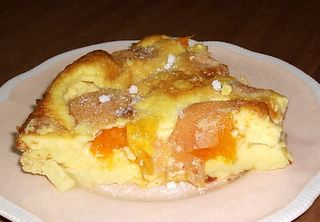
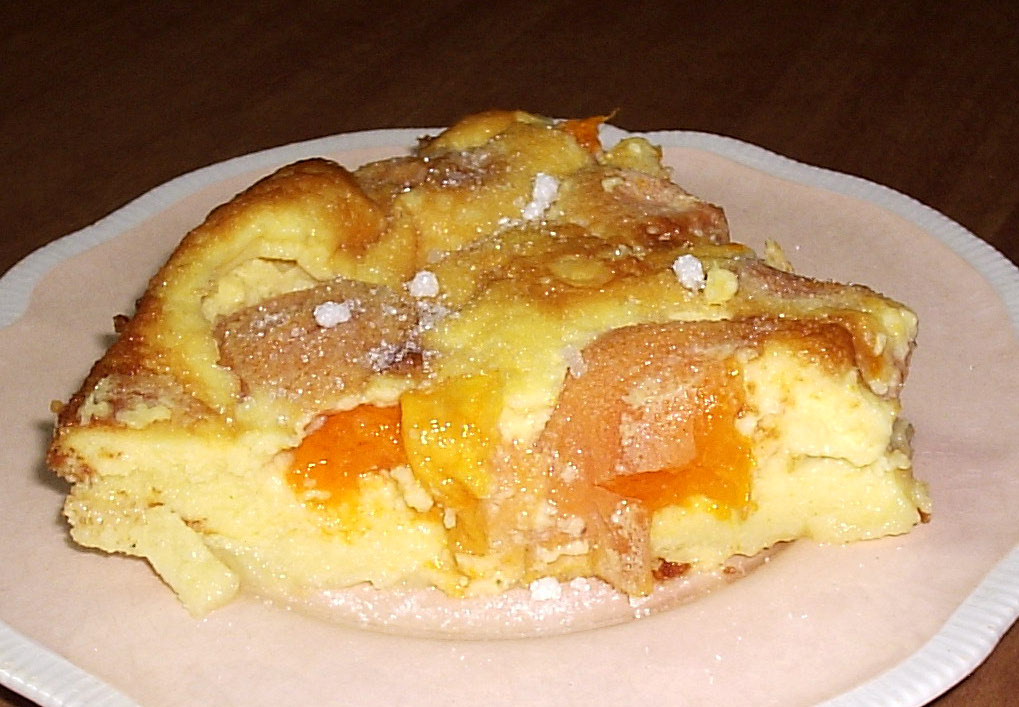
Here is my apricot clafouti made with Hélène's recipe.
And here is my clafouti made from Cooking with Amy's posted recipe for cherry clafouti by Julia Child
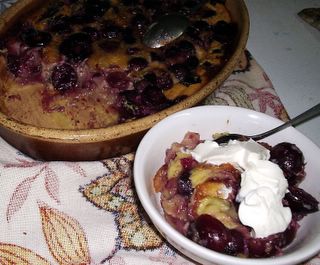
Both recipes were followed exactly. However, I found that the apricot recipe needed a touch more sweetness, hence the crushed sugar sprinkles. I much preferred Hélène's recipe for its inclusion of melted butter--it added a richness that even adding crème fraîche could not match in Julia Child's recipe. Prior to trying Hélène's recipe, I had always preferred Julia's recipe, especially in technique.
I highly recommend either recipe--they are great ways to use up small pieces of or irregularly shaped fruit. Think of the batter as a cross between a custard and a crepe--eaten either warm or cold, with or without extra sugar or crème--clafoutis are delicious.
Here is my apricot clafouti made with Hélène's recipe.
And here is my clafouti made from Cooking with Amy's posted recipe for cherry clafouti by Julia Child
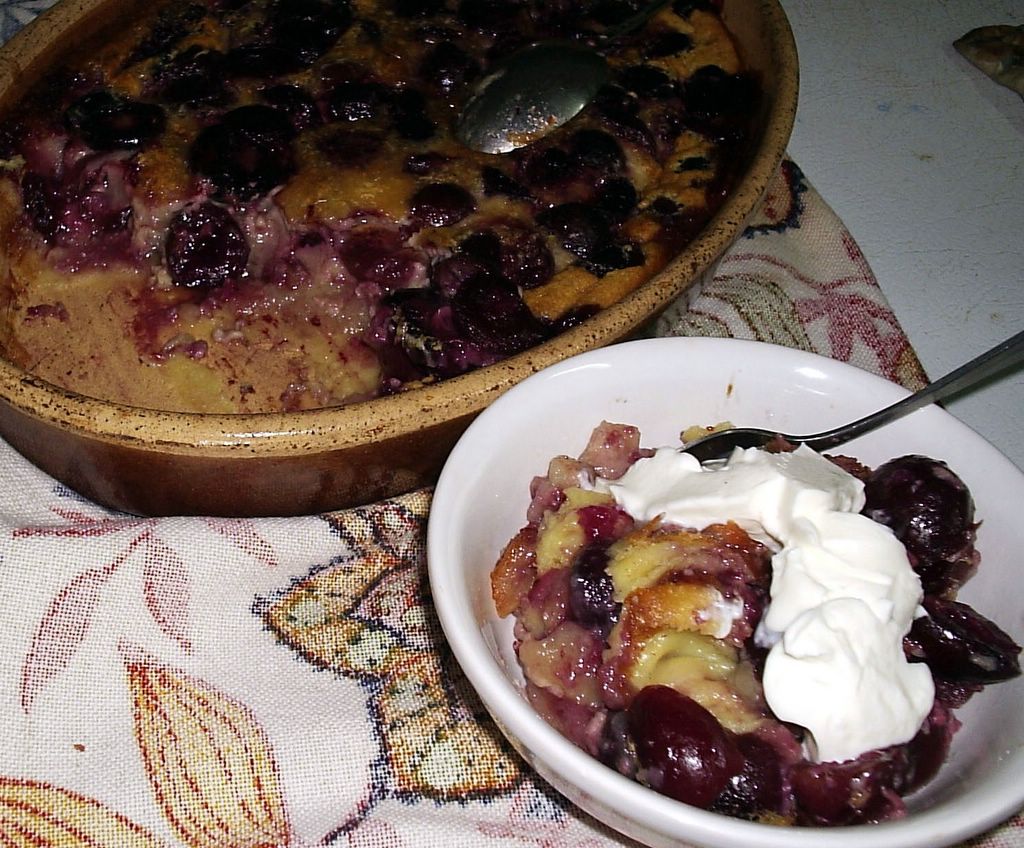
Both recipes were followed exactly. However, I found that the apricot recipe needed a touch more sweetness, hence the crushed sugar sprinkles. I much preferred Hélène's recipe for its inclusion of melted butter--it added a richness that even adding crème fraîche could not match in Julia Child's recipe. Prior to trying Hélène's recipe, I had always preferred Julia's recipe, especially in technique.
I highly recommend either recipe--they are great ways to use up small pieces of or irregularly shaped fruit. Think of the batter as a cross between a custard and a crepe--eaten either warm or cold, with or without extra sugar or crème--clafoutis are delicious.
Tuesday, August 16, 2005
oignon confit
Le confit d'oignon est employé avec des gras de fois, agneau, canard ou juste seule comme spead sur le pain avec l'apèratif. J'emploie également ceci comme base en quiche d'oignon avec le gruyère.
La fonte 4 cuillers à soupe chaque huile et beurre d'olive dans le skillet et ajoutent 3 grands oignons coupés en tranches. Arrosez légèrement avec du sel et le sucre. Placez ou 1 feuille de laurier ou quelques feuilles emiettées de thym au-dessus des tranches puis ajoutent 3 oignons et sels coupés en tranches plus grands de répétition, sucre et herbes.
L'endroit sur un bas au feu moyen et remuent occassionally, ne veillant jamais à roussir, jusqu'à ce que profondément et caramalized. Finissez avec une éclaboussure du vinaigre ou du vin blanc pour l'oignon blanc, vin rouge pour les oignons rouges. Feuilles enlevées de compartiment si utilisé. Couverture et congé à adoucir avant l'emploi. Gardera plusieurs semaines si resté calme.
* * *
Onion confit is used with fois gras, lamb, duck or just on its own as a spead on bread with apèratif. I also use this as a base in onion quiche with gruyere.
Melt 4 tablespoons each olive oil and butter in skillet and add 3 large sliced onions. Sprinkle lightly with salt and sugar. Place either 1 bay leaf or a few crumbled leaves of thyme over slices then add 3 more large sliced onions and repeat salt, sugar and herbs.
Place on a low to medium fire and stir occassionally, making sure never to scorch, until thick and caramalized. Finish with a splash of vinegar or white wine for white onion, red wine for red onions. Removed bay leaves if used. Cover and leave to mellow before use. Will keep several weeks if kept cool.
La fonte 4 cuillers à soupe chaque huile et beurre d'olive dans le skillet et ajoutent 3 grands oignons coupés en tranches. Arrosez légèrement avec du sel et le sucre. Placez ou 1 feuille de laurier ou quelques feuilles emiettées de thym au-dessus des tranches puis ajoutent 3 oignons et sels coupés en tranches plus grands de répétition, sucre et herbes.
L'endroit sur un bas au feu moyen et remuent occassionally, ne veillant jamais à roussir, jusqu'à ce que profondément et caramalized. Finissez avec une éclaboussure du vinaigre ou du vin blanc pour l'oignon blanc, vin rouge pour les oignons rouges. Feuilles enlevées de compartiment si utilisé. Couverture et congé à adoucir avant l'emploi. Gardera plusieurs semaines si resté calme.
Onion confit is used with fois gras, lamb, duck or just on its own as a spead on bread with apèratif. I also use this as a base in onion quiche with gruyere.
Melt 4 tablespoons each olive oil and butter in skillet and add 3 large sliced onions. Sprinkle lightly with salt and sugar. Place either 1 bay leaf or a few crumbled leaves of thyme over slices then add 3 more large sliced onions and repeat salt, sugar and herbs.
Place on a low to medium fire and stir occassionally, making sure never to scorch, until thick and caramalized. Finish with a splash of vinegar or white wine for white onion, red wine for red onions. Removed bay leaves if used. Cover and leave to mellow before use. Will keep several weeks if kept cool.
Sunday, August 14, 2005
July/August Chow Magazine - verjus
I was interviewed by Ella Lawrence for an article on verjus in this month's Chow in the "Tactics" section, portions of which were previously published in MetroActive Online.
I was out looking at my grapes to see what kind of crop I'll have, and there will be plenty for another jug of verjus for myself--I may try several different recipes this Fall.

I was out looking at my grapes to see what kind of crop I'll have, and there will be plenty for another jug of verjus for myself--I may try several different recipes this Fall.
Friday, August 12, 2005
Pots de Crème au Chocolat
Using coffee as an ingredient is this month's Sugar High Friday originated by Jennifer and hosted this month by Ronald.
Here is my recipe for a sublime pots de crème. Enjoy.
12 oz semisweet chocolate
1 tablespoon very strong coffee
1/4 teaspoon grated orange zest or
1 tablespoon orange liqueur or juice
2 (or 3 if small) egg yolks
1 1/2 cups heavy cream
Melt chocolate in top of bain marie. Stir in coffee and zest or liqueur or juice. Beat yolks with a fork and scrape chocolate mixture into the yolks gradually, stirring constantly. Add cream to top of bain marie and carefully stir in chocolate egg mixture. Stir constantly while cooking until thick over hot water. Pour immediately into small serving dishes.
Garnish with orange slices or strip of orange peel. Makes 4-6 small servings--a little goes a long way.
Here is my recipe for a sublime pots de crème. Enjoy.
12 oz semisweet chocolate
1 tablespoon very strong coffee
1/4 teaspoon grated orange zest or
1 tablespoon orange liqueur or juice
2 (or 3 if small) egg yolks
1 1/2 cups heavy cream
Melt chocolate in top of bain marie. Stir in coffee and zest or liqueur or juice. Beat yolks with a fork and scrape chocolate mixture into the yolks gradually, stirring constantly. Add cream to top of bain marie and carefully stir in chocolate egg mixture. Stir constantly while cooking until thick over hot water. Pour immediately into small serving dishes.
Garnish with orange slices or strip of orange peel. Makes 4-6 small servings--a little goes a long way.
Monday, August 08, 2005
Lavender, Chili and Peach Iced Milk

This month's Paper Chef combines some unusual ingredients: dried chillies, peaches, edible flowers and a local ingredient. I used this recipe as a starting point to come up with an ice cream garnished with local blackberries picked along Lake Huron's shore.
Steep lavender flowers and one or more dried chili pods to your taste in 2 and 1/3 cups hot milk. Use a seive to remove the flowers and chili, and stir the hot milk into 2 large egg yolks in the top of a bain marie. Add 1/2 cup sugar and a pinch of salt. Simmer gently over boiling water, stirring constantly until the mixture coats the back of a spoon. Stir quickly into 1/2 pureed fresh peaches and cool to the touch before processing in your ice cream machine.
Serve your iced milk with a few blackberries. Smooth and peachy creamy, cool with a bite of chili on the tip of the tongue and a whiff of lavender on the back of the throat--different and delicious.
Sunday, July 31, 2005
Tea Over Ice

Strong tea can be used to plump dried fruit prior to cooking or baking. Pruneaux is made by plumping the prunes in a strong tea over night. This now fruit-flavored tea can be used as a drink over ice, as a base for sorbet, or even used to deglaze a pan to get all the flavor incorporated into a sauce. Fruit-flavored tea adds an indefinable ingredient--give it a try
Wednesday, July 20, 2005
Tea
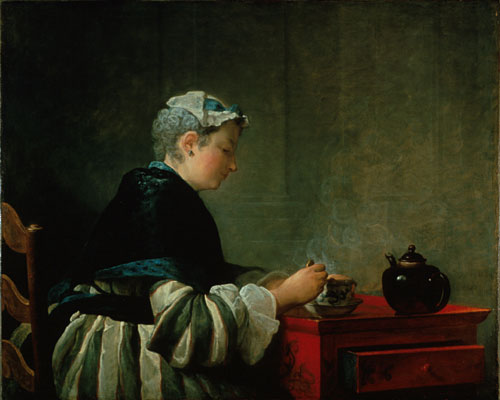
Lady Taking Tea, Chardin
Tea and tea implements were available and used in the 18thC kitchen in France, and Canada later in the century.
Teapots were both rustic

Detail, The Fast Day Meal, Chardin
and refined
Detail, Lady Taking Tea, Chardin
and special tables were used from which to serve and store tea implements.

Detail, The Butler's Table (Office), Chardin
Street sellers sold tisanes, or herbal tea preparations/purgative mixtures, as tea was considered something you drank for your stomach's sake as opposed to your palate's pleasure earlier in the century.

The Tisane Seller, Françoise DuParc
Toward the end of the century, tea services
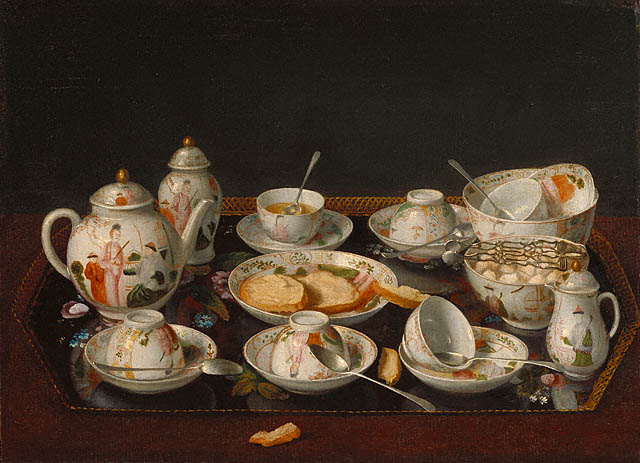
Tea Service, Jean Etienne Liotard
and traveling boxes began to appear for use in more affluent homes.
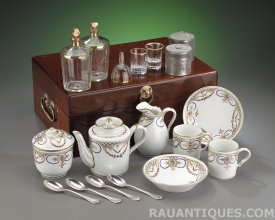
French 18thC traveling Tea Chest, Rau Antiques
Segolene has a wonderful series of posts on tea, both its past and present use, and the correct way to prepare it. Do use a translator, if necessary, to enjoy the information she has gathered.
Le Thé
La Preparation du Thé
Origine du thé
Le thé Matcha du Japon et le Raku
Le thé aux épices et la gloire du Darjeling
La course du thé et les thés parfumés
Le thé vert
Sélection de thés selon les moments de la journée
Friday, July 15, 2005
Nougat Blanc
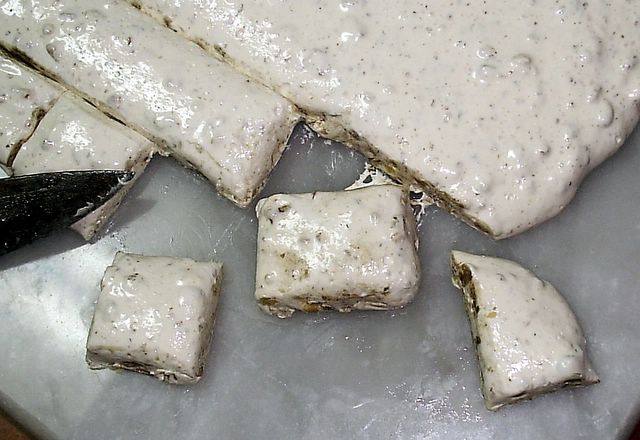
"One of the most commonly believed, and nicest stories, is that the name nougat evolved from France where an elderly lady combined almonds, egg whites, honey and sugar as a treat for local children. As the first nougat maker the children began to call her Tante Manon, tu nous gates (meaning Aunt Manon, you spoil us) and hence the word nougat is said to have first originated from this name. While the French believe nougat first originated in 1650 when the almond tree was introduced to the Montelimar area it is probable that nougat has been around far longer although carrying a different name. It seems nougat has been around for more than 500 years in the Middle East and probably paralleled the development of marzipan and other delicious desserts. Even before the birth of Christ the Greeks were praising the gastronomic value of a mixture made with almonds and honey".
Nougat Blanc:
3 c. sugar
1-3/4 c. honey
1 c. water
2 egg whites
1 tsp. brandy in which a vanilla bean has been infused
2 c. nutmeats (broken and toasted, if preferred)
Put the sugar, honey, and water together and cook until a hard crack ball will form when dropped in cold water. Beat the egg whites until stiff and pour the hot syrup slowly into them, beating constantly until the mixture grows too stiff to beat. Then fold in the brandy and nut meats. Mix well and pour onto a marble slab. When it is cool, cut in squares or rectangles. (If you do not have a marble slab, pour nougat onto pain azyme (rice paper or wafer paper) and place another sheet on top and weight with a board until cool.)
Depending upon the flavor of honey and type and shape of nuts (broken, toasted, ground) used, each batch of nougat will taste differently. Nougat is a traditional sweet eaten at holiday times.
Thursday, July 14, 2005
Confiture - Bachelor's Jam

Looking forward to Winter evenings' desserts and after dinner coffee, prepare now by making a confiture of summer fruits otherwise known as "bachelor's jam."
Layer fruits with their weight in sugar into a sealable jar and pour 40 proof (or more) alcohol over the fruit. Marc, eau de vie, armagnac, kirsch are all good alcohols to use. You can continue to add fruits and sugar, but always make sure the alcohol covers all. Seal the jar and set in a dark, cool place; shaking the jar occasionally to help dissolve the sugar.
The melange of fruits and their resulting liqueur can be used over iced creams or custards, or just served in a glass with after dinner coffee.
Wednesday, July 06, 2005
Utensibility

Kitchens can be a bête noir or a paradise, depending upon one’s stock of kitchen utensils—those implements that go beyond a mixing bowl, a frying pan and a butcher knife. Sam asked for a recommendation for an item she “cannot do without.” My immediate response was I couldn’t be without my food processor, more commonly known as a mortar and pestle. With my lovely marble mortar, I can pound garlic for aioli or grind herbs and spices to add just the right nuance to my latest sauce.
Monday, July 04, 2005
Radishes
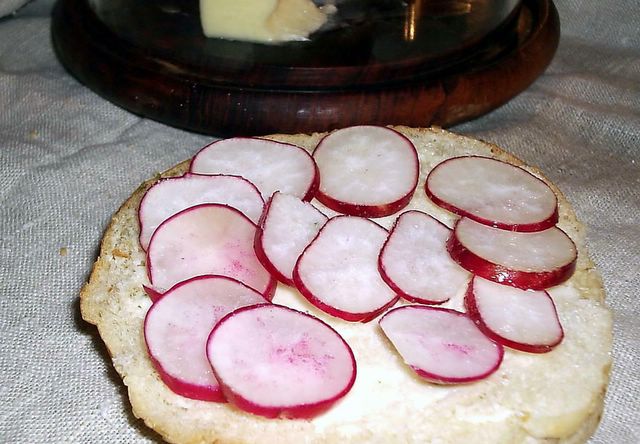
Radishes, if harvested regularly, do not take on that pithy, extra hot texture and taste. For a fresh, country taste slice radishes over a slather of butter on crusty bread and sprinkle on a pinch of salt. A great taste for a snack or picnic treat.
Subscribe to:
Posts (Atom)
