Showing posts with label Confiserie. Show all posts

Thursday, October 09, 2008

October for the Confectioner

In this Month and the following, you have other sorts of Apples and Pears, for all the above-mentioned Uses, and also for Jellies, if you shall think fit to prepare them.

But this is the chief time, for making the Pastes, Jellies and Marmelade of Quinces, as also Confits with Must or sweet Wine and others, which nevertheless only fall under the management of the Country People.

The Officers [those who preside over the cold kitchen/confectioners] and Butlers are otherwise employ'd in this Season, that is to say, in gathering the Fruits, that ought to be in their Custody, which requires a more than ordinary Skill and Precaution.
* * * * *

The court & country cook, faithfully translated out of French into English by J. K. A. J. Churchill, London, 1702, p. 14 New Instructions for Confectioners.

Monday, September 22, 2008

Of the Pastes of Fruits

See Quince Paste

It is only requisite to have recourse to the particular Marmelades, of every sort of Fruit, to know how to make as many Pastes; in regard that it is almost the same thing, and the whole Work is brought to Perfection by drying those Marmelades. To that purpose, when the Business requires dispatch, the Sugar must boil, till it be crack'd, or at least, greatly Feathered; to be incorporated with the dried Fruit. Afterwards, the Marmelade being made according to Art; may be taken up with a Spoon, and dress'd upon Slates, or in Moulds, in order to be dried in the Stove, with a good Fire. In the Evening, or the next Day, they must be turn'd on the other side, and laid again upon the same Slates, or upon Sieves: As soon as these Pastes are become very firm and compact, they are to be lock'd up in Boxes, and may be us'd, as Occasion requires.

At other times, when you would have any Paste-dryed, let as much Marmelade, as you shall think fit, be put into a Copper-pan, and having caus'd some Sugar to be brought to its Feathered Quality, pour it in; tempering it well till it slips off from the bottom of the Pan; after the same manner, as in the making of Marmelade. Then let all simper together, for a while, and let the Paste be immmediately dress'd upon Slates, or in Tin-moulds, made in form of a Heart, Square, Flower-de-luce, etc., which are usually set into the Stove, to be dried as before. These are the general Directions that may be given, for the ordering of such Fruit-pastes as are made of Marmelades; allowing two Pounds of Sugar, for every Pound of Fruit. But for other Pastes, that are made on purpose, an equal quantity of each will be sufficient, and the Sugar must be boil'd till it has attain'd to its Crack'd Quality.
* * * * *

The court & country cook, faithfully translated out of French into English by J. K. A. J. Churchill, London, 1702, p. 81-82 New Instructions for Confectioners.

Friday, May 02, 2008

Of the Pastes of Fruits

It is only requisite to have recourse to the particular Marmelades, of every sort of Fruit, described in the fore-going Chapter, to know how to make as many Pastes; in regard that it is almost the same thing, and the whole Work is brought to Perfection by drying those Marmelades. To that purpose, when the Business requires dispatch, the Sugar must boil, till it be crack'd, or at least, greatly Feathered; to be incorporated with the dried Fruit. Afterwards, the Marmelade being made according to Art; may be taken up with a Spoon, and dress'd upon Slates, or in Moulds, in order to be dried in the Stove, with a good Fire. In the Evening, or the next Day, they must be turn'd on the other side, and laid again upon the same Slates, or upon Sieves: As soon as these Pastes are become very firm and compact, they are to be lock'd up in Boxes, and may be us'd, as Occasion requires.
    At other times, when you would have any Paste dryed, let as much Marmelade, as you shall think fit, be put into a Copper-pan, and having caus'd some Sugar to be brought to its Feathered Quality, pour it in; tempering it well till it slips off from the bottom of the Pan; after the same manner, as in the making of Marmelade. Then let all simper together, for a while, and let the Paste be immediately dress'd upon Slates, or in Tin-moulds, made in form of a Heart, Square, Flower-de-luce, etc., which are usually set into the Stove, to be dried as before. These are the general Directions that me be given, for the ordering of such Fruit-pastes as are made of Marmelades; allowing two Pounds of Sugar, for every Pound of Fruit. But for other Pastes, that are made on purpose, an equal quantity of each will be sufficient, and the Sugar must be boil'd till it has attain'd to its Crack'd Quality.

New Instructions for Confectioners, faithfully translated out of French into English by J. K. A. J. Churchill, London, 1702, p. 81-82.

Monday, April 21, 2008

Ginger Candy - Gingembre Confit

Image Source


This month’s Sugar High Friday is hosted by La Petite Boulangette whose theme is Asian Sweet Invasion. The spice traders brought many delicious, nutritious and medicinal products to Europe, one of which is ginger. When you are feeling a bit low, nothing will perk you up quite like a nugget of ginger candy and a cup of hot China tea.

GINGER CANDIES: Crush some crystallized ginger, your choice of nutmeat, maybe some flower petals in a mortar until well blended. Form into squares or balls and roll in freshly crushed sugar. To preserve, pack between papers in a wood box. They will keep indefinitely.

GINGER: root of a plant which grows in India & in the Antilles; its taste is bitter & aromatic, it is used a great deal in the Antilles, where it holds the place of pepper, it excites the appetite. One eats it in salad in the places where it grows: here it is brought to us dry or candied.
* * * * *
GINGEMBRE: racine d’une plante qui croît dans l’Inde & aux Antilles; son gout est âcre & aromatique, on en fait un grand usage aux Antilles, où il tient lieu de poivre, il excite l’appétit. On le mange en salade aux lieux où il croît: on nous l’apporte ici sec ou confit.

Dictionnaire Portatif de Cuisine, d'Office, et de Distillation. Chez Vincent, Paris 1767, p. 306.

Thursday, January 17, 2008

Fruits Preserved Entire

mostarda-di-frutta To preserve fruits entirely, one must replace the moisture in the fruit with a solution of sugar syrup or honey. This is accomplished by carefully peeling away the outer skins or rinds [citrus rinds have other preservation techniques, as well] and cooking slowly in several boilings of sugar syrup or honey, and allowing to stand over night in the solution in a non-reactive vessel in a cool place. At the beginning of each day the syrup is drained from the fruit and reboiled and the fruits are again added to the boiling liquid and allowed to cool in the syrup overnight. This is repeated until the fruits have absorbed most of the sugar. The shape and color of the fruit can be ameliorated to some degree by only boiling the syrup and pouring it over the fruit, allowing it to cool without actually boiling in the syrup--this preserves the texture of the fruit and is exemplified by what is known as glacéd fruit; indeed, almost any fruit can be preserved in this manner.

Friday, January 11, 2008

Candied Oranges - anneaux, tailladins, orangettes

Winter is the time for citrus fruit, especially oranges. The golden fruit and juice are so sweet and remind me of summer tastes. At this time of year I am reminded how long it is 'til Spring, and I try to savor every possible remembrance. After I eat the fruit I candy the peel and dry some to use in herbal mixtures and to make vin d'orange.

Cut the top and bottom off the orange and set aside [use to dry and grate for seasoning]. Cut through the side of peel in three places, but not into the orange itself. Carefully lift off peel in three sections and turn pith side up. Use a spoon to scrape away as much pith as possible. Cut peels into strips about 3/8" wide. Place strips in pan and cover with water and bring to boil. Blanche for 5 minutes [this removes any impurities and mellows any bitter taste that may remain from the pith]. Drain and cover again with water and freshly crushed sugar. Place back on the fire and simmer until almost all sugar syrup has been absorbed by the peel. If you have any syrup left, use it to flavor a cup of coffee or tea. Remove to a rack and drain; when dry, roll in crushed sugar. At this point the ends can be dipped in some melted chocolate. Serve orangettes with strong coffee after dinner or with tea when you are feeling down. One taste and you'll think Spring.
*****

Oranges & Citrons.
Levez la peau des oranges le plus delicatement que vous pourrez, mettez la pelure dans de d’eau, faites boüillir de l’eau, fendez les oranges par le bout, & les mettez cuire, faites-les boüillir demie heure, & les tirez & mettez dans l’eau fraische, vuidez le jus, les zestes & le grains de dedans avec une petite cueillere d’acier, faites cuire du sucre à perle, égoutez les oranges, faites les boüillir à grand feu jusqu’à ce que le sucre soit cuit à la plume, ostez les de dessus le feu, les laissez un peu reposer, tirez les oranges sur de la paille, & les laissez secher avant que le les lever: Pour un quarteron d’oranges il faut environ six livres de sucre.


Oranges & Lemons.
Cut off ends of oranges, carefully raise the [peel], (save juice & pulp for salad or marmalade or citrusade. [this is most easily accomplished by cutting off ends of orange, removing peel in quarter section, then supreming the flesh from the sections]), remove seeds with a small steel spoon, & blanche peels in fresh boiling water, drain them & put in fresh water and sugar to cover, cook to the perle stage [220° F], drain oranges, cool syrup, reboil in sugar cooked until the feather [235°F], remove quickly from the fire, allow to rest a little in the hot syrup [they may absorb most of it], remove and drain oranges on straw mat, & let them dry a little, then roll in sugar to coat, allow to thoroughly dry: For 20-25 oranges [quarteron] one needs approximately six pounds sugar. [Save the sugar syrup, which may have crystallized, to use, dissolved in other preparations or as a flavoring in water for a refreshing drink].

Oranges en tailladins.
Pelez les oranges de mesme les autres, mettez-les à mesure dans de l’eau fraische, coupes-les en quatre, vuidez bien le dedans, & les nettoyez avec un couteau, coupez les par bandes comme des lardoons, mettez les à mesure dedans l’eau fraische, faites boüillir de l’eau & les égoutex, & les mettez dedans, faites-les cuire, & les remettez dans l’eau fraische, confisez-les comme les autres, & les tirez sur la paille avec des fourchetes en forme de petits rochers.


Peel oranges the same as the others, cut them into quarters, remove the inside [flesh], & clean them [the white pith] with a knife, cut them into bands like lardoons [strips], boil in fresh water and sugar to barely cover, drain them, let cool, reheat sugar syrup and cook them again in the boiling syrup, & preserve them like the others, & roll in white sugar & dry them on the straw mats until hard like rocks.

Oranges par anneaux.
Pelez les oranges comme les entieres, & les coupez par roüelles de l’épaisseur d’un demy doigt, mettez-les dans de l’eau fraische, faites boüillie de l’eau. égoutez-les, vuide-le dedans des anneaux, faites les cuire à l’eau, estans cuites tirez-les & les mettez dans l’eau fraische, & les confisez comme les oranges entieres, & les separez en les tirant sur la paille.


Oranges by rings.
Peel oranges, & cut them by rounds of the thickness of a little finger, put them in fresh boiling water, drain them, hollow the inside of the rings, saving flesh for salad or marmelade, cook [peels] once more with water [and sugar], when cooked withdraw them & put them [again] in fresh water [and more sugar], & preserve them like whole oranges, & separate them, roll in sugar and dry them on a straw [mat] or rack.
***

Le Cuisinier François, François Pierre La Varenne. Chex Jacques Canier, Paris, 1680, p. 400-401.

Thursday, January 25, 2007

Chocolat - From Bean to Confection

US Department of Agriculture photo
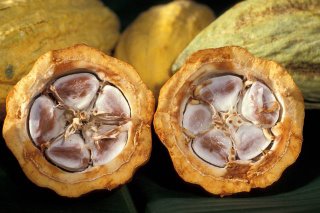
Chocolate is dry paste, made with cocoa beans, & sugar, to which vanilla or an infinity of ingredients that the inventive Americans add. One makes and stores tablettes [of prepared chocolate] in the [pantry]; one drinks it; one employs it to make creams. The chocolate cannot succeed, if one did not choose mature cocoa pods; the best known pods are of gall color [ripe and brown; inside the pod are beans both brown color & dark crimson; those which are red are not worth anything: they are the hard & bitter chocolate; but the quality of the cocoa will only be known after it is roasted; because then it is seen whether there are many of these red grains]. It is necessary that the cocoa is roasted in order to find the taste & the color of chocolate you desire.

To roast the chocolate to the appropriate color, put it [chocolate beans removed from the pulp] in a pan of copper or iron, or in an unglazed terracotta pot, and put it on the fire & stir it up constantly until it is black on the outside, like roasted chestnuts; for this first time, one cannot brown too much; then the cocoa should be peeled, & winnowed well [to remove the outsides of the seeds]; to see if it is roasted enough, it is best to make a test of it; take one ounce of cocoa, & an half-ounce of sugar, which you reduce to a paste to better distinguish the taste & the color; because if it is not brown enough, & if it does not feel roasted enough, one shouldn’t fear to roast it once again, but carefully, because once its bark is removed, it is burned easily; & takes a malicious taste.

When one reaches the proper color, smell and taste, one crushes it with the mortar, so that it is a rather tiny grained masse when some is put on a plate. When the paste of the chocolate approaches this fine grain, it is necessary to add to it vanilla*, & a little powdered cinnamon[or other spice and flavor]; the quantity depends on the will. The whole being mixed together, you add to it three quarters or a pound sugar, for a pound of cocoa; mix your sugar in well and put the mixture back into your mortar, and put it back in the mortar or put it on the stone [metate] or the iron pan heated below with a chafing dish or small fire; also get the roller [mano]: then reduce this compound powder until very fine, a paste will develop with pressure and heat; pass the roller above little-by-little, until it is fine when it does not crunch on the teeth; then tablettes of one ounce are formed, or rolls of a quarter or of half-pound.

*It is necessary to choose strong vanilla, not too dry, nor too fatty; because they are often mixed with oil of balsam [to preserve them], pare them to make sure they are good & fresh: they are very difficult to reduce to a powder; but after having cut them in small pieces with scissors, pulverize them & pass them by the sieve [before adding to the mortar].

Dictionnaire Portatif de Cuisine, d'Office, et de Distillation. Chez Vincent, Paris 1767, p. 156-158.

Tuesday, April 18, 2006

Maple Syrup and Sugar Candy


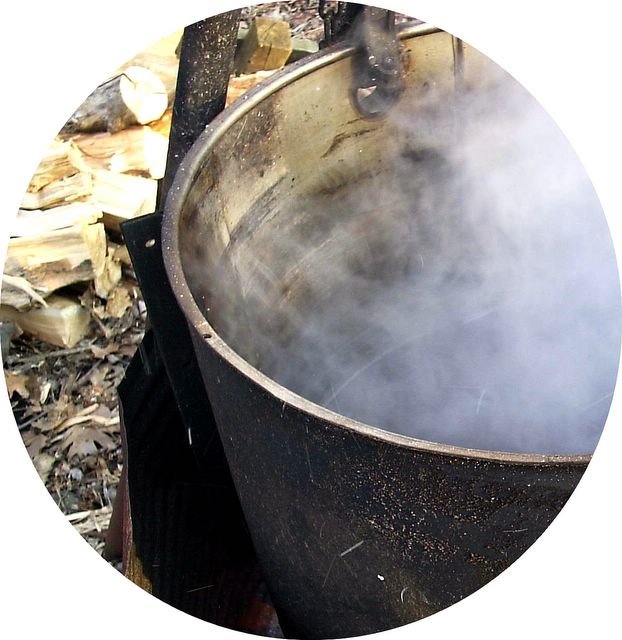
After boiling the syrup down for about 9 hours, I was able to put away many quarts of syrup.


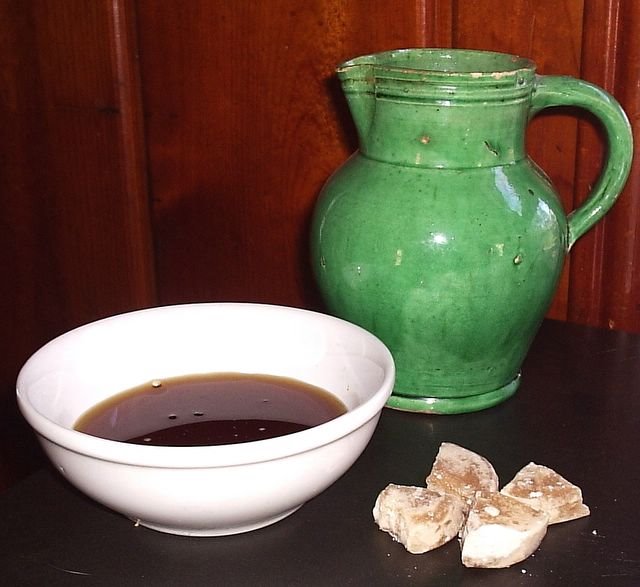
As a treat for the children, I always introduce crystals into the last of the syrup to cause maple sugar to form. Not only does the maple candy taste wonderful, but it keeps much longer than syrup, which sometimes can mold before it's eaten.

I will use the syrup as a binder and flavor for ground meat dishes, such as pâté and boudin. Crushed maple sugar can be used in many dishes and is a special treat for all ages.

Friday, October 21, 2005

Massepains de Chocolat - Chocolate Marzipan


A royal treat for this month's Sugar High Friday . . . Dark Chocolate

Massepains de Chocolat
Echaudez deux livres d’almandes douces, lavez le dans de l’eau fraîche, pilez les bien dans un mortier; faites cuire une livre de sucre à la plume, mettez les amandes dedans; desiechez la pâte à petitfeu, tirez la de la poële, and la mettez refroidir, and quand elle sera froide, vous y mettrez trios onces de chocolat pilé and passé au tamis, and un blanc d’œuf, que vous manierez le tout ensemble; vous pourrez former une a baisse d’une partie de ladite pâte, and la découperez avec des moules de fer-blanc, and en passer aussi a la seringue: ceux qui seront découpez, vous les pourrez glacer d’une glace Royale, comme ceux ci-dessus. Le Massepain de Canelle se fait de même.

Massialot, François. “Massepains de Chocolat.” NOUVELLE INSTRUCTION POUR LES CONFITURES, LES LIQUEURS ET LES FRUITS. Trans. Carolyn Smith-Kizer. Chez Claude Prudhomme, Paris, 1716, pp. 205-6.

* * * * *

Chocolate Marzipan
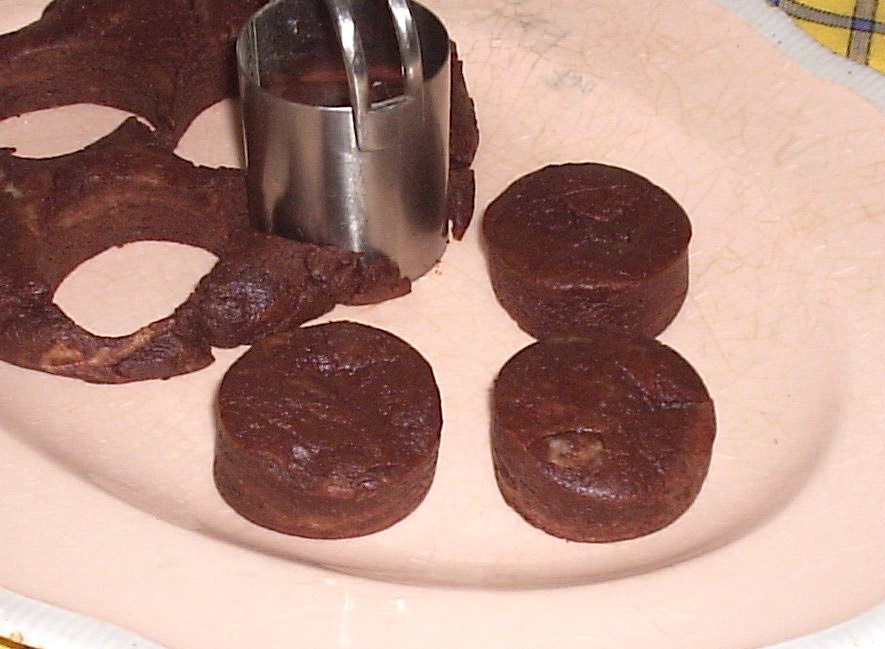
Scald two pounds of sweet almonds; wash them in fresh [cold] water [this should make the brown skins slip off when you rub them with your hands or a clean towel]; crush them well in a mortar; cook a pound of sugar to the feather [stage] (Hess* identifies the temperature as 232ºF, Recipe S6, "grand soufflé or feather."); put almonds inside [add to sugar]; desiccate the paste with a small fire, withdraw from the stove, and put it to cool [pouring onto a marble slab is best], and when it is cold, you will put [mix] in three ounces of crushed, sifted chocolate, and an egg white; that you will handle the whole together [knead on your marble slab]; you will be able to form the aforesaid paste into one mass, and will cut it out with tinplate moulds, and to also pass some to the syringe [extrude shapes from a pastry bag with tips]: those which will be cut out, you will be able to frost them with a Royal icing, like those above [massepains de pistache]. The Cinnamon Marzipan cake is done in the same way.

*Karen Hess(Martha Washington's Booke of Cookery)

Friday, July 15, 2005

Nougat Blanc


"One of the most commonly believed, and nicest stories, is that the name nougat evolved from France where an elderly lady combined almonds, egg whites, honey and sugar as a treat for local children. As the first nougat maker the children began to call her Tante Manon, tu nous gates (meaning Aunt Manon, you spoil us) and hence the word nougat is said to have first originated from this name. While the French believe nougat first originated in 1650 when the almond tree was introduced to the Montelimar area it is probable that nougat has been around far longer although carrying a different name. It seems nougat has been around for more than 500 years in the Middle East and probably paralleled the development of marzipan and other delicious desserts. Even before the birth of Christ the Greeks were praising the gastronomic value of a mixture made with almonds and honey".

Nougat Blanc:
3 c. sugar
1-3/4 c. honey
1 c. water
2 egg whites
1 tsp. brandy in which a vanilla bean has been infused
2 c. nutmeats (broken and toasted, if preferred)

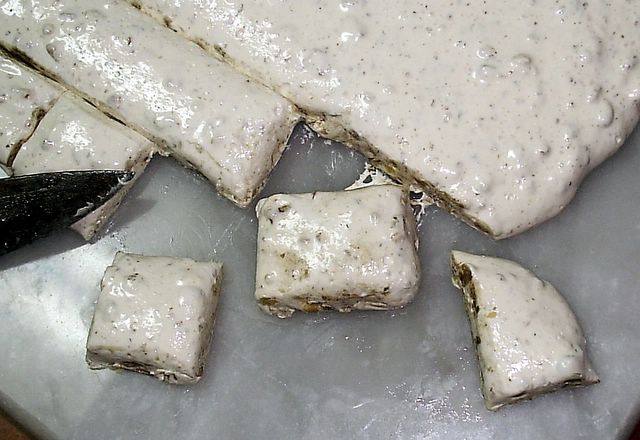
Put the sugar, honey, and water together and cook until a hard crack ball will form when dropped in cold water. Beat the egg whites until stiff and pour the hot syrup slowly into them, beating constantly until the mixture grows too stiff to beat. Then fold in the brandy and nut meats. Mix well and pour onto a marble slab. When it is cool, cut in squares or rectangles. (If you do not have a marble slab, pour nougat onto pain azyme (rice paper or wafer paper) and place another sheet on top and weight with a board until cool.)

Depending upon the flavor of honey and type and shape of nuts (broken, toasted, ground) used, each batch of nougat will taste differently. Nougat is a traditional sweet eaten at holiday times.

Friday, April 22, 2005

Molasses Toffee

Molasses Chocolate Toffee
Molasses and chocolate toffee cooling before cutting

Today is Sugar High Friday and Derrick chose Molasses.

Here is a recipe for the most delicious, chewy candy you'll ever eat. Stir together 4 oz bittersweet chocolate, 2/3 cup sugar, 1/3 cup + 1 Tablespoon molasses, and 1 stick butter (4 oz) over a medium flame until a small amount dropped into cold water forms a hard, chewy ball. Pour immediately onto a buttered marble slab and allow to cool. Cut into pieces and if you can restrain yourself from not eating them all in one fell swoop, wrap them in waxed paper and store in an airtight tin.

Saturday, January 01, 2005

Calissons - part of treize (13) desserts

Calissons, a very old sweet, is usually only seen as a professionally manufactured candy, not a homemade treat and is a regular part of holidays and fêtes, especially le gros souper followed by treize (13) desserts. A mixture of 40% almonds and 60% fruit and syrup is sandwiched between a layer of wafer/host and a topping of royal icing and is then cut into an almond shape. The history of calissons began in1474 at the time of the marriage banquet of King Rene with Jeanne of Laval. A cook, secretly enamoured of the Queen, created calissons for her in Aix-en-Provence from crystallized almonds, melons, sugar, syrup and unleavened bread or host.
Since the latest supplies from France did not include my order of wafer/host, I had to devise some sort of crust to replace it. I used a mixture of 1 cup flour, 1/2 cup sugar, some grated lemon rind, 1 egg yolk (keep the white for the royal icing), 1/4 cup butter, and a drop of rum. I chilled the resulting dough and then patted it very thinly onto the bottom of a sheet pan and baked it in a hot oven (425ºF) for about 8 minutes, watching very carefully that it only set, but didn't brown.

As the crust was cooling, I finely chopped and then pounded in a mortar 6 ounces of blanched almonds and 2 ounces of sugar until I had a fine powder, but not a nut paste. I then added in 8 ounces of finely chopped crystallized melon and continued to pound to mix. Previously I had drained some orange marmelade to obtain 2 ounces of syrup, which I also pounded into the mix to help bind it. The marmelade syrup was important to add a certain bitterness because I did not have any bitter almonds. Soon, I had a finely mixed paste which I then put into a poêle over a slow fire and stirred constantly until it had "drawn" as much as possible (this means I watched until no moisture vapor rose from the gently cooking mass). Next I patted the paste over the crust with wet fingers, leveling it up as much as possible.

Royal icing came next by whipping the remaining egg white with 1 cup of finely powdered sugar, which was spread over the paste. It flowed into all of the cracks and made a smooth surface. Then I took two round cutters and cut circles out with the small one; then used the larger one to intersect the midpoint of the smaller circle, thereby cutting the small circle into two almond shaped pieces. I had two tasty little bits left over from each small circle, which disappeared quickly into the greedy mouths hanging around the kitchen. Then the calissons were placed onto a clean baking sheet and put into a slow oven (300ºF) to "draw" [dry out] the paste and to set the icing. And there you have it--calissons. But be sure and order your wafer paper early, in hopes that the last boat from France for the year will have a ready supply.

Errata: You can see in the picture that my royal icing has cracked and is no longer smooth. Alas, while cutting out the almond shapes, I could not help but disturb the appearance of my icing. I hoped that it would smooth out in the oven, but it did not. Next time, I will cut the shapes first and then pipe or drizzle the icing over the little individual shapes to maintain the desired smooth appearance.

Tuesday, November 02, 2004

Pâte de Coings


I have some lovely large quinces, from which I wish to make quince paste or pâte de coings, also known as fruit cheese, for the winter holidays. Quince paste is one of the thirteen desserts of a Provençal Christmas. From a very old book given me by a friend, NOUVELLE INSTRUCTION POUR LES CONFITURES, LES LIQUEURS, ET LES FRUITS, Chez Claude Prudhomme. Paris, MDCCXVI, I have translated the following recipe:

"Page 150, Paste of Quinces
Have large Quinces well ripe & the yellows, healthiest which you will be able. Peel them & remove the heart if you want, if not leave the whole, satisfying you to cut your Quinces by quarters. You make boil water on fire, where you throw them, & make you cook them until they feel well soft. When they are, you drain it, to put them in a colander or net [chinois]; then pass them to you by the sieve [put through a food mill]. Being passed, you give your Paste for the drying to large fire, & then incorporate it with crushed Sugar, five quarters of Sugar for Fruit pound. You make it boil, & draw up it like the Others [It is necessary then to make it boil, & also early draw up it on slates or in your moulds of tinplate, made in heart, square, flower-of-lily, & other manners, which you will put at the oven for drying.]"

I did not peel my quinces --I wanted to make sure that as much pectin was extracted from the skins as possible, but did quarter them and I removed the core. I put them to simmer with a little water in a poëlon [frying pan or ceramic French casserole] for about 30 minutes. I then poured them and their liquid into a conical food mill and saved the juice and the pulp after reaming. To this juice and pulp, I added as much white sugar by volume and returned it to the pan to cook very slowly on the lowest heat, allowing as much moisture as possible to evaporate. I stirred the mixture from time to time, and after about an hour, the mass was a dull clear red and so thick it would draw away from the sides of the pan and leave wide, clean tracks so that I could see the bottom of the pan and it did not fall back into itself. I then poured, dumped really, the whole into a buttered tian [flat ceramic baking dish] and smoothed the top of the paste with a spatula. It set up into a fine paste, much like a gumdrop, which I then cut into squares [Because they had cooked so long and were so dry or "drawn," it wasn't necessary to dry them on screens. If your pastes should be ever so slightly moist, do dry them between plastic screens to keep insects off until they are dry to the touch and not sticky.] I then rolled each cube in white sugar and put them into a waxed paper-lined box with a tight fitting cover, in order to make sure they will last until the holidays. Each bite was an intense flavor burst with fruity-floral aroma on the palette--exquisite.

Pears, apples, sloes [sadly not available in America], crab apples, japonica fruit or medlars can be processed into paste the same way. And on this delightful site, I found many ways to use the quince paste other than as a candy. Enjoy!

Related Posts Plugin for WordPress, Blogger...