Showing posts with label Le Plat Principal. Show all posts

Monday, October 27, 2008

Casseroles

Casseroles, take their Name from the Stew-pan in which they are dress'd, call'd Casserole by the French, and are generally used for Side-dishes and Potages: For the former, take a large Loaf wash'd over with Eggs, which must not be chipt on the upper side; bore a Hole therein underneath, and take away the Crum or Pith. Afterwards prepare a good Hash of roasted Chickens, fat Pullets, or some other sort of Roast-meat, and put this Meat well minc'd into a Stew-pan, with good Gravy, as if it were to make a Hash. When it is dress'd, put some of it with a Spoon into the Loaf, that was roasted at the Fire; on the crummy side: After having thus pour'd in a little of this Hash, add some small Crusts of Bread, and proceed to fill up the Loaf alternately, with the Hash and small Pieces of Crust. Then take a Stew-pan that is no bigger than your Loaf; put a Sheet of Paper into it, or rather, some Bards or thin Slices of Bacon, and afterwards the Loaf on that side where it was farc'd; covering the bottom of it, with the same Loaf. Let it lye a soaking in this manner, with good Gravy; but it must not be too much press'd, nor too long steept, so that it may be kept altogether entire, and well cover'd. A little before 'tis serv'd up to Table, turn it out dextrously into a Dish, take away the Bacon-Bards, drain off the Fat, and cover your Loaf with a good Ragoo of Veal-sweet-breads, Artichoke-bottoms and Truffles; small tops of Asparagus being also spread round about the Dish, according to the Season.
* * * * *

The court & country cook, faithfully translated out of French into English by J. K. A. J. Churchill, London, 1702, p. 80-81.

See also: Stuffed Bread

Saturday, December 29, 2007

Oeuf Cocotte au Foie Gras - Baked Eggs and Foie Gras on Toast

I think unctuousness must now be my favorite word. On a cold day of rain after snow, curling up with a cocotte fresh from the oven from which I can dip warm eggs, cream and foie gras to spread on toast has to be a pleasant way to appease my hunger.

Recipe: place a slice of foie gras in bottom of cocotte, carefully break 1 or 2 eggs over the foie gras and top with 2 tablespoons of cream and sprinkle with truffle salt. Place cocotte in another oven dish and surround with warm water. Bake for 15 minutes at 350ºF. Serve with toast or brioche. Enjoy.

Recommended: Mire Poix USA fois gras and truffle salt

Tuesday, October 30, 2007

Selle de Chevreuil – Saddle of Venison

Image Source

Quickly sear and brown all over a saddle of venison in a large covered pot in graisse. Remove saddle from the heat and cool to the touch. Drain pot of excess fat, but do not disturb the crusty bits on the bottom of the pan.

Stir together a portion of butter and a dollop of prepared mustard. Slather all over roast and roll to coat in finely minced carrot, apple, squash or pumpkin. Sprinkle with freshly cracked pepper.

Place saddle back into large pot, cover and set into the slow coals at the back or side of the fireplace (375ºF oven). Do not remove cover for at least an hour. Begin to check on the doneness of the roast, and baste carefully with any juices that have collected on the bottom of the pot. When the roast has cooked to your desired taste, remove to a platter and keep warm. Degrease the pot and add enough verjus or vinegar to deglaze pot. Push pan juices through a sieve and serve over slices of roast.

The vegetable or fruit coating keeps the roast moist without the addition of barding and adds an indefinable something to the gravy. The amount of butter and mustard may preclude the use of salt, but adjust seasoning to your taste.

Venison available here.

Monday, October 08, 2007

Bécasses - Woodcock

image source

This recipe is an example of how different modern cooking is from the “old ways.” My French readers will have to comment on the current addition of innards [other than cooked, mashed liver to act as a liaison] and faisandée techniques as still in use today—in America, I do not believe they are the norm.

Woodcocks with wine. Divide the woodcocks in four, remove the insides [*see note following] & put them aside to thicken the sauce; put your woodcocks in a pan with sliced truffles, calf sweetbreads, mushrooms & will foam [a type of mushroom], & brown them altogether in melted fat, & moisten it with ox juice [sweated meat, cooked slowly to remove the juice—think bouillon or consommé]; season with salt, pepper, Welsh onion [scallions], & add two glasses of wine; bring to boil & when that is well cooked, stir into the sauce the insides* of the woodcocks which you have reserved to bind the sauce, & serve hot with the juice of lemon or orange which you will press above [at the last minute].

*innards as thickening or binder [La Cuisine, Raymond Oliver. Tudor, New York, 1969: p. 526-528] “Pluck the snipe [or woodcock] without drawing it [not removing innards] and bard it [prick it—wrap in bacon--I use turkey or beef bacon or chicken or goose fat pounded and tied around bird] … cook it … Remove gizzard from the bird’s innards and discard it. Put the [rest of the] innards on a plate and mash them with a work. … simmer with smashed bones, strain and serve over meat. … Do not draw the plucked snipe [woodcock], but bard it and tie them, place on spit. Fry bread slices in goose fat, rub with garlic and place in a dripping pan under spit or rotisserie pin, so that the juices from the roasting bird[s] will fall on the bread. The bird is cooked when its interior juices start flowing, that is, in about 15 minutes. Remove from spit and remove bard and innards. Throw away the gizzard, but mince the other innards and spread them on the fingers of toasted bread [from the dripping pan]. Season slices with salt and pepper and fry slices again, spread side down, in a little butter or goose fat. Put bird on a very hot dish, and flame with rum. Cut into halves and put each half on a slice of the fried bread that absorbed the cooking juices. Serve immediately. … Pluck and draw the bird. Discard gizzard; mince the rest of the innards and combine with salt pork [turkey or beef bacon] and … and stuff bird with this mixture, sew it closed and truss it.

La Bonne Cuisine de Madame E. Saint-Ange, translated Paul Aratow. Ten Speed Press, 2005:p. 397-8. “Woodcock and snipe is only roasted or prepared in a salmi. To develop ita aroma, it should be lightly “cured” (faisandée – it must hang for several days between killing and cooking [it implies the point just before mortification immediately preceding the extreme state of decomposition). … Do not gut the woodcock [but do pull the gizzard through the neck of the bird before spitting]. … bard and cook … heat butter in a small saucepan; add the intestines and season lightly; cook on gentle heat. Then smash them into a purée. Spread this purée on the fried crouton [as in Oliver’s description above]. Deglaze pan with cognac and strain sauce through a chinois and serve with game.

Bécasses au vin. Coupez les bécassess en quatre, ôtez-en les dedans & les mettez à part pour en faire une liaison, mettez ensuite vos bécasses dans une casserole avec des truffes coupées par tranches, des ris de veau, des champignons, des mousserons, & passez le tout ensemble avec lard fondu, & le mouillez de jus de bœuf; assaisonnez le tout de sel, poivre, ciboule, & y mettez deux verres de vin; faites bouillir le tout, & quand cela sera bien cuit, vous délayerez bien dans la sauce le dedans bécasses que vous avez reserve pour lier la sauce, & vous les servirez chaudement avec un jus de citron ou jus d’orange que vous presserez dessus.
* * * * *

Woodcocks in Salmi [ragout of game previously roasted]. Roast them with the pin [rotisserie], & when they are half-cooked, cut them in pieces & put them in a pan with wine, according to the quantity of the woodcocks; there add chopped truffles & mushrooms, a little anchovy & capers, good seasoning [salt & pepper], & cook until done: draw up the woodcocks [onto serving plate] & keep warm while binding the sauce with some good purée [of previously cooked and reduced and puréed vegetables and their seasoning juices]. Squeeze the juice of an orange into the sauce and serve warm.

Bécasses en Salmi. Faites-les rôtir à la broche, & quand elles seront à demi-cuites, coupez-les par morceaux & les mettez dans une casserole avec du vin, y en mettant ce qu’il en faut suivant la quantité des bécasses; ajoutez-y des truffes & des champignons hachés, un peu d’anchois & de câpres, bon assaisonnement, & faites cuire le tout: étant cuit, liez la sauce avec quelque bon coulis; ensuite dressez les bécasses & les tenez chaudement sans qu’elles bouillent. Auparavant que de servir, vous y presserez un jus d’orange, & servirez chaudement.

La nouvelle maison rustique, ou, Économie generale de tous les biens de campagne: la manière de les entretenir & de les multiplier : donée ci-devant au public / par le Sieur Louis Liger. Paris : Saugrain, 1755, Tome II, IV. Part. LIV. IV. Chap. I. La Cuisine. B., p. 799-800.

Tuesday, October 02, 2007

Biche - Hind [female red deer]

Hind is good only when it is quite young; its flesh is rather delicate & agreeable: it has [as] much [flesh] in ratio to the flesh of the stag & is cooked in the same way; but it is softer & more insipid flesh. It is eaten roasted, & for that soak in a marinade after having pricked it [larded or wrapped] with a little bacon. Baste it while roasting; & when cooked put capers & a little flour in the drippings with a little lemon, & simmer the sauce. It can also be eaten with a sweet sauce, made with vinegar [to deglaze the pan], pepper, cinnamon & sugar, & one whole shallot.

La nouvelle maison rustique, ou, Économie generale de tous les biens de campagne: la manière de les entretenir & de les multiplier : donée ci-devant au public / par le Sieur Louis Liger. Paris : Saugrain, 1755, Tome II, IV. Part. LIV. IV. Chap. I. La Cuisine. B., p. 800.

Biche, n’est bonne que quand elle est bien jeune; sa chair est assez delicate & agreeable: elle a beaucoup de rapport à la chair du cerf & s’accommode de même; mais elle a la chair plus molle & plus fade. On la mange rôtie, & pour cela on la fait tremper dans une marinade après l’avoir piquée de menu lard. On l’arrose en la faisant rôtir; & étant cuite on met des câpres & un peu de farine dans son dégoût avec un peu de citron verd, & on la fait mitonner dans la sauce. On la mange si l’on veut à la sauce douce, avec vinaigre, poivre, canella & sucre, & une échalotte entiere.

Sunday, September 30, 2007

Aloyau -- Sirloin

Beef Cuts chart courtesy WikipediaSirloin in ragout. Take a sirloin of the first part, degrease [cut off extra fat] & prick it [wrap it with well seasoned bacon], cook it with the pin [rotisserie]; being half-cooked, remove it from the pin & put it in a pot with juice of ox [jus--which see], some mushrooms, truffles, morels, artichoke bottoms—all well chopped, season with salt & pepper to taste & add a bouquet of sweet herbs; cover the pot & cook gently on embers: when cooked to desired doneness, slice the sirloin & serve it with a ragout of calf sweetbread, foie gras, truffles, mushrooms, morels, willfoam [mushrooms], artichoke bottoms, asparagus tips & salt and pepper to taste; pour a coulis [made from pan drippings, jus and puréed vegetables] above your sirloin & serve warm.

La nouvelle maison rustique, ou, Économie generale de tous les biens de campagne: la manière de les entretenir & de les multiplier : donée ci-devant au public / par le Sieur Louis Liger. Paris : Saugrain, 1755, Tome II, IV. Part. LIV. IV. Chap. I. La Cuisine. B., p. 795.

Aloyau en ragout. Ayez un aloyau de la premiere piece, dégraissez-le & le piquez du côté du filet de gros lard bien assaisonné, faites-le cuire à la broche; étant à demi-cuit, vous le retirerez & le mettrez dans une marmite avec jus de bœuf, un peu de champignons, un peu de truffes, morilles, de quelques culs d’artichaux, le tout haché, assaisonné de sel, poivre & un bouquet de fines herbes seulement pour donner gout; on couvre la marmite & on le laisse cuire ainsi doucement sur la braise: étant cuit à propos, on tire l’aloyau, & on le sert avec un ragout de ris de veau, de foies gras, de truffes, champignons, morilles, mousserons, culs d’artichaux, crêtes & points d’asperges & bon assaisonnement, le tout bien lié d’un bon coulis & de bon gout; vous le jettez dessus votre aloyau & le servez chaudement.
* * * * *

Stuffed sirloin. When your sirloin is almost cooked with the pin, take some of the flesh of the middle and chop quite small with bacon, beef marrow, sweet herbs & good trimmings, as one has just explained to the ragout above, & good seasoning; then you stuff them your sirloin between the skin & the bone; & repin upon the rotisserie properly, for fear the flesh does not fall into the dripping pan while completing cooking: when fully cooked & being table ready, remove the skins [bacon wrappings] to have freedom to eat it with a fork or spoon.

Aloyau farci. Votre aloyau étant Presque cuit à la broche, vous prenez la chair du milieu que vous hachez bien menue avec du lard, moëlle de bœuf, fines herbes & bonnes garnitures, comme on vient d’expliquer au ragout ci-dessus, & bon assaisonnement; ensuite vous en farcissez votre aloyau entre la peau & l’os; & le recousez proprement, de peur que la chair ne tombe dans la léchefrite en achevant de cuire: étant cuit à propos & servi sur la table, on ôte les peaux pour avoir la liberté de la manger avec une fourchette ou cuiller.
* * * * *

Roast sirloin. Have a sirloin of such size as you wish, cook it with the pin, take care that it is not cooked too much, for fear it does not lose its juice--if you want to eat it rare & red in its juice. Those which do not like it quite so rare, cut it by sections and place slices in a [chafing] dish, then add a little water, pepper, salt, a dash of vinegar & some chopped chives, & make it boil [in the chafing dish]; then serve. Some, who leave it on the pin, eat it with a caper sauce & with the anchovies, which is done thus: One washes well three or four anchovies [removes the salt], and the edges [fins], & chops them, then puts them in a pan with capers & well seasoned ox jus; one only heats this sauce & serves it under the sirloin.

Aloyau rôti. Ayez un aloyau de telle grosseur qu’il vous plaira, faites-le cuire à la broche, prenez garde qu’il ne soit trop cuit, de crainte qu’il ne perde son suc: il veut être mange saigneaux & rouge dans son jus. Ceux qui ne l’aiment point si peu cuit, le coupent par tranches dans un plat, puis y mettent un peu d’eau, du poivre, du sel, un filet de vinaigre & quelques ciboulettes hachées, & le font bouillir un moment sur le réchaut; on le set ainsi. Quelquez-uns, au sortir de la broche, le mangent avec une sauce aux câpres & aux achois, qui se fait ainsi. On lave bien trios ou quatre anchois, on en ôte les arêtes, & on les hache, ensuite on les met dans une casserole avec des câpres & du jus de bœuf assaisonné de sel & de poivre; on fait seulement chauffer cette sauce & on la sert sous l’aloyau.
* * * * *

The ox juice [jus] is made this manner. Take a piece of beef rump, cut it by sections & lay it in a pot, cover well with a lid, then put paste around [seal with a paste of water and flour], so that it is air-tight; put it on a small fire & one lets it sweat [cook very slowly in the embers] two hours; then [use a knife to cut the flour seal open] & draw the juice to use as needed.

Le jus de bœuf se fait de cette maniere. Prenez un morceau de bœuf de cimier, coupez-le par tranches & le jettez dans une terrine que vous couvrirez bien de son couvercle, puis mettez de la pâte autour, en sorte qu’il n’y ait point d’air du tout; on le met sur un petit feu & on le laisse suer pendent deux heures; en-suite on tire le jus & on s’en sert dans le besoin.

Wednesday, September 19, 2007

Boucons - rolled veal fillets with mushroom ragout

Boucons, is a ragout which is done as follows: take small sections of fillet of veal a little long & thin & flatten by pounding; then take as many raw ham & bacon plugs as fillets and arrange them perpendicularly on your sections, putting a bacon plug & one of ham on each, sprinkle on a little parsley & chopped Welsh onions [scallions], & season them with fine spices & sweet herbs [traditionally a blend of four herbs — Parsley, Chervil, Chives and Tarragon]. Roll them properly [tie securely] & sear until well browned & add liquid for braising--cover pot: when cooked and tender, degrease, remove to a hot dish to keep warm. Prepare a mushroom ragout in the pan drippings and serve ragout over boucons.
* * *

Boucons, est un ragout qui se fait ainsi: vous prenez de petites tranches de rouelle de veau un peu longues & minces & vous les applatissez sur une table; ensuite vous prenez de gros lardons de lard & autant de jambon crud, rangez-les en travers sur vos tranches, y mettant un lardon de lard & un de jambon, poudrez-les d’un peu persil & de ciboules hachés, & assaisonnez-les de fines épices & de fines herbes. Vos tranches étant garnies de ces lardons, vous les roulez proprement & les mettez cuire dans une marmite à la braise: étant cuites, vous en égouttez la graisse, vous les dressez dans un plat, puis vous les servez avec un ragout de champignons par-dessus.

La nouvelle maison rustique, ou, Économie generale de tous les biens de campagne: la manière de les entretenir & de les multiplier : donée ci-devant au public / par le Sieur Louis Liger. Paris : Saugrain, 1755, Tome II, IV. Part. LIV. IV. Chap. I. La Cuisine. B., p. 802.

fillet of veal image

rouelle de veau paupiette image La Bonne Cuisine de Madame E. Saint-Ange,translated by Paul Aratow. Ten Spreed Press, 2005, p. 280.


Today, Bouc[h]ons are known variously as corks or rammers or jammers, or beggars' purses. They are a bite-sized morsel, usually cooked [sometimes steamed] in a casing of dough, as in dumpling, or in a mold. Restaurants, paricularly in Lyon, where one can get a quick bite are also called bouchons. And for all you chocoholics, there are cork shaped chocolates filled with marc.

Tuesday, June 05, 2007

Côte de Boeuf & Croûtes farcies à l’ancienne--Blog Appétit #11--Salers & Salers AOC

Cette édition de Blog Appétit #11 appareille le boeuf de Salers, bien-marbree et d'une race antique, et du fromage du lait de la vache fruitée et forte à Salers. Puisque j'habite dans Nouvelle France, je n'ai plus accès à ces variétés, mais peux rapprocher la viande par Charolaise/Longhorn métisse le boeuf ; savoureux et pas trop maigre. Une coupe 18thC de boeuf est Côte de Boeuf, bifteck de nervure avec avec os, et l'une des coupes du boeuf principales.

Je propose un plat principal de Côte de grillé Boeuf servi avec Poivrade et un côté du l'ancienne d'à de farcies de Croûtes.

Côte de Boeuf
2 biftecks de Salers
beurre non salé de 1 cuiller à soupe
sel de cuillère à café de ¼
poivre fraîchement rectifié de cuillère à café de ¼
sucre de cuillère à café de ¼ (brun ou crus)

Poivrade
Des égouttures après boeuf est grillées
1 petit oignon, haché
Vinaigre ou verjus dans la casserole de deglaze
Zeste orange
Grains de poivre fraîchement fendus

Croûtes
baguette de 4 tranches, libéralement balayée avec du beurre et grillée
Confiture d'oranges d'oignon (oignons et thym caramélisés rôtis par four)
Fromage de Salers AOC, râpé

Sel, poivre et sucre de mélange ; frottez sur des biftecks de nervure. Grillez les biftecks à votre cuisson désirée en beurre non salé dans la casserole très chaude. Recouvrez les nervures de mode en spirale au centre du plateau de portion. Couvrez lâchement et placez en four de chauffage.

Oignon haché de Sauté en égouttures dans la casserole et la casserole de deglaze avec du vinaigre (verjus). Remuez en zeste orange et poivre criqué. Versez le jus au-dessus des biftecks.

Garnissez avec Croûtes qui ont été remplis de confiture d'oranges d'oignon et complétés avec du fromage râpé de Salers AOC et le beurre fondu et brunis. Appétit de fève !
* * * * *

This edition of Blog Appétit #11 pairs Salers beef, well-marbled and from an ancient breed, and fruity, strong Salers AOC cow’s milk cheese. Because I live in Nouvelle France, I no longer have access to these varieties, but can approximate the meat by Charolaise/Longhorn crossbreed beef; tasty and not too lean. An 18thC cut of beef is Côte de Boeuf, rib steak with bone-in, and one of the prime cuts of beef.

I propose a main dish of grilled Côte de Boeuf served with Poivrade and a side of Croûtes farcies à l’ancienne.

Côte de Boeuf
2 Salers steaks
1 tablespoon unsalted butter
¼ teaspoon salt
¼ teaspoon freshly ground pepper
¼ teaspoon sugar (brown or raw)

Poivrade
Drippings after beef is grilled
1 small onion, minced
Vinegar or verjus to deglaze pan
Orange zest
Freshly cracked peppercorns

Croûtes
4 slices baguette, liberally brushed with butter and toasted
Onion marmalade (oven roasted caramelized onions and thyme)
Salers AOC cheese, grated

Mix salt, pepper and sugar; rub onto Salers rib steaks. Grill steaks to your desired doneness in unsalted butter in very hot pan. Overlap ribs in spiral fashion in center of serving platter. Cover loosely and set in warming oven.

Sauté minced onion in drippings in pan and deglaze pan with vinegar (verjus). Stir in orange zest and cracked pepper. Pour jus over steaks.

Garnish with Croûtes which have been filled with onion marmalade and topped with grated Salers AOC cheese and melted butter and browned. Bon appétit!

Sunday, February 11, 2007

Tourte of foie gras

Make an undercrust of fine paste & put it in a tart plate, put grated bacon on the bottom, season it with salt and pepper & a little sweet herbs, arrange the livers next & finish with tips of mushrooms, morels, will foams & truffles; season like the lower part, & cover the whole with very thin veal slices & bacon slices, cover the tourte with a second crust, gild it with eggs & put it to bake in the oven; once cooked, take it out and remove the top section of crust [carefully], remove the sections of veal & the slices of bacon [save these for hash or a farce], degrease it & add a little ham essence, replace the upper crust, reheat it & serve.

La nouvelle maison rustique, ou, Économie generale de tous les biens de campagne: la manière de les entretenir & de les multiplier : donée ci-devant au public / par le Sieur Louis Liger. Paris : Saugrain, 1755, Tome II, IV. Part. LIV. IV. Chap. I. La Cuisine. B., p. 849.

Tourte de foies gras
Dressez une abaisse de pâte fine & la mettez dans une tourtiere, mettez dessus du lard rapé, l’assaisonnez de sel, de poivre & un peu de fines herbes, rangez les foies dessus & garnissez de crêtes, de champignons, morilles, mousserons & truffes assasisonnés comme le dessous, & couvrez le tout de tranches de veau bien minces & bardes de lard, couvrez la tourte de l’autre abaisse, dorez-la d’œufs & la mettez cuire au four; étant cuite, tirez-la & la découvrez, ôtez-en les tranches de veau & les bardes de lard, dégraissez-la & y mettez un peu d’essence de jambon, recouvrez-la & la servez chaudement.

Sunday, January 21, 2007

Casserole [Stuffed Bread]

An interesting dish--I suppose it would depend upon the shape of your loaf of bread and whether you had a casserole or skillet to fit it--an oval or round dish would seem to work best.


Casserole [Stuffed Bread]
Take a [loaf of] soft bread whose crust is browned [implied here is a tough, chewy well-colored crust], & cut off the very bottom of the loaf and remove the soft insides, & reserve the crust [shell]: then mince [chop not shred] roast chicken or a fattened poulet [female or hen], with another kind of cooked meat; heat it [meats] in the pan, with [a little] good gravy & good seasoning, as if it were to prepare minced meat [in other words, a dry mixture, not soupy]: once it is heated through, carefully spoon some into the breadcrust [shell] which you will have dried completely on the inside by placing it in an oven & continue to put a little of this mince, layered with some of the soft bread insides torn in pieces and also dried in the oven, & completely fill with this mince & small crusts, then close [cover] it with the same part that you have removed by slicing off the bottom of it to remove the crumb of it. Take then a pan which is not larger than your bread, put on the bottom bacon bards [a slice of fatty meat or very well butter or grease the pan], & then the bread on the side which it was stuffed [turn right side up so the top of the filled bread is now uppermost], simmer in this manner with good gravy, made so that it cooks slowly and does not simmer [boil] too much, so that it is all entire [bread crust or what is now a bread bowl within the pan] and does not come apart, keeping it well covered [with gravy]. A little before serving, pour it onto a [serving] dish or platter, remove the bards [if used], drain off any grease & cover [pour over] your bread [garnish the plate] with a good ragout of calf sweetbreads, artichoke bottoms, truffles & asparagus tips around, according to the season.

Casserole au fromage
[Cheese Stuffed Bread]
It is prepared just as above, in the stuffed bread one puts a little grated Parmesan or other cheeses [layered with torn bits of bread instead of the minced meats]; & when the bread is cooked [in good gravy] & placed on its serving platter, one still powders [sprinkles over] it some of the same cheese of which one [stuffed it], & one makes him take a little color in the furnace [pass a red hot fire shovel over it or put it under the broiler], & when one is ready to serve, one puts the ragout around & one serves it warmly.

La nouvelle maison rustique, ou, Économie generale de tous les biens de campagne: la manière de les entretenir & de les multiplier : donée ci-devant au public / par le Sieur Louis Liger. Paris : Saugrain, 1755, Tome II, IV. Part. LIV. IV. Chap. I. La Cuisine. B., p. 806-7.


Casserole
Prenez un pain mollet dont la croûte soit dorée, & ne le chapelez point dessus, percez-le par dessous, & en ôtez la mie: ensuite ayez un bon hachis de poulets rôtis ou de poulardes, au autre sorte de viande cuite; passez-le à la casserole, avec bon jus & bon assaisonnement, comme si c’étoit pour faire un hachis: étant passé, il faut, avec une cuiller en mettre dans le pain que vous aurez fait sécher à l’air du feu du côté de la mie; & après y avoir mis un peu de ce hachis, vous y mettrez quelques petites croûtes de pain par morceaux, & l’acheverez de remplir de ce hachis & de petites croûtes, puis vous le fermerez de la même piéce que vous avez ôtez en le perçant pour en ôter la mie. Prenez ensuite une casserole qui ne soit pas plus grande que votre pain, mettez au fond des bares de lard, & ensuite le pain du côté qu’il a été farci, faites-le mitonner de cette maniere avec de bon jus, faites en sorte qu’il ne soit pas trop pressé ni trop mitonné, de façon qu’il soit tout entire, le tout bien couvert. Un peu auparavant que de server, versez-le sur un plat avec adresse, ôtez les bardes, égouttez un peu la graisse & couvrez votre pain d’un bon ragout de ris de veau, culs d’artichauts, truffes & pointes d’asperges autour, selon la saison.

Casserole au fromage
On l’apprête de même que ci-dessus, hors que dans le pain farci on y met un peu parmesan rapé ou d’autres fromages; & quand le pain est cuit & qu’on l’a dressé dans son plat, on le poudre encore du même fromage dont on s’est servi, & on lui fait prendre un peu de couleur dans le four, & lorsqu’on est prêt à server, on met le ragout autour & on le sert chaudement.

Saturday, January 13, 2007

Boudin of foie gras

A delicious way of using up those broken bits and pieces derived from preparing your foie gras.

Boudin of foie gras. Finely cut a quarter pound of pig fat, chop a pound of foie gras & as much of flesh of capon, season the whole of fine herbes [tarragon, chervil, parsley & burnet or chives], salt, pepper, crushed cloves [nutmeg is an option], six raw egg yolks & two pints of cream, fill of the bowels of pig, sheep or lamb, & simmer your boudin in milk [can use aromatics to flavor milk {carrots, onions, bouquet garni}]: once cooked, drain and roast [in the oven] on paper [directly on the floor of the oven] with a moderate fire for fear they do not burst, or fry in a little lard or another grease [to give it an appetizing color], & serve warm.

La nouvelle maison rustique, ou, Économie generale de tous les biens de campagne: la manière de les entretenir & de les multiplier : donée ci-devant au public / par le Sieur Louis Liger. Paris : Saugrain, 1755, Tome II, IV. Part. LIV. IV. Chap. I. La Cuisine. B., p. 803.

Boudin de foie gras. Coupez menu un quarteron de panne de porc, hachez une livre de foie gras & autant de chair de chapon, assaisonnez le tout de fine herbes, sel, poivre, clous pilés, six jaunes d’œufs cruds & deux pintes de crême, remplissez-en des boyaux de porc, de mouton ou d’agneau, & faites cuire votre boudin dans du lait: étant cuit, vous le mettrez griller sur du papier avec un feu médiocre de peur qu’ils ne crevent, y mettre un peu de sain-doux ou autre graisse, & servir chaudement.

Wednesday, November 29, 2006

Before Prudhomme's Turducken - There Was Goose Pye


Dead Duck with a Pie, Porcelain Bowl and Jar of Olives, Chardin 1764

Chef Paul Prudhomme is credited with creating turducken, a boned chicken stuffed in a boned duck stuffed in a boned turkey, all layers surrounded by forcemeat [farce], usually served at holiday times when some cooks yearn to bring something splendid to the table. But Hannah Glasse beat him to the table, as did other 18thC cooks.

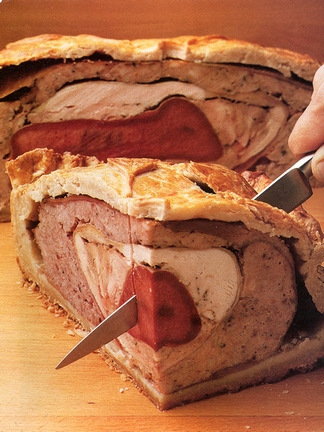
Once you have fattened your holiday goose, removed its foie gras, and it hangs cooling on the meat hook in the office [cold kitchen], it’s time to think of goose pye, a corned [pickled] tongue surrounded by farce stuffed in a marinated, boned chicken, surrounded by farce, stuffed in a boned and marinated well-hung [term used to connote ternderizing] goose baked in a crust—perfect for today’s holiday meals, but a means of preserving in the past.

The spices [today's French four-spice or quatre-epice] used in the farce and in the marinating process serve to preserve the meat once it is cooked and cooled, allowing the pye to be kept in the cool room and sliced for serving as needed—time here also serves to ripen or develop the many flavors in this dish.


Goose Pye, photo from Terrines, Pâtés & Galantines. Time-Life, 1982, p. 52.

Here is Glasse's recipe for goose pye.

I highly recomend both Time-Life's Terrines [which also uses Glasse's recipe and is accompanied by marvelous step-by-step photos] and Glasse's book, also known as First Catch Your Hare. Terrines is edited by the late inimitable Richard Olney. Glasse's book served as the take off for many following books and incorporates about a hundred years of previous cooking knowledge--still a great book after two and half centuries!


Friday, September 01, 2006

Eggs with Gravy or à la Huguenotte


In honor of the Holy Days of September, an 8-day festival once kept by Huguenots in 1713 beginning on the first Friday evening in September [as evidenced by their liturgy], I give you eggs [poached] in gravy, known as Oeufs à la Huguenote. This is a perfect dish to celebrate EOMEOTE, end-of-the-month-egg-on-toast-eggstravaganza.

Eggs with Gravy or à la Huguenotte
Let some mutton-gravy or any other sort be put into a hollow dish, and when 'tis hot,; break your eggs into it either au Miroir [To break egg on a mixture of moderately hot butter and oil {otherwise, gravy}. To finish with the furnace so that a film is formed on the yellows.] or mingled together [scrambled]: season them with salt, nutmeg and lemmon-juice, and pass the red-hot fire-shovel [salamander] over them, to give them a good color.

Use toast or bread to sop up every unctious drop--a truly decadent dish of soul food!

The court & country cook, faithfully translated out of French into English by J. K. A. J. Churchill, London, 1702, p. 117.

Oeufs au jus, ou à la Huguenote
Mettez jus de mouton ou autre, sur une assiette creuse; & étant chaud, cassez-y vos oeufs, ou au miroir, ou broüillez; assaisonnez de sel, muscade, jus de citron; & passez la péle rouge par-dessus pour leur donner couleur.


Le cuisinier royal et bourgeois, Massialot. Paris, 1691, p. 451-2.

Sunday, August 13, 2006

Pâté de Poulets à la Crême - A Chicken Pie with Cream


Pâté de Poulets à la Crême
Vôtre Pâté étant dressé; mettez-y vos poulets par quartiers, assaisonné de sel, poivre, muscade, champignons & morilles, lard pilé and fines herbes: couvrez-le de tranches de veau and de bardes de lard, and le recouvrez d’une abaisse, and le mettez au four; étant cuit, découvrez-le, and ôtez-en les bardes de lard, tranches de veau, and le dégraissez; mettez-y un coulis blanc. Le maniere de faire le coulis blanc est marquée à la letter C. Voyez que le pàté soit d’un bon goût, and le servez chaudement pour Entrée.

Le cuisiner roïal et bourgeois, François Massialot. Paris: Charles de Sercy, 1691.

Translation:
Line your pie dish with pastry; put your quartered chickens in, season with salt, pepper, nutmeg, mushrooms & morels, crushed, fried bacon and sweet herbs: cover it with calf and sections of bacon, and cover it with an uppercrust, and bake it in the oven; after it’s cooked, uncover it, and remove the bacon bards, calf sections, and degrease it; put a white sauce in. The manner of making the white sauce is marked with the letter C. See that your pastry is of a good taste, and serve hot for Entrée


Adaptation:
A Chicken Pie with cream
As soon as the pastry [undercrust] is in your pie dish, put your chickens into it in quarters [I used cubed chicken breast], seasoned with pepper, salt, nutmeg, cinnamon, and fines herbs [I used celery and onions. I fried the onions and celery in a little butter and olive oil and added the fresh cubed chicken breast and sautéed it until the vegetables were translucent and the chicken was white and mostly done. I then added one cup of milk and 1/3 cup of flour stirred together and cooked it until a white sauce came together. Next I poured the filling in to pastry lined pie dish] and covered it with an uppercrust of the same paste. [Most pies of this type had vent holes in the upper crust with applied circles of pastry, which when baked, make it possible to add liquids {aspic, cream, mushroom juice, etc.}] When it is baked, pour in some cream and let it stand a little while longer in the oven. Lastly, add some mushroom juice and serve it up hot to table.

Comment:
The nutmeg and cinnamon is not a flavor we associate with chicken today; however, it is delicious and would make a very tasty “hot dish” to share at impromptu dinners where one is asked to bring a dish. This is one place to use all of the green veggie leftovers [I think carrot or squash would overpower this dish] or fresh green herbs—green onions, chives, celery, artichokes, etc.

I will make this dish again; my husband was pleased with the complexity of flavors. Enjoy!

Tuesday, April 19, 2005

petits pois & agneau

petits pois & agneau
cliquez sur la photo pour des restes comme ragoût d'agneau

"La nourriture dont les classes meilleures des Français ont mangée était comme suit : pour le dîner, le potage clair avec des morceaux de pain de blé et les divers goûts ; puis un plat de viande cuite, parfois frit après avoir été fait cuire. . . Souvent les pois composés troisième par cours." Voyages de Peter Kalm en Amérique du nord, la version anglaise de 1770. Douvres, New York, 1987, p. 383.

J'ai combiné ces deux cours d'agneau cuit avec des légumes pour ce mois blog appétit.

Prenez les règlages et les cubes d'agneau et de brun en un peu d'huile et de beurre d'olive. Quand tous les morceaux sont bruns, enlevez sur le marmite et le sauté plusieurs clous de girofle d'ail écrasé et de marjolaine écrasée part en huile. Deglaze la casserole avec une tasse de la Madère et fermentent pendant une minute pour mélanger les saveurs, puis versent partout l'agneau, ajoutent l'eau à la couverture juste et ont placé pour fermenter en charbons lents.

Au sujet d'une demi-heure avant que l'agneau soit fini, écossez les pois, épluchez et coupez dedans les eighths quelques navets et pommes de terre et coupez en tranches quelques carottes. Placez dans un poêle, couvrez avec de l'eau et fermentez jusqu'à ce qu'offre. Vidangez et ajoutez à l'agneau dans le marmite aux saveurs de mélange pendant environ 5 minutes ; sel et poivre à goûter. Vous pouvez servir des légumes séparément ou remuer ensemble comme en ragoût. Bon de goût très réchauffé. Servez un pain semé de seigle et beurre avec l'agneau et un fruit au goût âpre dans la saison pour le dessert.

Vin : Le Bordeaux 1982 de Calon-Segur Saint Estèphe de chateau - robuste et à vie longue, retenu, mais la société, un manque de jamminess avec une finition au goût âpre - juste juste avec de la sauce à agneau et à ail.

* * * * * * * * * * * * *

"The food which the better classes of Frenchmen ate was as follows: for dinner, clear soup with pieces of wheat bread and various relishes; then a dish of cooked meat, sometimes fried after being cooked. . . . Often the third course consisted of green peas." Peter Kalm's Travels in North America, the English Version of 1770. Dover, New York, 1987, p. 383.

I have combined these two courses in stewed lamb with vegetables for this month's blog appétit.

Take trimmings and cubes of lamb and brown in a bit of olive oil and butter. When all pieces are brown, remove to marmite and sauté several cloves of crushed garlic and crushed marjoram leaves in oil. Deglaze the pan with a cup of madeira and simmer for a minute to blend the flavors, then pour all over lamb, add water to just cover and set to simmer in slow coals.

About half an hour before lamb is finished, shell peas, pare and cut in eighths some turnips and potatoes and slice some carrots. Place in a poêle, cover with water and simmer until tender. Drain and add to lamb in marmite to blend flavors for about 5 minutes; salt and pepper to taste. You can serve vegetables separately or stir together as in stew. Tastes very good reheated. Serve a seeded rye bread and butter with the lamb and a fruit tart in season for dessert.

Wine: Chateau Calon-Segur Saint Estèphe Bordeaux 1982 - Robust and long lived, restrained, but firm, a lack of jamminess with a tart finish - just right with the lamb and garlic sauce.

Thursday, February 10, 2005

Close Your Eyes and Take a Bite!

This is for Jennifer's Fond Food Memories .

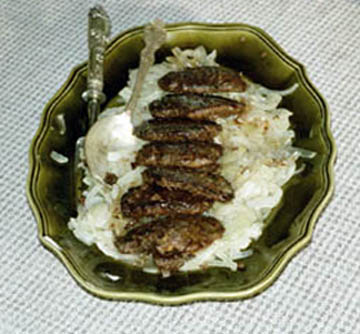
One of the church elders' inlaws had come to town and I wanted to have them all over for dinner, as I also knew them. This particular elder had raved about my cooking from the pulpit and I was out to impress. My favorite food at the time was Hungarian Goulash served on a bed of sauerkraut and potatoes--I could eat it seven days a week and cold for breakfast. My teenage children liked it too, but they are not good judges, because unlike most children today, my kids would eat all kinds of vegetables and were always willing to try my new cooking experiments. They usually found that when I told them to "close your eyes and take a bite" they were in for a taste treat that most mothers didn't even dare to proffer.

My recipe for goulash takes about 6 hours to prepare, and may indeed look a little strange if ethnic food is not one's choice, but I was pleased with the taste and aroma and proudly bore the tureens to the table. When the elder removed the lids from the goulash and the kraut and took a deep breath and said, "Carolyn, I thought you always cooked something good when you had company," I was crushed. I told him, "Fred, you know I would never serve a guest something that was not scrumptious--close your eyes and take a bite--I promise you won't be disappointed." He steeled himself to take a tiny bite of each onto his plate and then into his mouth--and he did close his eyes! And he wasn't disappointed, he even told his teenage kids that they had to eat some. But I learned a valuable lesson--when you're out to impress--it has to look as good as it tastes!

Hungarian Goulash with Sauerkraut from McCall's Cooking School Magazine

For the Goulash:
3 lb boneless beef chuck cut into 1 1/2" cubes
1 lb onions sliced
1/4 cup salad oil
1 tablespoon paprika
1 1/2 teaspoons salt
1/8 teaspoon pepper
1 can (10 1/2 oz) condensed beef broth, undiluted

For the Sauerkraut:
2 cans (14-oz size) or 1 quart bag sauerkraut
1 large potato
3 tablespoons butter
1/2 cup chopped onion
1 teaspoon caraway seeds
2 tablespoons light brown sugar
Boiling water

For the Finish:
3 tablespoons flour
1 cup sour cream

In a large skillet, heat oil over high heat and sauté beef cubes until brown on all sides. Remove to a Dutch oven as it browns. It will take 30 minutes or so. Add sliced onions to drippings, cooking and stirring until golden, about 10 minutes. Spoon over beef. Add paprika, salt and pepper. Stir 3/4 cup beef broth into skillet to deglaze pan and bring to boiling. Scrape all into Dutch oven over meat and onions. Place into 300ºF oven and cook, covered about 4-5 hours. When it is done, it will look brown and soft, and the onions will be melted away. Just before beef is done, prepare sauerkraut.

Drain sauerkraut well. Pare potato or not, and grate enough to measure 3/4 cup. In hot butter in a large skillet, sauté chopped onion until golden. Add sauerkraut, potato, caraway seed, brown sugar and 2 cups boiling water. Bring to boil, reduce heat and simmer, uncovered, stirring occasionally, until most of the liquid has evaporated.

To finish, stir remaining beef broth into flour until smooth and then stir into beef goulash, stirring constantly. Simmer on the stove, stirring occasionally for 15 minutes. Just before serving, slowly stir 1/2 cup hot gravy into sour cream in a small bowl. Mix and add slowly back to beef mixture. Stir well to blend, reheat, but do not boil. Serve goulash over sauerkraut. Makes 8 servings.

Sunday, January 23, 2005

Cassoulet


Is My Blog Burning 11 - Beans

- French Baked Beans

Soak 1 kg white beans over night. In the morning, cook the beans with a bundle of parsley, 1 bay laurel leaf and a pinch of salt about two hours with a soft fire until tender; set aside.

Rub the inside of your casserole with garlic. Place a layer of beans, drained, pieces of confit of duck or goose, chunks of sausage, chunks of lamb and some confit fat. Sprinkle with a few slices of carrots (optional) and sliced onions and garlic. Cover with the rest of the beans. Pour the reserved bean liquid over all, cover and set into the oven with a slow fire (300ºF). Cook until the liquid is absorbed and a uniformly brown crust has formed. If the cassoulet becomes dry, add a little hot broth, but gently, so as not to disturb the crust. Serve from the earthen pot very hot with crusts of freshly baked bread.

Be sure and check out Derrick's and Tom's entries for cassoulet--they have all the modern explanations and steps deliniated--sadly, 18thC receipts were very sparsely detailed, as most everyone knew the steps to be taken. As a result, translating recipes from Old French can be frustrating.

Monday, December 13, 2004

Tourtiere


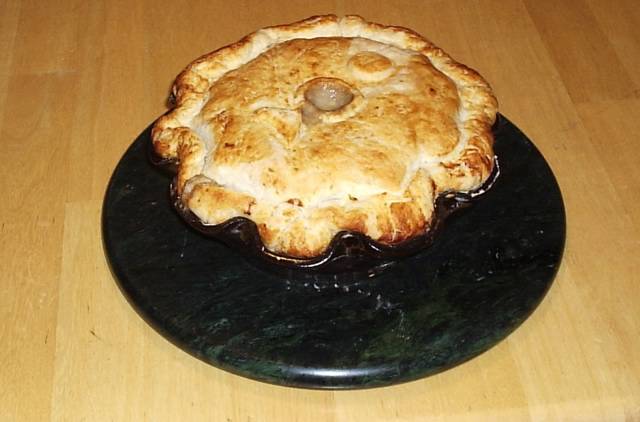
Savory pyes or tourtes are rib-sticking good on cold winter days. They can either be eaten warm from the oven or are even better reheated the next day or eaten cold as snack food.

Although French people, for the most part, did not eat potatoes during most of the 18thC, considering them to be food for pigs or the English, "the generally accepted story is that a French army officer named, Antoine-Auguste Parmentier, an Economist, was imprisoned in Hamburg during the Seven Year’s War (1756-63), and got used to eating potatoes. Returning to France, he persuaded King Louis XVI to eat them, and his wife, Marie Antoinette, to wear potato flowers on her dress. Potatoes then became so fashionable (c.1787) that even now French dishes containing potatoes are called Parmentier." Thomas Jefferson brought home recipes from his diplomatic sojourn in Paris for potatoes to be served in the "French manner," generally believed to be French fries. Soon, a national dish of Quebec was known as Tourtiere, and is basically meat and potatoes baked in a crust.

Tourtiere

Pâte Brisée or enough short pastry dough for two crusts
Parboiled sliced potatoes
Either shredded,precooked meat or raw ground beef [turkey, chicken, venison or veal]
2 slices bacon [turkey], diced or minced
Onions, diced
Celery, sliced
Garlic, minced
Allspice
Sage
Nutmeg
White Pepper
Milk
Flour
Oil or fat
Salt

Roll out pye dough and place half in deep pye dish. Reserve other half under cover. Add a bit of oil to spider [cast iron skillet on three legs with a long handle] and fry onions, celery and garlic until golden along with browning ground beef and bacon, or add cooked, shredded beef. Season with 1/2 teas rubbed sage and 1/2 teas ground allspice and salt and pepper to taste. Remove from heat and cool slightly; then pour onto bottom of pye crust. Cover with a layer of precooked, sliced potatoes.

Take oil or fat and make a roux with flour in your spider to take advantage of the drippings and flavor. Add milk to make a béchamel or white sauce. Season with 1/2 teas nutmeg and salt and white pepper to taste. Pour over potatoes in pye shell. Cover with top crust, seal edges and brush with milk. Cut a vent hole for steam in the middle of the pie and bake in a hot oven until done [450ºF for 15 minutes and 350ºF for 30 minutes more].

Thursday, November 18, 2004

Sauced Duck Breast with Onions


The ponds haven't frozen yet, so a few ducks still remain before flying south for the winter and I was able to share in the largess of a friendly hunter who gave me some ducks. I sliced a breast and marinated it in a little thyme, salt, pepper and red wine vinegar for about 20 minutes. Next I heated my frying pan and melted some duck fat in it and then seared the breasts until crispy. I removed the duck to a heated plate to rest and deglazed the pan with more vinegar and added some plum jam and walnut ketchup. When the sauce was bubbly and slightly reduced, I put the duck back into the pan and turned each slice to absorb the sauce and add color to each slice. I served the duck breast on a plate of grilled onions.

Friday, October 29, 2004

Boudin Blanc


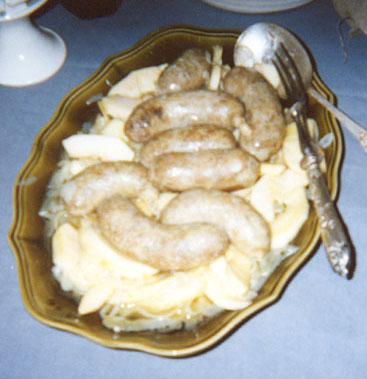
Sausage is a very good way of using up those bits and pieces of flesh that aren't pretty as a roast or a steak. A friend once said that there were no saucisse, sausages in Nouvelle France in the 18th Century because they did not have sausage stuffers. The Lewis & Clark journals describe a way that it may have been done, but I am too fumble fingers to do it. I use a large tin funnel and insert the long end into the casing and use a wood reemer to push the forcemeat through. In Savoring the Past: The French Kitchen and Table from 1300 to 1789, page 61, is an engraving of Winter, from the Four Seasons by Crispin de Passe after Martin de Vos, showing hanks of sausages in the border. So I will again use my spice mixture from her book, as I find the taste is very much as I remember from a child. My grandfather, Joseph Marie Blanc, was from Aymavilles, Aste, Italy, just over the border from France, and I make and eat these sausages in his memory. To see boudins being made, click here.

Soak 4 ft of beef casings for an hour in cold water and flush twice with a faucet

1 large onion, minced, sautéd in 2 tbls of butter, cool

In a large bowl, soak 1 c of freshly ground bread crumbs with 1/2 c light cream

Grind 8 oz of skinless chicken breasts with 8 oz of hamburger and 1 handful of duck or goose fat twice with the fine blade of meat grinder or use two knives brought down over the meat alternately with a rhythmic action to preserve the juices in the meat and to incorporate the meats and fat together

Add the meat to the large bowl of crumbs along with the onions.

Add 1 1/2 teas. mixed spices, 1 tbls salt and gresh ground white pepper to taste

Add two slightly beaten eggs and 2-4 tbls of brandy or white wine

Use your hands to completely mix the forcemeat together.

Tie one end of the casing into a knot and begin pushing the other end over the end of the funnel. Try to push evenly so as not to have air bubbles in your sausage. Twist it into 4-6 inch lengths and tie the other end with twine, as well as the twists in the lengths. Prick each link with a needle 2 times to keep the sausage from bursting during cooking.

Bring a large pot of water to boil into which you put a rib of celery with a sprig of thyme tied to it, a carrot sliced, one onion sliced and salt and pepper to taste. Once this broth is simmering, slowing let your sausages down into the liquid and cover with a ceramic plate to keep the sausages submerged. Cook gently for 1/2 hour. Remove and drain.

To serve, fry gently in butter until lightly brown and garnish with grilled onions.

Recipe from James Villas, The French Country Kitchen, p. 184.

Next: Making Quince Paste, pâte de coings, to save for the winter holidays.
Related Posts Plugin for WordPress, Blogger...