Friday, March 10, 2006

Fromage Glacé


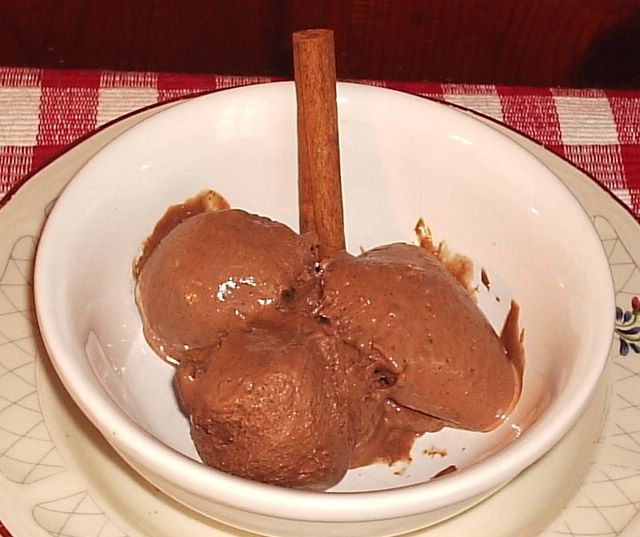
Andrew chose dairy for this month's Sugar High Friday, Jennifer's monthly sweet treat. Here is the 18thC answer to ice cream!

"If French confectioners brought ice cream to the attention of the world by serving it at the French court, these same confectioners also codified the art of making ice cream so that, by the middle of the eighteenth century, numerous books could be consulted on ice cream making from A to Z." Ice Cream from families.com

Autre Fromage Glacé
Prenez une chopine de Crême douce, foüettez-la bien, et délayez-la avec un petit Fromage caillé; mettez-y du sucre raisonnablement, et un peu d’eau de fleur d’orange; passez le tout au travers d’un tamis: ensuite mettez-le dans un moule pour le faire glacer, . . . . Vous pouvez diversifier le goût et la couleur, en y mettant selon les saisons, comme fraises, framboises, ou fleurs d’orange en feüilles, que vous mêlez avec vôtre crême en la passant au tamis. La fleur d’orange ne passe point, mais y laisse son goût. En hiver on le fait cuire, comme le premier fromage glacé, et on luy donne le goût de canella, de chocolat, de citron, ou d’essence de bergamotte.

Massialot's Les Confitures (1717), p. 284.

Iced Cheese, another way
Take a pint of Sweet cream, whip it well, and fold it into 6 ounces of curdled cream [Cream cheese]; add sugar to taste, and a little water of orange flower; pass the whole through a sieve: then put it in a mould and freeze. You can diversify the taste and the color, by adding ingredients according to the seasons, like strawberries, raspberries, or orange flower petals, which you mix with yours creams while passing through the sieve. The orange flower does not pass, but leaves its taste there. In winter one cooks the mixture as in custard, and one uses cinnamon, chocolate, lemon, or oil of bergamotte (orange flower water).

Saturday, March 04, 2006

Potted Cheese


What to do with those tiny rinds and bits of left-over or dried out cheese? Grind and mash them with some butter, even a few bits of shallot or garlic and use to spread on bread before toasting for croutons in salad or soup or dab on grilling meats to impart a piquant glaze. Bits of bleu cheese make for a very tasty mixture.

If you really feel decadent, eat it by the spoon straight out of the crock and wash it down with a chope [mug] of beer!

Wednesday, February 22, 2006

Foie Gras Grilled


What to do with those little trimmings off the lobes of that expensive foie gras?

Dredge them in bread crumbs and grill in a pan to catch all that lovely flavor and juice. Grill on both sides just until it loses its pinkness and deglaze the pan with a teaspoon of juice from lemon confit.

If you do not achieve enough liquid for a sauce, add a spoon or two of water. Pour over grilled foie gras and garnish with a julienne of preserved lemon.

Here is a recipe for grilled foie gras from La Varenne's The French Cook, p.93.

#51 Foie Gras on the gridiron
Put it on the gridiron, and powder it with crumbs of bread and salt. After it is broiled, powre the juice of a Lemon upon it, and serve.


Purchase fresh or frozen foie gras from Enjoy Foie Gras.

Monday, February 20, 2006

Pâté de foie gras


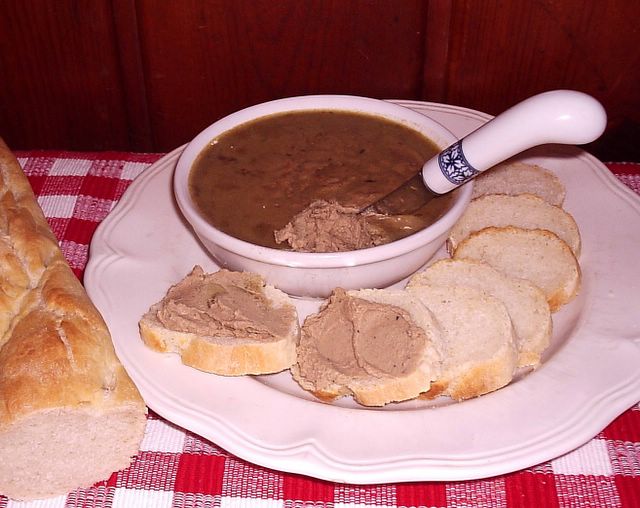
Soul food for me is liver pâté on good bread served with either cornichons or a glass of vin noix, which I find tastes like a fine port.

It’s cold here, the coldest it’s been all year. So yesterday I took some livers out of the frozen cache and made pâté. I soaked them in some fresh cold water to thaw, then drained and patted them dry with a towel.

To Make Pâté:
Crush and mince one fat clove of garlic and sauté in butter or graisse along with one small onion or two shallots minced until just golden. Put one sprig of thyme and one bay leaf in the pan and bruise the bay leaf in the hot oil to release the flavor. Add one cup of water and bring to a simmer. Place about one pound of livers gently into the simmering liquid and cook just until livers lose their pinkness.

Remove sprig of thyme and bay leaf. Using your écumoire or skimmer, strain all of the solids into a bowl, reserving the liquid in the pan. Use your masher to combine all solids into a paste in the bowl. While the paste is still warm, mash in ½ cup of butter. Season mousse with pepper and salt and a spoonful of brandy to your taste. Pour into a small bowl or terrine and tap on the table to remove air bubbles. At this point is it necessary to cover the top of the mousse with a layer of melted butter or calve’s foot jelly* to keep it from darkening. Put in the cold room to set and develop flavor.

After serving, if you still have leftovers, seal again with melted butter to maintain color of mousse.

calve’s foot jelly* Add a cube of jelly to the pan liquid and bring to a boil, stirring to melt the jelly. Strain and pour over mousse carefully to keep the surface intact.

Caroline has a wonderful article on foie gras that explains all the ins and outs of this marvelous treat.

Purchase readymade foie gras mousse from Enjoy Foie Gras.

Saturday, February 18, 2006

Celery Fried with Pepper


"Kay was reading Letters of a Loyalist Lady Being the Letters of Anne Hulton, sister of Henry Hulton, Commissioner of Customs at Boston, 1767-1776 (Harvard University Press, 1927). What a fascinating read! And only 750 copies printed. . . . "'We put in the Green house last fall 500 heads of the finest Celery that ever was seen here.'"

There appear to be some seven people in the household and no evidence so far of their selling or bartering any of their crops, so what do you think was done with 500 heads of celery? It seems a large amount IMHO. I understand that celery would be a much-used item (somewhere I have a receipt for braised celery of the period), but it still seems like a lot." Message #6689 from 18thC Woman's list.

French gardeners found that much of the too-strong flavor of celery could be eliminated, making the stalks better for salad use and not just medicine, by growing the plants in late summer and fall, then keeping them into the winter. In winter, fried celery makes a great accompaniment to game dishes, making use of sometimes withered stalks.

Here is a recipe for celery in oil with pepper from La Varenne's The French Cook, p.183.

"19. Celeris It is eaten with pepper and salt, or with oile, pepper, and salt."

Slice the tops and stalks of celery in about 1/2 inch slices and fry in a good oil or oil and butter until lightly carmelized. Season with salt and freshly cracked pepper. Serve with game dishes as a side vegetable


Thursday, February 02, 2006

Navettes for Candlemas


It is February, 40 AD, and Mary Magdalene, Jesus Mother', and Lazarus have just come ashore in Saintes-Maries-de-la-Mer, near Marseilles. A small unleavened cake in the shape of their boat is eaten at Candlemas to commemorate their landing. You will find a recipe for navettes here. The small cakes keep well and have a delicate flavor. Enjoy.

Sunday, January 29, 2006

Bread from Levain from my EBBP3 Box


Just out of the oven, a country loaf made from a levain received from Petula, my Euro Blogging by Post sister from Italy. I received a wonderful box filled with candies, torrones smothered in chocolate; 2 bars of dark rich chocolate for use in cooking something truly memorable; a tiny Italian cookbook written in French; chamomile tea and a wonderful chatty letter written in very good French, because Petula doesn’t speak English “so good,” such a wonderful box of goodies.

My thanks to Johanna, the Passionate Cook, for hosting this edition of EBBP.”

Monday, January 23, 2006

Fresh Eggs


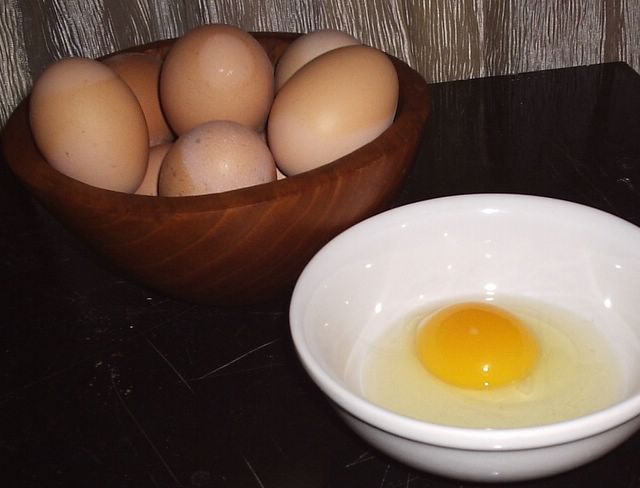
Eggs fresh from the henhouse can’t be beat. Their yolks are rich in color and sit high in the white; not like old eggs that spread out across the bowl and have little color to recommend them.

If, per chance, you have found an egg you are not sure is fresh, float it in a bowl of water. If it sinks below the surface of the water line to the bottom of the bowl, it is fresh. If it bobs on the surface, either horizontally or vertically, break it into a saucer and smell to see if it’s fresh before using.

The color of an eggshell is not an indication of one egg being better than another, i.e., brown over white. All eggs would be white if not bathed in a shower of dye or not as they are laid. Different breeds of chicken lay different colored eggs. Shell color is not a reflection of fertility or quality. Allowing your chickens to run free and to scratch among your plants for bugs and seeds will insure that you have the most nutritious eggs.

Store your eggs in a cool place. Sitting out at room temperature, except when in preparation for use as an ingredient, will shorten their keeping quality and appearance.

Technorati Tags:

Sunday, January 15, 2006

The War That Made America


The War That Made America begins this Wednesday evening on PBS. Several of the actors who bring such authenticity to their roles are reenactors and provided their own "kit" and accoutrements. Let my 18thC world come alive for you this week - history as you've never seen it.

Categories:

Friday, January 06, 2006

12th Night Ball

It's that time of year, the end of the winter holidays. Old Fort Niagara's 12th Night Ball is Saturday night, January 7th.

In New Orleans and Montreal and Paris 12th Night will be celebrated as Epiphany or Three Kings Day, January 6th. Part of the celebration will be the cutting of the King's Cake, a gallette du roi, made of frangipan and puff paste. To those of you lucky enough to find the fève in your piece, enjoy being king or queen for a day!

Thursday, January 05, 2006

Nominee - Best Theme - 2005 Food Blog Awards

Dearest readers and friends,

Thank you so much for your nomination again in this year's 2005 Food Blog Awards category for Best Theme. I am very honored and pleased. Please cast your votes here. My competition is stiff and each competitor is worthy of the honor.

A special thanks to Kate Hopkins, The Accidental Hedonist, for hosting the competition. Her efforts inspire us all!

Tuesday, December 27, 2005

Vin Brûlé

During this holiday season as the weather outside is cold and drear, I promise you this wonderful beverage will warm you and bring feelings of contentment. Dim the lights, cuddle in that cozy chair by the fire, and sip away. Enjoy!

Il faut prendre une pinte du meilleru Vin de Bourgogne. Les Vins de Champagne ne valent rein pour cela. Mettez ce Vin dans une Chocolatiere, avec demi-livre de sucre, une feüille de Macis, deux clous de girofle, & un petit baton de canella, deux dousaines de grains de coriander, & deux ou trios zests de citron, & deux feüilles de laurier franc: mettez ensuite vôtre chocolatiere devant un bon feu, & du charbon allumé tour autour; & quand vôtre vin fera bien chaud, ce que vous connoîtrez à la vapeur ou fume, vous y mettrez le feu avec du papier allumé, & la laisserz brûler jusqu’a ce qu’il s’éreigne tout seul: ensuite moûillez une serviette blanche, & le passez au travers dans une éguiere. Le server tout chaud.

Page 340, Nouvelle Instruction Pour Les Confitures, Les Liqueurs et Les Fruits de Massialot


• It is necessary to take one pint of the best wine of Burgundy. The Champagne wines are not the best for this.

• Put this wine in a chocolatiere or pipkin [ceramic, non-reactive oven-proof vessel], with a half-pound of sugar, a blade of mace, two cloves, a small stick of cinnamon, two dozen grains of coriander, two or three zests of lemon [I sometimes use orange], & two leaves of French bay-laurel [I find any other laurel to be too strong]:

• then put your chocolatiere in front of a good fire; as it sets in the coals, turn it around until it’s quite hot, which you will know from the steaming vapor;

• you will set the vapors on fire with lit paper, & allow it to burn until it dies out:

• then strain it through a wet, white cloth napkin into a ewer [tin, pewter, silver, vermeil, crystal were all used]. Serve very hot.

Monday, December 19, 2005

Dried Mushroom Gravy


Quand j'avais 7 ans, un voisin est venu courant plus de pour dire que le pré au-dessus de la colline brûlait-un le bûcheron était allé dormir, se reposant contre un arbre, alors que le tabagisme d'une pipe et des braises de la cuvette avait attrapé le pin moche sur le feu. Une pluie de trempage de début de l'été avait fortuitement eteint le feu. Le matin prochain tôt le même voisin est venu courant encore, cette fois avec des nouvelles merveilleuses. La pluie avait fait jaillir des champignons des cendre-acres de morelles maintenant froides tenues poussantes leurs têtes au-dessus de la dévastation tout autour de elles. Mon grand-mère et mère ont rapidement recueilli autant de sacs et paniers car nous pourrions trouver et la famille entière pénible au-dessus de la colline et dans le pré noirci. Nous avons traîné la maison beaucoup de boisseaux de morelles, que nous avons ficelées dans des fils et avons accrochées les des combles. Quand le processus de séchage avait accompli, nous avons eu quatre boisseaux de la rançon du roi sec de morelles-un dans manger fin. Tout l'hiver long, avec chaque morceau de viande-élans, des cerfs communs, volaille sauvage et volaille-nous avons pris la sauce au jus succulente de champignon. Quand je pense de nouveau aux odeurs et le goût et les combles lourds avec la générosité de cette année, je désire pour ce goût merveilleux. Depuis ce jour, en ressort en retard et début de l'été quand les mayapples apparaissent sur le plancher de forêt, j'ose dedans aux bois, poussant par le moule de feuille, espérant ces couronnes de morelle pour apparaître. Mais en toutes années où j'ai recherchées, j'ont seulement trouvé uns. Maintenant, avec chaque type de champignon je parviens à moissonner, I sèche toujours uns dans les tranches sur une corde pour s'ajouter à mon [garde manger] pour me rappeler ce jour glorieux il y a beaucoup d'années.

Dried le champignon Gravy
Une corde de huit pouces des champignons secs (rudement une poignée)
Eau bouillante à couvrir à peine
1 tranche d'un petit clou de girofle d'ail, haché
1 petite échalote, hachée
Graisse ou beurre ou huile d'olive
vin rouge pour les viandes rouges, vin blanc pour les viandes blanches
sel et poivre

Prenez les champignons outre de la corde et les placez dans une petite cuvette. À peine couverture avec l'eau bouillante. Mis de côté pour tremper reconstituez.

Hachez l'ail et l'échalote et le sauté dans votre choix de graisse jusqu'à commencer caramelize. Casserole de Deglze avec du jus de trempage de champignon. Fermentez jusqu'à la moitié en volume. Ajoutez votre choix de vin, au sujet de tasse de ½, et les champignons reconstitués coupés ou coupés en tranches à la casserole. Fermentez doucement jusqu'à ce que les champignons soient faits à votre tendresse désirée ; réduisez probablement le mélange plus loin pour intensifier la saveur. Ajoutez le sel et le poivre au goût. Servez très chaud avec des viandes grillées, rôties ou bouillies. Appréciez.
* * * * *

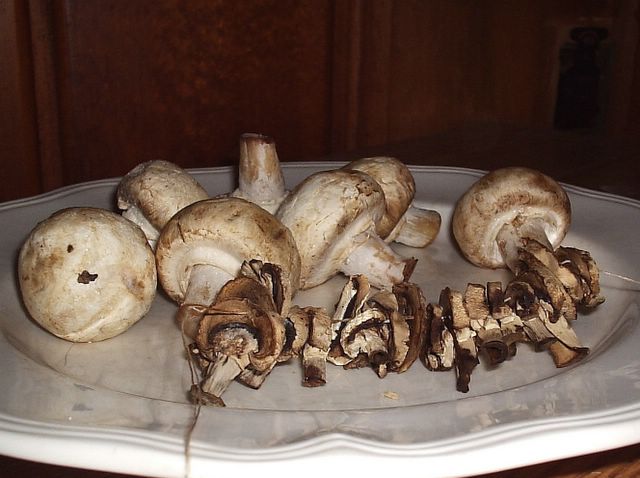
When I was 7, a neighbor came running over to say the meadow over the hill was burning—a woodcutter had gone to sleep, sitting against a tree, while smoking a pipe and the embers from the bowl had caught the pine duff on fire. A soaking early summer rain had fortuitously put the fire out. Early next morning the same neighbor came running again, this time with wonderful news. The rain had caused mushrooms to spring from the now cold ashes—acres of morels stood poking their heads above the devastation all around them. My grandmother and mother quickly gathered as many sacks and baskets as we could find and the whole family trudged over the hill and into the blackened meadow. We dragged home many bushels of morels, which we strung on threads and hung them from the rafters. When the drying process had completed, we had four bushels of dried morels—a king’s ransom in fine eating. All winter long, with each piece of meat—elk, deer, wild fowl and poultry—we had luscious mushroom gravy. When I think back to the smells and tastes and rafters heavy with the bounty of that year, I hanker for that wonderful taste. Since that day, in late spring and early summer when the mayapples appear on the forest floor, I venture in to the woods, poking through the leaf mould, hoping for those morel crowns to appear. But in all the years I’ve searched, I’ve only found a few. Now, with each type of mushroom I do manage to harvest, I always dry a few in slices on a string [to add to my garde manger] to remind me of that glorious day many years ago.

Dried Mushroom Gravy
An eight inch string of dried mushrooms (roughly a handful)
Boiling water to barely cover
1 slice of one small clove of garlic, minced
1 small shallot, minced
Graisse or butter or olive oil
red wine for red meats, white wine for white meats
salt and pepper

Take mushrooms off the string and place in a small bowl. Barely cover with boiling water. Set aside to steep reconstitute.

Mince garlic and shallot and sauté in your choice of fat until beginning to caramelize. Deglze pan with mushroom soaking juice. Simmer until half in volume. Add your choice of wine, about ½ cup, and either chopped or sliced reconstituted mushrooms to the pan. Simmer gently until the mushrooms are done to your desired tenderness; possibly reduce the mixture further to intensify the flavor. Add salt and pepper to taste. Serve piping hot with grilled, roasted or boiled meats. Enjoy.

Friday, December 16, 2005

Graisse Normande

Many habitantes here in Nouvelle France came from Normandy. Before butter became one of the flavors associated with Norman cuisine, “graisse normande” was the chief cooking medium. Each farm would have added its own signature vegetables/herbs in its preparation, giving graisse characteristic flavor and imparting the unctiousness associated with goose and duck fat in Southwest France. The Norman Table: the traditional cooking of Normandy, by Claude Guermont, gives a particularly great recipe for graisse, which I will share with you. It will keep, frozen as “ice cubes,” indefinitely; up to four months in the refrigerator. This is one of the secrets in my garde manger.

GRAISSE NORMANDE
8 oz very firm beef fat and 4 oz pork fat (I use a mixture of duck, chicken, and/or goose fat for these fats as I don’t eat pork products)
½ cup coarsely chopped onions
1 medium carrot, peeled and cut into ¼ inch slices
1 medium turnip, peeled and cut into ¼ inch slices
1 medium parsnip, peeled and cut into ¼ inch slices
1 leek (green part only), cut into ½ inch lengths
1 small bouquet garni (parsley stems, sprigs of fresh thyme, and 1 bay leaf in a cheesecloth bag)
Salt and pepper

• Chop fat into small pieces and place them in a heavy pot. Add 1 cup water.
• Place the pot over a low fire for 2 hours and stir occasionally. The fat will melt and begin to clarify.
• After 2 hours, add the vegetables and the bouquet garni. Stir, then simmer for about 2 hours more, or until the fat is clear and the vegetables have released all their flavor.
• Remove the pot from the fire and let it rest for about 30 minutes. This will allow the particles to settle to the bottom of the pot. Strain the fat mixture through a fine sieve or cheesecloth once or twice if necessary to remove all the particles.
• Season the graisse with about 1 ½ teaspoons salt and 1/8 teaspoon pepper. Place in a tightly closed jar in a cool place.

Use graisse to season soups; as the fat for frying dry meats, such as venison, or left overs and to flavor farces.

Thursday, December 15, 2005

Garde-manger


Behind the doors and hidden in the drawers of my garde-manger (larder, also known as a pie-safe) are many basic necessities of my kitchen. Peer behind the doors and into the drawers and I will share with you some of the secrets of great flavor and incredible variety found in the 18th Century . . .
Related Posts Plugin for WordPress, Blogger...