
Tuesday, December 21, 2004
2004 Foodblog Awards Nomination - Best Theme
Dear Readers, 18thC Cuisine has been nominated for Best "Theme" in the 2004 Foodblog Awards--what an honor and a privilege just being nominated. Please check out the other wonderful blogs in this category and others and cast your votes while catching glimpses of eye-catching photography and scrumptious recipes.

Thursday, December 16, 2004
The enigma of arrival - or - how it all began . . .
For me it is quintessentially French . . .
from - http://groups.yahoo.com/group/FandIWomen/message/7123 9-17-04
From In Remembrances of Things Past, here is Proust's description:
...when one day in winter, on my return home, my mother, seeing that I was cold, offered me some tea, a thing I did not ordinarily take. I declined at first, and then, for no particular reason, changed my mind. She sent for one of those squat, plump little cakes called petites madeleines, which look as though they had been molded in the fluted valve of a scallop shell. And soon, mechanically, dispirited after a dreary day with the prospect of a depressing morrow, I raised to my lips a spoonful of the tea in which I had soaked a morsel of the cake. No sooner had the warm liquid mixed with the crumbs touched my palate than a shiver ran through me and I stopped, intent upon the extraordinary thing that was happening to me. An exquisite pleasure had invaded my senses, something isolated, detached, with no suggestion of its origin. And at once the vicissitudes of life had become indifferent to me, its disasters innocuous, its brevity illusory - this new sensation having had the effect, which love has, of filling me with a precious essence; or rather this essence was not in me, it-was-me. I had ceased now to feel mediocre, contingent, mortal. When could it have come to me, this all-powerful joy? I sensed that it was connected with the taste of the tea and the cake, but that it infinitely transcended those savors...
And . . .
From the French Country Kitchen by James Villas, pp. 3-4: "The novelist and essayist V. S. Naipaul has written persuasively of what he calls " the enigma of arrival," a cogent psychological concept used to describe how sudden exposure at a young age to a new surrounding, a new people, and an altogether new culture can reveal a mystery within ourselves that defines our true nature while remaining unresolved. This experience was exactly mine over 30 years ago when, after crossing the Atlantic aboard the old Queen Elizabeth and taking the boat train from Cherbourg to Paris, I had my first French meal with two other excited but rather frightened students at a bistro called Allard.
Inside it was warm, tables were very close together, and we could barely read the menu scribbled in purple ink. People around the long zinc bar were laughing, drinking a strange yellow concoction, and speaking the language I was yearning to master. The aromas of food and Gauloises and garlicky breaths were like none I'd ever known. The old waiter in a long black apron shuffled across the sawdust floor and placed a basket of bread on the table. I ate a piece, then another, and another, only to realize that the wondrous crust had torn the roof of my mouth. Our waiter finally smiled, and when the time came to order, he simply took over as we stumbled along in miserable French. I recall every dish: escargots de Bourgogne, jambon persille, paté de campagne, coq au vin, gigot aux flagelots, canard aux olives, smelly but wonderful Camembert cheese, and small shiny apricot tarts served with a silver bucket of crème fraîche that was slightly sour. We drank red wine, Beaujolais, which the waiter chose and replenished automatically, I was ecstatically dumbfounded—by the foreign chatter around us, the sense of joyous abandon, the exotic odors, the sensuous new flavors. The only problem was that, for a while, I felt I didn't really belong in this incredible place, that none of us yokels could ever belong here, that we were strangers whose vicarious participation in this alien environment had to be fictional, like something we'd read about back home, in Sartre or Hemingway. Then, just as I was savoring another luscious bite of apricot tart and trying to avoid the boring academic conversation of my companions, someone to my left touched my arm and uttered, "C'est formidable, n'est-ce pas?"—pointing to the tart—"Oui, c'est formidable, formidable!" I responded fearlessly and proudly. Nothing more was said, but suddenly, with the bittersweet taste of apricot in my mouth, and the consoling remark, and the sound of myself perfectly imitating the pronunciation of that strong word, I knew almost instinctively that an important transition in my life was about to occur, that I was moving into a world that was forbidden but had to be explored. The enigma of arrival."
When I married 10 years ago, my husband introduced me to living history. We started out as buckskinners, now we do French Colonial reenacting. We even moved out of Western Idaho to the Midwest so we would be closer to French sites. It's been a wonderful journey back into time--come, join us!
Wednesday, December 15, 2004
Bean Soup

We often think of chocolate in terms of a sweet, but in the 18thC chocolate was as often used to flavor savory dishes and chocolate can enrich a sauce for beans.
Soak white beans overnight. Drain and add to your marmite along with some sauteed onions and garlic and a pinch of thyme. Pour hot broth [vegetable or meat or poultry] to just below the top of the marmite, replace the cover and set into the coals at the edge of the fire. Turn pot as soup comes to a boil and keep simmering for a couple of hours. When most of the liquid has been absorbed, stir in a grated square of chocolate and a good pinch of cinnamon. Season with salt and pepper to taste.
Marmite by Michel Nichol. Wood ladle and bowl by my husband at Old Bedford Mercers Woodware.
Monday, December 13, 2004
Tourtiere
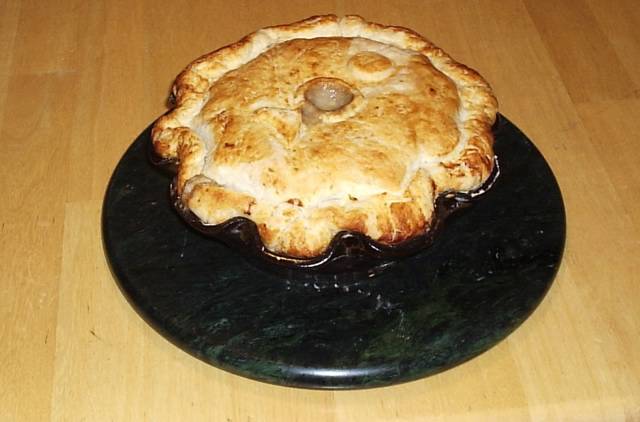
Savory pyes or tourtes are rib-sticking good on cold winter days. They can either be eaten warm from the oven or are even better reheated the next day or eaten cold as snack food.
Although French people, for the most part, did not eat potatoes during most of the 18thC, considering them to be food for pigs or the English, "the generally accepted story is that a French army officer named, Antoine-Auguste Parmentier, an Economist, was imprisoned in Hamburg during the Seven Year’s War (1756-63), and got used to eating potatoes. Returning to France, he persuaded King Louis XVI to eat them, and his wife, Marie Antoinette, to wear potato flowers on her dress. Potatoes then became so fashionable (c.1787) that even now French dishes containing potatoes are called Parmentier." Thomas Jefferson brought home recipes from his diplomatic sojourn in Paris for potatoes to be served in the "French manner," generally believed to be French fries. Soon, a national dish of Quebec was known as Tourtiere, and is basically meat and potatoes baked in a crust.
Tourtiere
Pâte Brisée or enough short pastry dough for two crusts
Parboiled sliced potatoes
Either shredded,precooked meat or raw ground beef [turkey, chicken, venison or veal]
2 slices bacon [turkey], diced or minced
Onions, diced
Celery, sliced
Garlic, minced
Allspice
Sage
Nutmeg
White Pepper
Milk
Flour
Oil or fat
Salt
Roll out pye dough and place half in deep pye dish. Reserve other half under cover. Add a bit of oil to spider [cast iron skillet on three legs with a long handle] and fry onions, celery and garlic until golden along with browning ground beef and bacon, or add cooked, shredded beef. Season with 1/2 teas rubbed sage and 1/2 teas ground allspice and salt and pepper to taste. Remove from heat and cool slightly; then pour onto bottom of pye crust. Cover with a layer of precooked, sliced potatoes.
Take oil or fat and make a roux with flour in your spider to take advantage of the drippings and flavor. Add milk to make a béchamel or white sauce. Season with 1/2 teas nutmeg and salt and white pepper to taste. Pour over potatoes in pye shell. Cover with top crust, seal edges and brush with milk. Cut a vent hole for steam in the middle of the pie and bake in a hot oven until done [450ºF for 15 minutes and 350ºF for 30 minutes more].
Friday, December 10, 2004
Spices -
SHF#3

Umm, cardamom, allspice and nutmeg--all say apples to me. In accepting Zarah's challenge of Spices for Sugar High Friday and after reading Pascale's post on steamed puddings I decided to try a steamed apple pudding, redolent of spices, butter and molasses.
In Diderot's Encyclopédie many types of cookware are displayed. One is the charlotte mold with lid--this is the ideal baking pan to use for steaming. I butter the inside of my charlotte pan and shake sugar on it instead of flour--this gives a more pleasing brown to the outside of the steamed pudding--which sometimes can be somewhat peaked.
Pudding ingredients: cut up three pealed apples very finely and stir them into 1/3 cup melted butter, 3/4 cup molasses (I actually used a mixture of sorghum and molasses) and 1 beaten egg. Into this stir 2 1/2 cups flour, 1/4 teas salt, 1 teas cinnamon, 1/4 teas cardamom, 1/4 teas nutmeg, 1/4 teas allspice and 1 1/2 teas soda (not available to 18thC cooks). Spoon this mixture into the sugared charlotte mold and cut a piece of buttered paper to fit over the top of the pudding.

Now, place the lid on the mold and tie the cover to the pan through and around the handles.

Set a trivet into the larger steamer kettle

and lower your mold down onto the trivet. Pour boiling water into the steamer halfway up the charlotte mold sides;

place the lid on the steamer and set onto the fire. Bank coals and ashes around and keep a supply of boiling water handy in your teakettle to replenish the water level as needed. Boil for 1 1/2 hours. Remove the mold from the steamer and let sit for a few minutes. Take off the lid and peel away the paper.
Run a knife around the edge of the mold and invert onto a serving plate. Serve with a sabayon sauce.

Sabayon: 1 egg yolk, 1/4 cup sugar, 1/4 cup Marsala (I used Vin Noix [walnut wine]) Whip over a boiling water bath (Bain Marie) until thick. Serve over pudding slices.
Pudding recipe adapted from Ladies Home Journal Dessert Cookbook, edited by Carol Truax, Doubleday, 1964, p. 152.
Sunday, December 05, 2004
Squash in Almond Crust
with Spicy Applesauce

This is my entry for the first ever Paper Chef Event - December 2004, sponsored by Owen at Tomatilla, which will continue each first Friday. We were given 4 ingredients on Friday and had to come up with an entry by noon on Sunday using cilantro (or its seed coriander), ginger, almonds, and winter squash.
Crush 12 almonds, 1 Tabls. brown sugar, 1 pinch salt, and 1/2 teas. powdered ginger. Peel and slice the neck area of a butternut squash into 1/4" slices. Press each slice into the crushed nut mixture and fry in butter over a slow fire in your spider. Turn each slice once as soon as it is golden brown. Remove to a serving plate and keep warm.
Grind 2 peeled and cored apples into bits with a sprinkle of crushed cinnamon and coriander seed. Pour mixture into the spider and stir to deglaze the pan, adding a bit more butter for gloss. Spoon spiced applesauce over squash slices and serve with sausages or roast fowl.
The crunchy texture of the fried nut coating contains the soft squash and the citrusy tang and aroma of the coriander in the applesauce finishes the dish just right. My DH (dear husband), who is a meat and potatoes man, said it was good enough to serve to company--high praise indeed.
Wednesday, December 01, 2004
Sumac "Lemonade"

The snow clouds are gathering off to the north, but the day is sunny and cold. It's time to gather sumac before migrating flocks of cardinals and waxwings eat them all. Staghorn sumac grows all over the rocky knoll where I live overlooking Lake Huron--unlike other plants, it likes the dry, sandy soil. Sumac is also known as the vinegar tree and a European variety is widely used in Mediterranean cuisine, both as a garnish and a ground spice.
Native Americans and early settlers to America used sumac for medicinal purposes, but today I will gather it to make a refreshingly tart drink, not unlike a pink lemonade. I will dry some, hanging it from the eaves for later consumption, either as a drink, or to add piquancy to my cooking.
To make a drink, you can either soak it overnight in cool water for a light taste, or bring it to a boil and steep it to obtain a stronger solution. Then it must be strained through cheesecloth or a strainer to remove the hairs and stray berries. Add sugar to taste for a drink, or bottle some to use as you would vinegar. À votre santé!
Sunday, November 28, 2004
Pruneaux - Prunes in Wine

At the end of a fine evening meal, what better way to prolong its enjoyment than to nibble at a prune preserved in spiced armagnac. The liqueur that results from making the pruneaux can be used as a sauce over Coeur a la Crème or drizzled over a fine aged cheese and nuts.
Take a pound of prunes and prick them with a needle four times. Pour warm, strong tea over them and mascerate overnight. Drain the tea (can be used over ice cubes for a delicious drink). Fill preserving jars 3/4 full with prunes.
Bring to a simmer 2 parts red wine, 1 part armagnac (rum or eau de vie can be used as well), 1 part sugar, 1 vanilla bean and 1 stick cinnamon [Jean Paul has told me I forgot a bit of orange zest]. Stir until the sugar is dissolved. Remove the cinnamon, vanilla and orange zest and pour liquid over prunes. Seal and set back in a dark cupboard for at least two weeks. The longer it sits, the better it is.
To serve, place one prune in a goblet and cover with liqueur. Nibble with a spoon along with coffee.
Sunday, November 21, 2004
Sweets

This is my first contribution to IMBB, Cookie Swap #10, hosted by Jennifer.
In the 18thC there were no cookies as we know them today. There were little cakes baked in special molds and other foods such as confectionary and meringues could be said to be used as we would use cookies today. The meringue jumelles are actually 17thC and the madeleines are representative of the types of little cakes that were such a treat in the 18thC. Enjoy.
Meringues Jumelles Massialot's Les Confitures, p. 210.
Take three or four fresh eggs, according to the quantity of meringues which you want to make; separate the white, and whip until they form stiff peaks: after put in a little grated lemon rind, & three or four spoonfuls of fine powder sugar. One needs to whip the whole together, until sugar is dissolved and it looks satiny: Then take a sheet of white [parchment] paper, & with a spoon form round or oval meringues, according to which you want, of the size of a walnut, leaving distance from the one with the other; sift over a powder of fine sugar; & without removing them from the same table or you will have to reform them, cover with lid of the furnace with fire above [lid of a dutch oven with coals on it]: they will swell early, & will take color, leaving a void in the middle, you will fill it with candied fruits according to the season, fruit of cherry, strawberry or raspberry, & will cover it with another meringue which to close the whole of it, & they will be meringues jumelles.
I put them together with some black cherry jam made earlier this summer.
Madeleines Madeleine Kamman's The Making of a Cook, p. 1129.
Madeleine Palmier was the young girl who, in Commercy, presented the first known madeleines to King Louis XV of France.
Butter and flour your madeleine tins [preheat your oven to 350ºF]. Cream 1 cup butter until white. Beat in 2 egg yolks. Separate 3 large eggs. Whip whites until stiff in separate large bowl. Beat yolks in to butter alternately with 1 cup sugar. Beat in the grated rind of one lemon and 2 tablespoons dark rum and 1/4 teaspoon salt. Sift and then measure 2 cups cake flour. Fold flour into egg and butter mixture. Fold whites in until just barely blended. Drop by tablespoonsful into madeleine molds and bake until lightly golden around the edge. Unmold and cool. Can sift powdered sugar over madeleines or dip one end into chocolate.
Thursday, November 18, 2004
Sauced Duck Breast with Onions
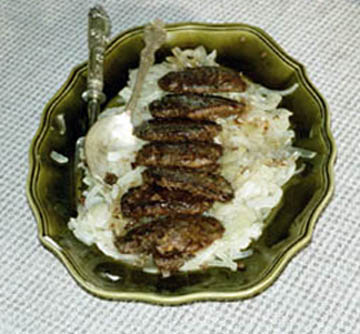
The ponds haven't frozen yet, so a few ducks still remain before flying south for the winter and I was able to share in the largess of a friendly hunter who gave me some ducks. I sliced a breast and marinated it in a little thyme, salt, pepper and red wine vinegar for about 20 minutes. Next I heated my frying pan and melted some duck fat in it and then seared the breasts until crispy. I removed the duck to a heated plate to rest and deglazed the pan with more vinegar and added some plum jam and walnut ketchup. When the sauce was bubbly and slightly reduced, I put the duck back into the pan and turned each slice to absorb the sauce and add color to each slice. I served the duck breast on a plate of grilled onions.
Tuesday, November 16, 2004
Green Walnut Chutney

When I drained the salty vinegar infusion from the chopped green walnuts, onions and garlic to make walnut ketchup, I couldn't bring myself to throw those aromatics away. Although the liquid was somehwhat brown, the solids were still greenish. I added chopped, peeled apples & pears, raisins, grated ginger, mustard seed and one crushed cayenne pepper to my poële. Then I added brown sugar and vinegar to cover. Had I layered all this in a glass jar and just left it to sit macerating, uncooked or "unfinished", I would have had a plain compote. But as I simmered the chutney, the mixture turned inky brown and put forth a wonderfully pungent aroma.
I will use this chunky dark jam to flavor grilled meats and to finish sauces with game. I will even add it to cream sauce to pour over noodles on meatless days. French Catholics observed a lot of meatless days in their religious observance and many early cookbooks spoke to the need to offer "rich" fare that was legal. A rich sauce will please the eye and fill the stomach.
Saturday, November 13, 2004
Walnut Ketchup

Last Midsummerday I was allowed to walk through my friend's walnut orchard to pick green walnuts to make vin noix. After picking an apronful, I put three fourths down for wine and the rest I ground and set to steep in vinegar with some onions, garlic and salt. Several weeks later I drained the mixture, reserving the liquid for ketchup and the solids I turned into a chutney [see next post] to eat with game this winter.
To the liquid in the pan I added some wine, a few blades of mace, peppercorns and a few cloves. I simmered this until reduced in volume by half, strained it into a jug, and set it back on the shelf. Use walnut ketchup to deglaze the pan or to add that certain something to vinaigrette.
Friday, November 12, 2004
Tarte aux Pommes

On my table sits a basket of apples, more windfalls that I rescued from the deer. For supper tonight I made a tarte and glazed it with some apple jelly for color.
After peeling and slicing the apples I cooked them with a little white wine and freshly crushed sugar until they were translucent, then I piled them onto a round of pâte brisée in my baking pan. I then dotted the apples with a few nubbins of butter and folded the crust up to make an edge.
I placed the pan into the dutch oven and set it into the coals and placed a few coals on top of the lid. After about 20 minutes, I lifted the lid and brushed on a bit of jelly, setting the lid back on for another 5 minutes. When I lifted the lid again, I had a golden, juicy tarte for dessert.
This is my first contribution to the second edition of the Sugar High Fridays, the food-blogging event hosted by Jennifer.
Thursday, November 11, 2004
Garbure

Tonight I had but a small piece of smoked meat for supper so I made garbure, a delicious soup of greens, either cabbage or lettuce, carrots and onions. First I sliced a small cabbage into eigths and placed these on the bottom of the marmite. Next came two medium onions quartered followed by four carrots sliced. I threw in a clove of garlic, well minced, and placed the piece of meat on top. Broth was then added to just barely cover the vegetables.
On went the lid and the marmite was set into the ashes at the edge of the fire. As the garbure bubbled merrily away in the marmite, I turned it several times, but did not lift the lid which had been sealed with a flour paste mixture.
Just before the garbure was done, I fried some slices of bread in butter on the spider. I placed fried bread (or a few crusts) in the bottom of the bowl and spooned the vegetables onto the bread and ladled on some broth. When I have more than a dab of meat to flavor the garbure, I save it to use in a forcemeat for stuffing poultry.
Tuesday, November 09, 2004
Apple Jelly

Yesterday the wind was cold with threats of snow, but it brought down the last remaining apples on the trees, ones I couldn't reach before. Windfall apples are sometime perfect, but normally covered with russeting or scabs or bruises from hanging on the tree so long or from unfavorable growing conditions prior to falling. But they make excellent apple jelly.
Cut away blemishes but leave the seeds and cores. Quarter your fruit and put into a copper preseving kettle and add a little water, just to barely cover the fruit. Place on a slow fire and simmer gently for 30 minutes. Put all into chinois or jelly bag and allow to drain overnight.
To each cup of juice add one cup of freshly crushed fine sugar in the preserving kettle. Bring to a boil and cook until a small dab on a cold plate shows the correct set or it falls from the spoon in a curtain. Pour into pots and cover with a cloth until cold. Place a piece of paper cut to fit the inside of the pot which has been soaked in eau de vie on the jelly and tie a cloth or paper around the pot.
Apply jelly can be used in small amounts in cooking other fruits to help them set jelly. Aside from being great on bread as a snack use it to brush on bread slices in making fruit Charlottes and to deglaze the pan when cooking meat. Can also be used as a basting sauce on roasting meats to retain moisture.
Subscribe to:
Posts (Atom)
