To fatten all sorts of Fowl in fifteen days, whether Hens, Geese, Ducks, or others; from All-Hallows till Lent.
Take Nettle leaves and Seed, gathered and dryed in the proper Season, which beat to Powder and sift; when you would use it, make it into a Paste with Wheat-Bran or Flower, making it up with Dish-water; for want of it with warm Water; give it to your Fowl once a day, and you will see the effect.
Another way to fatten Fowl.
First put them into a Coop, and three times a day give them to eat a sort of Paste made of two parts Barley, and one of black Wheat, or Millet, ground together, the Flower sifted and the Bran taken off, of which make bits rather long then round, of a convenient size, and give them seven or eight a day, and in fifteen days or thereabouts, they will be very fat.
Taken from:
Modern Curiosities of Art & Nature. Extracted out of the Cabinets of the most Eminent Personages of the French Court. Together with the choicest Secrets in Mechanicks: communicated by the most approved Artists of France. Composed and Experimented by the Sieur Lemery Apothecary to the French King. Made English from the Original French. London, Printed for Matthew Gilliflower, at the Spread Eagle in Westminster-Hall, and James Partirdge, at the Post-house between Charing-Cross and White-hall. 1685, pp. 241-242.

Wednesday, November 08, 2006

Friday, November 03, 2006
Foie Gras - Several Ways

Tourtiere pan sits on a trivet in the ashes, cover closes and ashes can be put on top.
Recipes taken from:
Dictionnaire Portatif de Cuisine, d'Office, et de Distillation. Chez Vincent, Paris 1767, p. 279-280.*
Foie gras braised. Sprinkle your livers with a little salt, pepper & sweet herbs [traditionally a blend of four herbs — Parsley, Chervil, Chives and Tarragon]; wrap them in a bacon slice & tie them in a little wet paper sheet; & put them between two embers [bury them in hot ashes—not glowing coals], to cook with small fire. Serve hot with good jus [their own juices].
Foie gras in a caul [lacy fatty membrane encasing the internal organs of an animal used to wrap food in for cooking]. Take your smallest pieces of foie gras; chop them with blanched bacon, a little grease & marrow, truffles, mushrooms, calf sweetbreads, parsley, Welsh onions [chives] & cooked ham, & bind the whole with an egg yolk; cut caul into pieces, according to the size of your liver pieces; put your farce on first the caul, then a layer of foie gras; cover with more farce and so on, until the layers of caul are used up with a layer of caul being last; wrap your livers in paper to put them on the grill, or better, in a tart plate; put them in the oven. Serve with a little hot jus [its own cooking juices], pepper, salt & juice of an orange [use orange juice to deglaze pan or paper and serve over bundle].
Foie gras (Another caul version). Put foie gras in a tart plate with bacon bards below; season with salt, pepper, & cover with rest of bards; bake in the oven or the hearth, fire [coals] above & below [a tourtiere baking pan makes this easy], without letting them dry out. Make a mushroom ragout; (see Champignons;) once they are cooked, simmer them gently in the ragout, & serve hot. One can also bread them & cook in the oven, like above [recipe], & serve with good orange juice.
Foie gras with Spanish sauce. Skewer your livers, alternating with bacon and cook. Serve with Spanish sauce. (See Sauces.)
Foie gras with ham. Cut ham slices finely [julienne]; make a roux and add to it ham, livers, a chopped Welsh onion [chives] & fine parsley; cook with small fire [slow oven] in a tart plate in the oven or on the hearth, fire above & below [again, the tourtiere pan is best for this]; season to taste[with salt and pepper], & serve with a lemon section and pan juices.
Foie gras roasted. Sear livers on stove top; then chop them with bacon, some mushrooms, sweet herbs, salt & pepper; cook with small fire [slow oven] in a tart plate.
Foie gras (Ragout) . Blanche [To Whiten--it is to steep in water, either cold or hot, to make plump or white, or both. You're looking to set the flesh so that it will not disintegrate in the next step.] your livers and drain; add diced mushrooms and a bouquet [garni] to the whole livers; moisten with broth or coulis and cook until heated through. Serve with a wedge of lemon.
Foie gras (Tort). Make an undercrust of flaky pastry; line a tart pan; put raked [julienned] bacon, with salt, pepper, fine spices & sweet herbs; there arrange your foie gras with mushrooms, green peaks [tips of asparagus], truffles & will foam [fairy ring mushrooms { mousserons}], bouquet [garni] in the middle; season with a little more salt, pepper, fine spices and sweet herbs, cover with beaten & thin calf sections, & bacon bards, & over all seal with an uppercrust, gild with an egg yolk, & put in the oven; Bake until done. Open crust & remove calf & bacon; degrease & serve with ham essence [gravy].
Enjoy Foie Gras, source for whole [entire] and canned [bloc] foie gras and other French treats. Once your whole foie has been deveined, use the small bits to try some of the great recipes above.
*Foies gras à la braise. Saupoudrez vos foies de sel menu, poivre & fines herbes; enveloppez-les d’une barde de lard & d’une feuille de papier un peu mouillé; sicelez-les & les mettez entre deux braises, cuire à petit feu. Servez chaud avec du bon jus.
Foies gras à la crépine. Prenez les plus maigres de vos foies gras; hachez-les avec du lard blanchi, un peu de graisse & de moëlle, truffes, champignons, ris de veau, persil, ciboules & jambon cuit, & liez le tout d’un jaune d’œuf; coupez de la crépine par morceaux, selon la grosseur de vos foies; mettez de votre farce sur cette crépine, ensuite un foie gras; recouvrez de farce, & que le tout soit bien renfermé dans le crépine; ajustez vos foies dans du papier pour les mettre sur le gril, ou mieux, dans une tourtiere, pur les mettre au four; ensuite dépecez vos crépines. Servez avec peu de jus chaud, povre, sel & jus d’orange.
Foies gras. (Autre crépine de) Mettez des foies gras dans une tourtiere avec des bardes de lard dessous; assaisonnez de sel, povre, & recouvrez de bardes; faites cuire au four ou au foyer, feu dessus & dessous, sans les laisser sécher. Faites un ragout de champignons; (voyez Champignons;) tirez vos foies à sec; faites-les mitonner dans ce ragoût, & servez chaud. On peur aussi les paner & les faire cuire au four, comme dessus, & les servir avec de bon jus d’orange.
Foies gras à l’Espagnole. Embrochez vos foies; bardez de lard cuit. Servez avec une sauce à l’Espagnole. (Voyez Sauces.)
Foies gras au jambon. Coupez du jambon sort menu; passez-le au roux avec vois foies, une ciboule & du persil hachés fin; faites cuire à petit feu dans une tourtiere au four ou au foyer, feu dessus & dessous; assaisonnez de bon gout, & mettez une tranche de citron. Servez avec du bon jus.
Foies gras en rôtie. Passez-lez d’abord à la poële; hachez-les ensuite avec du lard, quelques champignons, fines herbes, sel & poivre, faites-en des rôties-que vous ferez cuire à petit feu dans une tourtiere.
Foies gras. (Ragoût de) Faites blanchir vos foies; passez des champignons coupes en dés avec un bouquet; mouillez de bouillon & de coulis; mettez vos foies entiers; faites-les bouillir queques bouillons, & servez avec un jus de citron.
Foies gras. (Tourte de) Faites une abaisse de demi-feuilletage; foncez-en une tourtiere; mettez du lard ratissé, avec sel, poivre, fines épices & fines herbes; arrangez-y vos foies gras avec champignons, crétes, truffes vertes & mousserons, bouquet au milieu; assaisonnez dessus comme dessous, couvrez de tranches de veau battues & minces, & bardes de lard, & par-dessus tout une seconde abaisse, dorez d’un jaune d’œuf, & mettez au four; ôtez ensuite le veau & le lard; degraissez & servez avec une essence de jambon.
Thursday, November 02, 2006
The Symbolism of Liver
"According to the Roman poet Horace, the liver is the seat of the passions, particularly sensual love and anger. According to Suetonius, it is the center of the intelligence of the mind. Since the foie gras we eat comes from geese, it need not present us with any metaphysical problems - the stupidity of a 'silly goose', after all is proverbial - but it is true that consuming it provides a sensual, almost voluptuous pleasure.
. . . In the Sou-wen, the basis of all Chinese medicine, eating liver is supposed to engender strength and courage.
. . . Examination of the livers of sacrifices animals was a method used by Roman soothsayers to predict the future."
History of Food, Toussaint-Samat, Maguelonne, translated by Anthea Bell. Blackwell Publishers, Oxford UK, p. 433-4.
Friday, October 27, 2006
Anniversary #2
18thC Cuisine has marked its 2nd anniversary with receipt of enough foie gras to try many recipes. Look for upcoming posts on different ways of preparing this delicacy and also on the archaeology of the ceramic dishes used to cook it sans a flour crust.
Many thanks to my loyal fans--here's to another year of exploring the past in French kitchens!
Enjoy Foie Gras, home of some of the best foie gras and other French treats--charcuterie and truffles.
Many thanks to my loyal fans--here's to another year of exploring the past in French kitchens!
Enjoy Foie Gras, home of some of the best foie gras and other French treats--charcuterie and truffles.
Sunday, October 22, 2006
Judging Paper Chef 22, the Slow Edition
Owen is amazing–he manages to elicit the most creative dishes from sometimes humble and oftentimes obscure ingredients–and he always throws in a curve at the last minute! But cooks from around the world always come up with combinations that fit in both home-style and haute cuisines. This month’s edition drew barberries, pumpkin, spinach and slow ingredients and when Own emailed me the writeup, my mouth immediately began to water! Eye-popping haute dishes and earthy, unctious home-style casseroles–now the dilemma–how to decide!
First the home category . . . Noodle Cook prepared a smoky dish of grilled and carmelized vegetables–one a capsicum pepper [too hot for me!]–and deglazed the pan with slow-aged balsamic vinegar served over couscous. My kids would eat this dish up before the cook could get a taste!
The Laughing Gastronome introduced me to Middle Eastern cooking and a new use of yoghurt. Her Chicken Barberryani was a spinoff from a famous traditional Iranian recipe using a rice mixture as the “container” of a finished casserole. Emma served it with a beautiful combination of greens and caramelized pumpkin.
Jonskifarms, even though laboring with a broken arm, turned out a complicated and winning entry in the Home category, complete with an interesting history of the dish–again using a slow-cooked rice and yoghurt crust, Oven-baked Rice with Barberries and Butternut Squash on a bed of spinach, also of Persian influence. This dish would bubble merrily away in the back of my fireplace tucked in among the ashes. Congratulations!
Haute category’s entries begin with Columbus Foodie’s fresh-looking salad of goat cheese, blueberries, and crunchy pumpkin seeds dressed with balsamic vinegar. This was her first entry and her salad would certainly do any restaurant proud–her plating was very appetizing and colorful.
Anita’s entry of Parsee Dhansak made me want to lift the lid and dig right in–I could fairly smell the toasted spices and richness of the lentils and pumpkin wafting through my kitchen. She was concerned that the plating did not do the dish justice, but served in an earthen crock with crusty bread this main dish could happily grace any harvest table in the richest restaurant.
Congratulations to our Haute winner, Bron, whose Pumpkin Tortellini stuffed with spinach and cheese served with a berry-wine sauce was a stunner! The colors alone shout Haute cuisine and the tart-sweet taste combination make this a winner in any category. Her plating and photos were superb.
Kudos for a job well done for all of the entrants–your dishes look wonderful and should taste even better. Thanks, too, to Owen for hosting such a fun competition. This edition’s entries would certainly compare to any TV competition–great job.
Sunday, October 08, 2006
Deportment 101

Nicolas LANCRET, Paris, L'automne 1738
When it's all said and done, things haven't changed all that much . . .
"It is proper that her [bourgeois housewife] behavior at table be fitting. But before coming to sit, she should be seen moving throughout her household so that everyone is aware that she is attending to all matters: let her come and go busily, then sit down at last. She should even have everyone wait for her a little. And when she is seated she should, if possible, serve everyone; she should be the first to cut the bread and to pass it around her, beginning with her tablemate with whom she will share a bowl. In front of him she should set the thigh or wing of fowl, on in front of him carve beef depending on what is served, whether it is meat or fish. She should not be chary in this serving, if she is able. She should be careful not to moisten her fingers up to the knuckles with the broths, and that her lips not get smeared with sops, garlic or grease; nor should she stuff her mouth too full, nor take too large bites. Only with the tip of her fingers should she pick up the morsel she dips into the Green Sauce [fresh green herbs stamped with salt, pepper and vinegar] or the Cameline [unboiled cinnamon sauce] or Jance [boiled ginger sauce]; and then she should bear it carefully to her mouth so that not a drop of the broth or sauce drips down her front. Likewise, she should drink carefully so that not a drop falls, else she will be looked upon as vulgar and piggish. She should refrain from reaching for her goblet while she has a morsel in her mouth, and she should always wipe any grease from her mouth—at least from her upper lip, because if there is any grease there, drops of it will show up on the wine, which isn’t pretty.
She should take only small sips; even is she is thirsty, she should not guzzle in a single gulp from her goblet or cup, but rather in small sips, and often, so that others will not say she is swilling down greedily. She should not swallow the rim of her goblet as many wet-nurses do who are so simple-minded and gluttonous that they pour their wine into their belly as if they were filling an empty boot. She should avoid becoming drunk, because neither a drunk man nor a drunk woman can keep private counsel; besides, when a woman is drunk she can no longer protect herself; she prattles her thoughts and is open to everyone’s advances. She should keep herself from falling asleep at the table; it is really improper, and too many indecent things happen to those who let that happen. It doesn’t make sense to doze when you should be awake; many who do so end up falling to one side or the other, or backwards, and break their arm or ribs or crack their head."
Jean of Meun, Romance of the Rose,13thC, II. 13,355-444.
Thursday, September 28, 2006
Sumac Syrup

Now is the time to begin thinking about gathering sumac to dry for winter. I plan to dry some for use as a spice and as lemonade, as well as to make vinegar syrup now. Vinegar syrup can be made from just about any fruit and makes a delicious drink either hot or cold. Store corked in a cool place.
500 mL [2 cups] fruit or berries
500 mL [2 cups] vinegar I use white wine or distilled
1.1 L [4 1/2 cups] sugar
Steep the fruit and vinegar in a non-reactive pot for 8 days; the level of the vinegar should not submerge the fruit. Strain through a silk strainer [or a stocking]. Set aside 500 mL [2 cups] syrup.
In a bain marie [double boiler], dissolve the sugar and the syrup until there are no crystals left. Remove from the heat and let cool. Bottle. To serve, pour one part syrup for three parts water, cold or hot. Be ready for an amazing taste!
Recipe: A Taste of history: the origins of Quebec's gastronomy, Marc Lafrance & Yvon Deslonges. Canadian Parks Service, 1989, p.68.
See also: Sumac Lemonade
Friday, September 22, 2006
Asparagus Ice Cream, or how to get your kids to eat their vegetables!
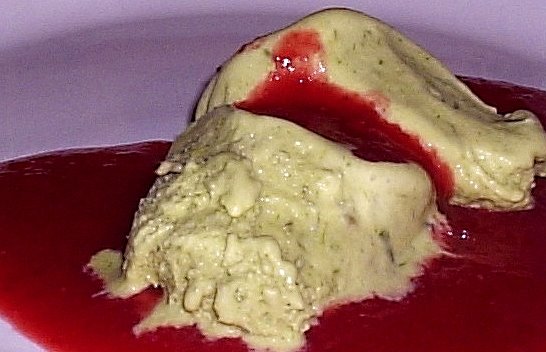
For this month's Sugar High Friday, I offer a delightful taste and color combination, vegetables in ice cream--whoever heard of such a thing! Officers [cold kitchen cooks] in the 17th and 18th centuries, made ices from everything imaginable, including asparagus. As this recipe's creator found recipe here, Asparagus Ice Cream does taste a little like pistachio, so it's odd green color can be forgiven. Pairing it with strawberry coulis with a touch of balsamic vinegar is pure genius.
Strawberry Coulis with Balsamic Vinegar
300 g fresh strawberries
150 ml water
100 g icing sugar
15 ml lemon juice
25 ml balsamic vinegar
Wash the strawberries and place them in a blender;
add the water, icing sugar and lemon juice and blend everything together thoroughly;
place the coulis in a sauté pan and cook for a few minutes;
let cool for 5 minutes;
add balsamic vinegar to taste.
NB: This ice cream previously appeared as an entry in blog appetit!
Thursday, September 21, 2006
To Eat Before I Die . . .
Detail from 18thC Cahokia, Pays Illinois
Pascal stopped by on his way to market and we talked about many things over the fence—especially the types of food we would recommend to someone to eat before we die. My list included:
—Horseradish & crème fraîche eaten with the end cut from a roast of beef [with all the meat juices carmelized on the crispy edges] or with a slice of boiled tongue, either cold or hot.
—Ice cream with rum-soaked fruit mixed in [spumoni], eaten with a small cup of very strong black coffee.
—A slice of charentais melon, fresh from the garden and sprinkled lightly with sea salt.
—A place in the shade after you’ve been working hard on a hot day and a cold glass of beer to quaff while eating a few salty tidbits.
—A group of friends with whom to sip a bit of your own homemade liqueur. My favorite is vin noix, green walnut wine.
Tuesday, September 05, 2006
Gizzard Salad - Cold or Hot


Home-style cooking, always frugal, sometimes adventuresome!
Out of Africa, this month's Paper Chef competition.
Prepare your ingredients: black bean paste, eggs, gizzards and something African.
Let your giblets [I used just gizzards, hearts and the neck] boil in good broth season’d with a bunch of fine herbs and salt: Then cut them into pieces and fry them in lard [I used Graisse Normande] , with parsly, chervil and a little white pepper: Lastly, having stew’d all with yolks of eggs, a little verjuice and the juice of a lemmon [I used black bean paste to deglaze the pan], dress your pottage upon the soaked crusts [bread soaked in broth--I used couscous from North African cuisine]. The same thing may do also done with the beatils [“small blessed objects” – meaning delicacies like cocks’ combs, lambstones, etc.] or tid-bits of other sorts of fowl.
The court & country cook, faithfully translated out of French into English by J. K. A. J. Churchill, London, 1702, p. 131-2
Cook couscous in broth left from gizzards. When done, arrange in a bowl or platter. Sieve several boiled eggs and arrange on top of couscous around the edges of the bowl. Place gizzards over remaining couscous in the center. Can be eaten cold as salad in Summer, or hot in the Winter.
Friday, September 01, 2006
Eggs with Gravy or à la Huguenotte

In honor of the Holy Days of September, an 8-day festival once kept by Huguenots in 1713 beginning on the first Friday evening in September [as evidenced by their liturgy], I give you eggs [poached] in gravy, known as Oeufs à la Huguenote. This is a perfect dish to celebrate EOMEOTE, end-of-the-month-egg-on-toast-eggstravaganza.
Eggs with Gravy or à la Huguenotte
Let some mutton-gravy or any other sort be put into a hollow dish, and when 'tis hot,; break your eggs into it either au Miroir [To break egg on a mixture of moderately hot butter and oil {otherwise, gravy}. To finish with the furnace so that a film is formed on the yellows.] or mingled together [scrambled]: season them with salt, nutmeg and lemmon-juice, and pass the red-hot fire-shovel [salamander] over them, to give them a good color.
Use toast or bread to sop up every unctious drop--a truly decadent dish of soul food!
The court & country cook, faithfully translated out of French into English by J. K. A. J. Churchill, London, 1702, p. 117.
Oeufs au jus, ou à la Huguenote
Mettez jus de mouton ou autre, sur une assiette creuse; & étant chaud, cassez-y vos oeufs, ou au miroir, ou broüillez; assaisonnez de sel, muscade, jus de citron; & passez la péle rouge par-dessus pour leur donner couleur.
Le cuisinier royal et bourgeois, Massialot. Paris, 1691, p. 451-2.
Wednesday, August 30, 2006
To Preserve Cucumbers

Take the best sort of cucumbers, that are not too ripe, and set them in good order in a pail, earthen pan, or some other vessel, in which is put an equal quantity of water and vinegar, with some salt; so as they may be thoroughly steept: they must be well cover’d, and not touch’d for the space of a whole month. Thus when cucumbers are out of season, these may be us’d, after they have been well par’d and soak’d. If you would garnish potages with them, they must be scalded; also when they are us’d for filets, as well on day of abstinence as on flesh-days, they must be cut after the usual manner, and dress’d, as if they were fresh. Indeed they will be of great use through-out the whole Winter, and during the time of Lent. To those that are to be eaten in a sallet, some pepper is usually added, with some handfuls of salt, and they may be stuck with cloves, at least one for every cucumber. They are commonly call’d girkins or pickled cucumbers; and to this purpose, the lesser sort is to be chosen, such as grow in the latter season. They are generally pickled with the stalk or leaves of purslane, and more especially with samphire, which serves instead of sweet herbs for that sort of sallet.
The court & country cook, faithfully translated out of French into English by J. K. A. J. Churchill, London, 1702, p. 100.
These cucumbers are Parisian Pickling from Baker Creek Rare Seeds. They are the crunchiest, crispest non-bitter cucumbers I have ever eaten!
Friday, August 25, 2006
Cantaloupe Preserves
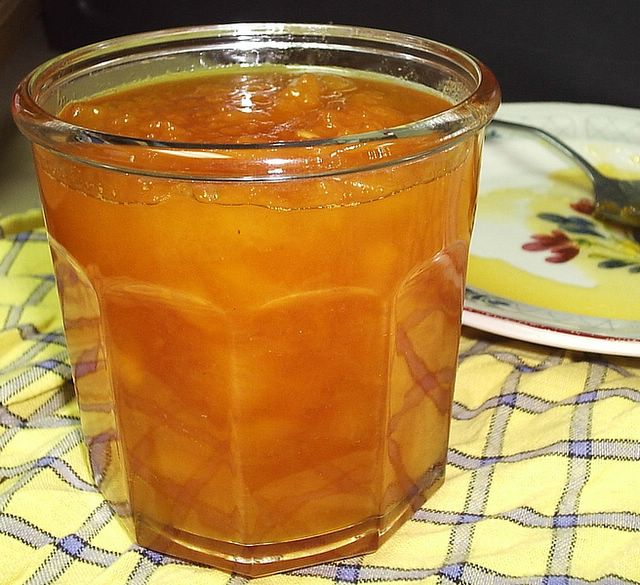
SHF's Can You Can? entry.
To preserve cantaloupe . . .
2 pounds firm, ripe cantaloupe
4 cup sugar
juice of 1 lemon
Peel cantaloupe and cut in thin slices [I mashed mine, as I will be using this in calissons later in the year]. Mix sugar and cantaloupe. Stand overnight [I find this causes the cantaloupe to lose too much water and can then make a tough preserve. Just long enough to get the fruit to begin loosing its liquid is enough time--after all, you're looking for enough liquid to dissolve the sugar]. Add lemon juice and cook until clear in a large pot. Pour into hot jars. Cover with a piece of white paper soaked in brandy [can cover with a thin film of wax]. Makes about 2 pints
Wednesday, August 23, 2006
Sardines in Marinade

Sardines and tomatoes--today an ubiquitous snack to spread on crackers out of a tin--but in the 18thC Century, a delicious treat in countries that bordered the Mediterranean. Tomatoes arrived in France from Italy and Spain, but weren't eaten in the ways we think of until the end of the 18thC century. A sauce with tomato was served to Marie Antoinette, and after the Revolution, it became a mainstay, especially in Provence.
Sardines are a very oily fish and are best grilled and/or marinated--sardines in mustard or tomato sauce are today found on many grocers'shelves the world over. Try this marinade on fresh sardines, either after grilling or by baking the fish in the sauce.
Une autre sorte de marinade pour des poissons peut être faite, après qu'ils aient été faits frire de cette manière ; laissez quelques tranches de citron ou d'orange être mis dans la poêle avec les feuilles de compartiment, le beurre de raffinage, les échalotes, le poivre, le sel, la noix de muscade, et le vinaigre, et laissez cette sauce être versé sur les poissons ; comme des semelles, des congers, des sardines, le thon coupé en tranches rondes et etc.
Le cuisinier royal et bourgeois, Massialot. Paris, 1691
J'ai employé la peau d'orange et ai épluché, ai semé et ai coupé la tomate et ai réduit la sauce résultante d'un demi-. Cette sauce me rappelle la « sauce piquante » - il est très bon.
Another sort of marinade for fish may be made, after they have been fried in this manner; let some slices of lemon or orange be put into the frying pan with bay leaves, refined butter, chibbols[shallots], pepper, salt, nutmeg, and vinegar, and let this sauce be poured upon the fish; such as soles, congers, pilchards [sardines], tunnies cut into round slices & etc.
The court & country cook, faithfully translated out of French into English by J. K. A. J. Churchill, London, 1702, p. 153.
I used orange peel and peeled, seeded and chopped tomato and reduced the resulting sauce by one half. This sauce reminds me of 'sauce piquant' - it is very good.
Sunday, August 13, 2006
Pâté de Poulets à la Crême - A Chicken Pie with Cream

Pâté de Poulets à la Crême
Vôtre Pâté étant dressé; mettez-y vos poulets par quartiers, assaisonné de sel, poivre, muscade, champignons & morilles, lard pilé and fines herbes: couvrez-le de tranches de veau and de bardes de lard, and le recouvrez d’une abaisse, and le mettez au four; étant cuit, découvrez-le, and ôtez-en les bardes de lard, tranches de veau, and le dégraissez; mettez-y un coulis blanc. Le maniere de faire le coulis blanc est marquée à la letter C. Voyez que le pàté soit d’un bon goût, and le servez chaudement pour Entrée.
Le cuisiner roïal et bourgeois, François Massialot. Paris: Charles de Sercy, 1691.
Translation:
Line your pie dish with pastry; put your quartered chickens in, season with salt, pepper, nutmeg, mushrooms & morels, crushed, fried bacon and sweet herbs: cover it with calf and sections of bacon, and cover it with an uppercrust, and bake it in the oven; after it’s cooked, uncover it, and remove the bacon bards, calf sections, and degrease it; put a white sauce in. The manner of making the white sauce is marked with the letter C. See that your pastry is of a good taste, and serve hot for Entrée
Adaptation:
A Chicken Pie with cream
As soon as the pastry [undercrust] is in your pie dish, put your chickens into it in quarters [I used cubed chicken breast], seasoned with pepper, salt, nutmeg, cinnamon, and fines herbs [I used celery and onions. I fried the onions and celery in a little butter and olive oil and added the fresh cubed chicken breast and sautéed it until the vegetables were translucent and the chicken was white and mostly done. I then added one cup of milk and 1/3 cup of flour stirred together and cooked it until a white sauce came together. Next I poured the filling in to pastry lined pie dish] and covered it with an uppercrust of the same paste. [Most pies of this type had vent holes in the upper crust with applied circles of pastry, which when baked, make it possible to add liquids {aspic, cream, mushroom juice, etc.}] When it is baked, pour in some cream and let it stand a little while longer in the oven. Lastly, add some mushroom juice and serve it up hot to table.
Comment:
The nutmeg and cinnamon is not a flavor we associate with chicken today; however, it is delicious and would make a very tasty “hot dish” to share at impromptu dinners where one is asked to bring a dish. This is one place to use all of the green veggie leftovers [I think carrot or squash would overpower this dish] or fresh green herbs—green onions, chives, celery, artichokes, etc.
I will make this dish again; my husband was pleased with the complexity of flavors. Enjoy!
Subscribe to:
Posts (Atom)
