Wednesday, June 17, 2009

Estragon - Tarragon

Estragon: plante potagere, d’un goût âcre & aromatique qu’on emploie en cuisine, & les sommités, sur-tout les plus tendres, dans les fournitures des salades.

OBSERVATION MÉDECINALE.
Cette plante fournit un assaisonnement fort sain; elle augmente l’appetit, facilite la digestion, préserve les humeurs de putridité, ou la corrige; fait périr les vers; est legérement apéritive & calmante.


Tarragon: plant potagere, of a bitter & aromatic taste which one employs in kitchen, & the buds, especially most tender, in the supplies of salads.

MEDICINAL OBSERVATION.
This plant provides an extremely healthy seasoning; it increases the appetite, facilitates digestion, preserves moods of putridity, or corrects it [acid tisane]; purges worms; is slightly apéritive & calming.
* * * * *

Dictionnaire Portatif de Cuisine, d'Office, et de Distillation. Chez Vincent, Paris 1767, p. 263.
* * * * *


«An old French remedy for insomnia and hyperactivity that's been tried with pretty good success is tarragon tea. Tarragon tea is used for tough insomnia. Just steep 1-1/2 tsp. of the dried, cut herb in 1-3/4 cups boiling water, covered and away from the heat, for 40 minutes. Prepare about an hour before retiring, then strain and drink the tea while it's still lukewarm.

The best way to take tarragon for digestive-related problems is in the form of a homemade vinegar, 1 tbsp. before each meal. To make tarragon vinegar, fill a wide-mouthed fruit jar with the freshly gathered leaves, picked just before the herb flowers, on a dry day. Pick the leaves off the stalks and dry a little on a flat cookie sheet lined with foil in a low-set oven.

Medicinal uses - A simple infusion of tarragon leaves has been used to stimulate the appetite, relieve flatulence and colic, regulate menstruation, alleviate the pain of arthritis and rheumatism and gout, and expel worms from the body. The fresh leaf or root, applied to aching teeth, cuts, or sores, is said to act as a local anesthetic.

Culinary uses - Tarragon is essential in the making of Béarnaise sauce, hollandaise sauce, Montpellier butter, sauce tartare, salad dressings and vinaigrettes. It is always included in French fines herbes mixtures.

Use tarragon leaves to flavor fish, shellfish, poultry, meat dishes, particularly veal, creamy soups, omelets, quiche, and delectable oeufs en gelee, as well as spinach and mushroom dishes. As it takes but a few minutes' cooking time to release tarragon's flavor, add the leaves when your dish is just about ready to serve.»

Cited from: Herbs 2000

Sunday, May 24, 2009

Spinage-pan-pie.


A Spinage-pan-pie.
Take Spinage-leaves, and scald them in Water, or else stew them in an earthen Pot, with half a Glass of white Wine, to take away their Crudity. As soon as the Wine is consum’d, let the Spinage be drain’d, and chopt very small, season’d with a little Salt, Cinnamon, Sugar, Lemmon-peel, two Macaroons* (Macarons) and sweet Butter. Them let them be put into fine Paste, and cover’d with Slips of cut Pastry-work; adding some Sugar and Orange-flower (water), as it is serving up to Table.

The court & country cook, faithfully translated out of French into English by J. K. A. J. Churchill, London, 1702, p. 261.
* * * * *
*A tablespoon of flour mixed with the sugar will work well if you have no macarons. Because of the flavor achieved from the macaron (usually ground almonds or other nutmeats), add a grating of nutmeg or a drop of almond oil.

Again, we usually don't think of spinach with sugar, but this is delicious, either for dessert or as a side dish.

Wednesday, April 15, 2009

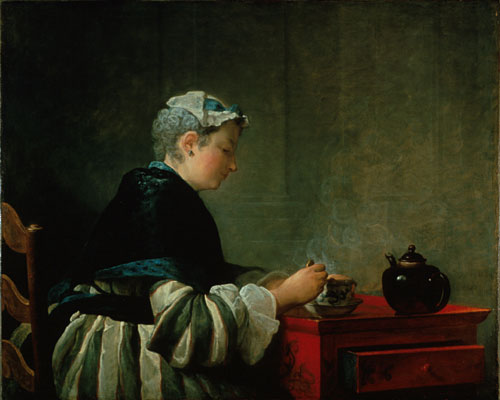
Tisane - an herbal brew


The Tisane Seller, Françoise DuParc

On this day of protest, I bring you a medicinal brew, a tisane*, used in place of that once heavily taxed tea.

«You are cordially invited to An Independence Tea Party.

On October 25, 1774, fifty-one ladies of Edenton, North Carolina, were called together by Penelope Barker and met in the home of Elizabeth King to express their indignation over the newly imposed British tax on tea. The ladies vowed (while sipping tea made from raspberry leaves) that: "We, the ladies of Edenton, do hereby solemnly engage not to conform to the Pernicious Custom of Drinking Tea."»

* * * * *
Invitation quoted from The Military Wives' Cookbook, Carolyn Quick Tillery. Cumberland House Publishing, Nashville, TN, 2008, p. 5.

*[Middle English tisane, peeled barley, barley water, from Old French, from Latin ptisana, tisana, from Greek ptisanē, from ptissein, to crush.]

Monday, April 06, 2009

As Those Tea Parties Brew …


Detail, Lady Taking Tea, Chardin


Back in 1773, the powers that be imposed an unpopular tax on tea. The colonists, already seething with rebellion over taxation without representation, dumped a boatload of the stuff into Boston Harbor in protest.

Today it appears that we have not learned the lessons of history--our leaders are once again heaping unfair taxes upon us--so it's time once again to proclaim liberty!

Wednesday, April 01, 2009

Tourte of franchipanne

Take the fairest flowre you can get, and allay it with whites of eggs. Presently take the twelfth part of your paste, and spread it untill you may see through it. Butter your plate or tourte pan, spread this first sheet, dress it up, butter it at the top, and do the same to the number of six. Then put what cream you will, and make the top as the bottom to the number of six sheets. Bake your tourte leasurely, After it is baked, besprinkle it with water of flowers, sugar it well and serve.
You must have a care to work up your paste as soon as it is made, because it drieth up sooner than you are aware, and when it is dry, it is unusefull, because your sheets must be as thin as cobwebs, therefore you must choose a moist place.
* * * * *
The French Cook, François Pierre La Varenne, Englished in 1653, p. 200.

Basically this is describing using phyllo dough, and the adjuration to work it in a moist place is imperative. Thaw your dough in the fridge and place your 12 sheets of dough between waxed paper with a moist towel laid over the top. Remove one sheet at a time and recover the rest immediately. Lay your dough in a pan and brush with melted butter, one layer at a time.
Prepare a mixture of 5 oz of pounded almonds, 4 oz of sugar and 2 eggs. Pour into your pan and cover with 6 more layers of dough brushed with melted butter. You could also use beurre cream or a cream cheese mixture with sugar and eggs.
Bake at 425°F for 5 minutes; then reduce temperature to 400°F and bake for 10-20 minutes more until golden brown and a broom straw inserted in the center comes out clean.
Removed from oven and sprinkle with orange or rose flower water and a sprinkle of sugar. Cool, slice and serve.

Friday, March 27, 2009

A loaf of bread, a jug of wine …

It seems the way to a man's heart has always been through his stomach. If the lady who supplies the bread and honeyed wine is also good in other wifely arts, so much the better.

Here is a plate of barley bread & goat cheese with honey, served with that infamous Pramnian wine in honor of Novel Food, an event celebrating food immortalized in prose or poetry, and a dish that Circe served Odysseus, hoping to tempt him to stay.

While my Homer eschewed the wine, he thoroughly enjoyed the honeyed cheese and barley bread baked on the griddle. He liked it so much, he has requested that I bake them again for Days of Unleavened Bread.

Barley Bread.
Take leftover mashed potatoes or other root vegetable, add a little milk and enough barley flour to make a soft dough--adjust taste with more salt if needed. Stir or knead, cover and allow to rest for about an hour.

Heat griddle to medium heat. Prepare several pats of butter or clarified butter to grease griddle.

Roll out dough, cut into circles, squares or triangles and fry on both sides on buttered griddle. Adding a cover to the griddle will help with baking the bread all the way through. The vegetables in the dough help the dough stay fresh and moist.

Serve with butter, cheese, jam or honey.

Saturday, March 21, 2009

The TEMPUS FUGIT Award

Chloe, the Widow Black of Slightly Obsessed, has lately granted 18thC Cuisine the Tempus Fugit Award. My thanks go out to her for both her support & for her continued blogging on various 18th century subjects.

"The TEMPUS FUGIT Award is given to writers & living historians whose journals represent the best aspects of the 18th Century. These writers aim to inform and entertain the public with tales from events, historic research & experiments and highlights from 18th Century arts and culture. It is the hope of TEMPUS FUGIT that this award will forge a web of friendship and knowledge that will aid in creating a tight community of reenactors and living historians on the internet and beyond. Winners of the TEMPUS FUGIT Award should pass this award along to six other 18th Century blogs that meet the above criteria, and include this text with the Award, as well as a link back to the TEMPUS FUGIT blog."

Here is a list of my nominations, which alas, seems somewhat short by comparison, due to so many already being named.

Culinary History Online: not a blog, per se, but an extensive onine resource for 18thC culinary arts

New Orleans Cuisine: Danno blogs about his love, New Orleans, and his recipes are modern adaptations of Creole la Louisiane. Bon Apetit!

Les portraits au pastel du XVIIIe: JP has access to beautiful portraits from the 18th Century, many never seen by those of us on this side of the pond.

Friday, March 20, 2009

Tourte de beurre

Butter Tourte.

Melt a peece of butter; after it is melted, put some sugar in it, and some stamped almonds, with a little cream or milk, allayed with flower sod. Then make a sheet of fine or puft paste. Put your implements into it, make a brim about it, bake it, and serve it sugred, and with sweet water, if you have any.

The French Cook, François Pierre La Varenne, Englished in 1653, p. 198.
* * * * *
Sugar High Friday is the brainchild of Jennifer, the Domestic Goddess, and is hosted this month as The Test of Time - Desserts over a century old by In My Box.

Similar sweets to this 1653 tourte de beurre are known today as crème brulée or sugar cream pie. Whether baking in a puff paste shell on a sheet of paper on the sole [floor] of the oven or in a flaky pastry crust in a pie pan, this rich pastry cream flavored with almonds has been delighting palates for centuries.

Steep your crushed almonds in warm milk. Mix melted butter with an equal amount of sugar and flour then stir in heated milk and almonds, continuing to heat and stir constantly until mixture bubbles for one minute. Pour onto a plate and cool.

Roll puff paste and cut into desired shape. Build up the edges with waste strips of puff paste and place on baking paper. Chill until pastry cream is cold. Fill cold paste shell with cold pastry cream. Bake in a hot oven [400°F] until crust is golden and flaky. Sprinkle baked tourte with sugar and pass a red hot fire shovel [salamander or torch] over the top of the tourte to melt the sugar. Cut into portions and serve with a drizzle of orange flower or rose water--an oldie but goodie!

Friday, February 20, 2009

The Excessively Diverting Blog Award


Chloe, the Widow Black, of Slightly Obsessed, and one of the circle of 18th century bloggers, has generously nominated 18thC Cuisine for an Excessively Diverting Blog Award. Started by the blogging team at Jane Austen Today the "aim of the Excessively Diverting Blog Award is to acknowledge writing excellence in the spirit of Jane Austen’s genius in amusing and delighting readers with her irony, humor, wit, and talent for keen observation. Recipients will uphold the highest standards in the art of the sparkling banter, witty repartee, and gentle reprove." What an honor, and, yes, what a delight to be in such good company!

Here is a list of my nominations, which alas, seems somewhat short by comparison, due to so many already being named.

La Cuisine du Jardin: a beautiful blog with sunny photos of home grown food and recipes from Portugal

The Long Eighteenth: a blog by academics with wonderful 18thC resources and interesting ventures

A Reenactor’s Journal: a blog about the journey of soon to be reenactors as they walk the steps of their ancestors through the 18th and 19th century.

Recipients, please claim your award by copying the HTML code of the Excessively Diverting Blog Award badge, posting it on your blog, listing the name of the person who nominated you, and linking to their blog. Then nominate seven other blogs that you feel meet or exceed the standards set forth. Nominees may place the Excessively Diverting badge in their side bar and enjoy the appreciation of their fellow blogger for recognition of their talent.

Sunday, February 15, 2009

Creme Triangles

triangle of puff pastry and cremeSometimes you just want richness in the dead of Winter. All it takes is a few scraps of puff pastry, some left over pastry cream, crème Chantilly or whipping cream and some preserved fruit.

Take chilled pastry cream and whip it with a little heavy cream until smooth and fluffy or fold in crème Chantilly. Spread between two sheets of baked puff paste. Chill until firm. Dust with powdered sugar, cut in traingles and serve with a piece of fruit preserved in syrup. I used apricots. Fresh berries or a drizzle of heated jam would work, as well. This is a very simple but elegant dessert to serve throught the year.

Variation: Chocolate pastry cream with raspberries or strawberries.

Sunday, January 25, 2009

Bouillans

Another way to disguise leftovers, Bouillans would make great finger food at your next get-together and are made thus: Take the Breasts of roasted Pullets or Capons, with a little Marrow, about the thickness of an Egg, some Calves-udder parboil’d, as much Bacon and a few fine Herbs, and put the whole Mixture will minc’d and season’d upon a Plate: Make some fine Paste and roll out two pieces, as thin as Paper: wet one of them lightly with a litter Water, and lay your farced Meat upon it in small heaps, at a convenient distance one from another: Cover them with the other piece of rolled Paste, and with the tips of your Fingers, close up every Parcel between the two Pastes; then with an Instrument proper for that purpose, cut them off one by one, and set the uppermost underneath; dressing them neatly, as if they were so many little Pies. Thus they are to be bak’d, and may be used for Out-works or to garnish Side-dishes; but they must be serv’d up hot to Table.

The court & country cook, faithfully translated out of French into English by J. K. A. J. Churchill, London, 1702, p. 70.

Wednesday, December 31, 2008

Potage, with Spinage

Take only the Heart or soundest part of the Spinage, which must be chopt small and stew'd in a little Pot with Pease-soop, a Carret, an Onion stuck with Cloves, and the other seasoning Ingredients. As the Crusts are soaking, scrape in some Parmesan, and dress your Potage; garnishing it with sticks of Cinnamon, round about, and one in the middle; or else with Onions, or fried Bread.

The court & country cook, faithfully translated out of French into English by J. K. A. J. Churchill, London, 1702, p. 216.

Sunday, December 28, 2008

Sauce à la Czarienne - Russian Sauce

You have a purposely made a reduction of a beautiful color [from whatever meat or fish you have cooked, i.e., brown sauce made by deglazing pan with liquid] in which you make a liaison a little before serving, with two rolls of butter of Vamvre [Vanvres-fresh sweet butter], minced grapes of Corinth [small grapes], long pepper[s] which are in gherkins [entire long pepper fruit included in pickling of cornichons—these have a sweet, hot taste], green gherkins [cornichons—small whole pickled cucumbers] & two Lemon slices, heat through [& strain if desired] & spoon upon your entrée and serve. You can make it the same with white sauce, without binding with reduction, by adding a little butter, long pepper, & gherkins.
* * * * *
Sauce à la Czarienne.

Vous avez une essence faite exprès de belle couleur dans laquelle vous mettez, un peu avant de servir, deux pains de beurre de Vamvre, raisin de Corinthe, poivre long qui se trouve dans les cornichons, & cornichons verds, deux tranches de Citron, faire chauffer & dressez sur votre entrée à ce que vous voulez. Vous pouvez la faire au blanc de même, sans lier avec de la réduction, mais y mettre peu de beurre, poivre long, cornichons bien blanchis.

Le Cuisinier Gascon. A Amsterdam. 1740, p. 82.

Saturday, December 27, 2008

Beurre de Vanvres[Vamvres] - Fresh, Sweet Butter

A favorite of the Bourbon court, was the good fresh butter [sweet, not salted], brought to Paris every Thursday by the women, the children or the domestiques of the plowmen & farmers of those villages surroundings Paris, & the butter of the village of Vanvre[Vamvres--Southwestern outskirts of Paris] was the most excellent; it was usually sold in rolls of three or four ounces for eating on bread, & was much more expensive than other butter, in that it could not be kept for long. Even today, the finest pastries, custards and sauces are made with sweet, not salted, butter.

“The fresh butter most in request for the table in Paris, was that made at Vanvres [Vanves], which in the month of May the people ate every morning mixed with garlic.”

Manners, Customs, and Dress During the Middle Ages and During the Renaissance Period, Paul LaCroix. D. Appleton and Co, New York, 1874, p. 135.

And here is Madame de Pompadour's Asparagus with butter sauce.

Friday, December 26, 2008

Gâteau à la Jacobine

It is the same mixture as the cake of Savoye [this same batter is used to make lady fingers, savoiardi and other biscuits cuiller]; make paper moulds of the same form as an éclair, six inches long; butter the moulds of paper well [I used a cast iron financier pan], fill the moulds with batter half way; & put them in a soft furnace [350◦F for about 15 to 20 minutes]; remove from the oven when light golden brown, cool slightly and remove from mould or peel paper away and allow to cool thoroughly; cover them with Royale icing, and then drizzle with red currant jelly.

The tartness of the currant jelly is just the right foil for the sweetness of the icing. The cake itself is rather bland, but lends itself as a blank canvas for experimenting with tastes and textures of soaking syrups, icings or fruit compotes.

The original recipe goes on to suggest using these in conjunction with caramel--that was too much sweetness for me.
* * * * *

Gâteau à la Jacobine.
C'est le même appareil que le gâteau de Savoye; vous faites des moules de papier de la mêrne forme d'un rouleau à pâte longs de six pouces; vous les beurrez bien, ensuite vous les dreffez tout de bout sur une tourtiere bien collés; Vous y mettez de cet appareil à moitié; & les mettez au four doux; étant cuits, Vous les ôtez du moule, & les glacez d'une glace Royale, & au bout de la gelée de groiseilles; Vous les dressez toutes de bout dans le plat qu'il les faut server, & les faites tenir avec du caramele, & servez.

Le Cuisinier Gascon. A Amsterdam. 1740, p. 156.
Related Posts Plugin for WordPress, Blogger...