During this holiday season as the weather outside is cold and drear, I promise you this wonderful beverage will warm you and bring feelings of contentment. Dim the lights, cuddle in that cozy chair by the fire, and sip away. Enjoy!
Il faut prendre une pinte du meilleru Vin de Bourgogne. Les Vins de Champagne ne valent rein pour cela. Mettez ce Vin dans une Chocolatiere, avec demi-livre de sucre, une feüille de Macis, deux clous de girofle, & un petit baton de canella, deux dousaines de grains de coriander, & deux ou trios zests de citron, & deux feüilles de laurier franc: mettez ensuite vôtre chocolatiere devant un bon feu, & du charbon allumé tour autour; & quand vôtre vin fera bien chaud, ce que vous connoîtrez à la vapeur ou fume, vous y mettrez le feu avec du papier allumé, & la laisserz brûler jusqu’a ce qu’il s’éreigne tout seul: ensuite moûillez une serviette blanche, & le passez au travers dans une éguiere. Le server tout chaud.
Page 340, Nouvelle Instruction Pour Les Confitures, Les Liqueurs et Les Fruits de Massialot
• It is necessary to take one pint of the best wine of Burgundy. The Champagne wines are not the best for this.
• Put this wine in a chocolatiere or pipkin [ceramic, non-reactive oven-proof vessel], with a half-pound of sugar, a blade of mace, two cloves, a small stick of cinnamon, two dozen grains of coriander, two or three zests of lemon [I sometimes use orange], & two leaves of French bay-laurel [I find any other laurel to be too strong]:
• then put your chocolatiere in front of a good fire; as it sets in the coals, turn it around until it’s quite hot, which you will know from the steaming vapor;
• you will set the vapors on fire with lit paper, & allow it to burn until it dies out:
• then strain it through a wet, white cloth napkin into a ewer [tin, pewter, silver, vermeil, crystal were all used]. Serve very hot.

Tuesday, December 27, 2005

Monday, December 19, 2005
Dried Mushroom Gravy
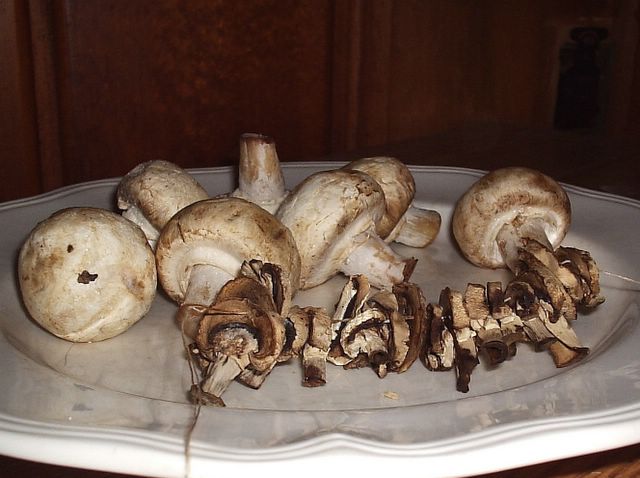
Quand j'avais 7 ans, un voisin est venu courant plus de pour dire que le pré au-dessus de la colline brûlait-un le bûcheron était allé dormir, se reposant contre un arbre, alors que le tabagisme d'une pipe et des braises de la cuvette avait attrapé le pin moche sur le feu. Une pluie de trempage de début de l'été avait fortuitement eteint le feu. Le matin prochain tôt le même voisin est venu courant encore, cette fois avec des nouvelles merveilleuses. La pluie avait fait jaillir des champignons des cendre-acres de morelles maintenant froides tenues poussantes leurs têtes au-dessus de la dévastation tout autour de elles. Mon grand-mère et mère ont rapidement recueilli autant de sacs et paniers car nous pourrions trouver et la famille entière pénible au-dessus de la colline et dans le pré noirci. Nous avons traîné la maison beaucoup de boisseaux de morelles, que nous avons ficelées dans des fils et avons accrochées les des combles. Quand le processus de séchage avait accompli, nous avons eu quatre boisseaux de la rançon du roi sec de morelles-un dans manger fin. Tout l'hiver long, avec chaque morceau de viande-élans, des cerfs communs, volaille sauvage et volaille-nous avons pris la sauce au jus succulente de champignon. Quand je pense de nouveau aux odeurs et le goût et les combles lourds avec la générosité de cette année, je désire pour ce goût merveilleux. Depuis ce jour, en ressort en retard et début de l'été quand les mayapples apparaissent sur le plancher de forêt, j'ose dedans aux bois, poussant par le moule de feuille, espérant ces couronnes de morelle pour apparaître. Mais en toutes années où j'ai recherchées, j'ont seulement trouvé uns. Maintenant, avec chaque type de champignon je parviens à moissonner, I sèche toujours uns dans les tranches sur une corde pour s'ajouter à mon [garde manger] pour me rappeler ce jour glorieux il y a beaucoup d'années.
Dried le champignon Gravy
Une corde de huit pouces des champignons secs (rudement une poignée)
Eau bouillante à couvrir à peine
1 tranche d'un petit clou de girofle d'ail, haché
1 petite échalote, hachée
Graisse ou beurre ou huile d'olive
vin rouge pour les viandes rouges, vin blanc pour les viandes blanches
sel et poivre
Prenez les champignons outre de la corde et les placez dans une petite cuvette. À peine couverture avec l'eau bouillante. Mis de côté pour tremper reconstituez.
Hachez l'ail et l'échalote et le sauté dans votre choix de graisse jusqu'à commencer caramelize. Casserole de Deglze avec du jus de trempage de champignon. Fermentez jusqu'à la moitié en volume. Ajoutez votre choix de vin, au sujet de tasse de ½, et les champignons reconstitués coupés ou coupés en tranches à la casserole. Fermentez doucement jusqu'à ce que les champignons soient faits à votre tendresse désirée ; réduisez probablement le mélange plus loin pour intensifier la saveur. Ajoutez le sel et le poivre au goût. Servez très chaud avec des viandes grillées, rôties ou bouillies. Appréciez.
When I was 7, a neighbor came running over to say the meadow over the hill was burning—a woodcutter had gone to sleep, sitting against a tree, while smoking a pipe and the embers from the bowl had caught the pine duff on fire. A soaking early summer rain had fortuitously put the fire out. Early next morning the same neighbor came running again, this time with wonderful news. The rain had caused mushrooms to spring from the now cold ashes—acres of morels stood poking their heads above the devastation all around them. My grandmother and mother quickly gathered as many sacks and baskets as we could find and the whole family trudged over the hill and into the blackened meadow. We dragged home many bushels of morels, which we strung on threads and hung them from the rafters. When the drying process had completed, we had four bushels of dried morels—a king’s ransom in fine eating. All winter long, with each piece of meat—elk, deer, wild fowl and poultry—we had luscious mushroom gravy. When I think back to the smells and tastes and rafters heavy with the bounty of that year, I hanker for that wonderful taste. Since that day, in late spring and early summer when the mayapples appear on the forest floor, I venture in to the woods, poking through the leaf mould, hoping for those morel crowns to appear. But in all the years I’ve searched, I’ve only found a few. Now, with each type of mushroom I do manage to harvest, I always dry a few in slices on a string [to add to my garde manger] to remind me of that glorious day many years ago.
Dried Mushroom Gravy
An eight inch string of dried mushrooms (roughly a handful)
Boiling water to barely cover
1 slice of one small clove of garlic, minced
1 small shallot, minced
Graisse or butter or olive oil
red wine for red meats, white wine for white meats
salt and pepper
Take mushrooms off the string and place in a small bowl. Barely cover with boiling water. Set aside to steep reconstitute.
Mince garlic and shallot and sauté in your choice of fat until beginning to caramelize. Deglze pan with mushroom soaking juice. Simmer until half in volume. Add your choice of wine, about ½ cup, and either chopped or sliced reconstituted mushrooms to the pan. Simmer gently until the mushrooms are done to your desired tenderness; possibly reduce the mixture further to intensify the flavor. Add salt and pepper to taste. Serve piping hot with grilled, roasted or boiled meats. Enjoy.
Friday, December 16, 2005
Graisse Normande
Many habitantes here in Nouvelle France came from Normandy. Before butter became one of the flavors associated with Norman cuisine, “graisse normande” was the chief cooking medium. Each farm would have added its own signature vegetables/herbs in its preparation, giving graisse characteristic flavor and imparting the unctiousness associated with goose and duck fat in Southwest France. The Norman Table: the traditional cooking of Normandy, by Claude Guermont, gives a particularly great recipe for graisse, which I will share with you. It will keep, frozen as “ice cubes,” indefinitely; up to four months in the refrigerator. This is one of the secrets in my garde manger.
GRAISSE NORMANDE
8 oz very firm beef fat and 4 oz pork fat (I use a mixture of duck, chicken, and/or goose fat for these fats as I don’t eat pork products)
½ cup coarsely chopped onions
1 medium carrot, peeled and cut into ¼ inch slices
1 medium turnip, peeled and cut into ¼ inch slices
1 medium parsnip, peeled and cut into ¼ inch slices
1 leek (green part only), cut into ½ inch lengths
1 small bouquet garni (parsley stems, sprigs of fresh thyme, and 1 bay leaf in a cheesecloth bag)
Salt and pepper
• Chop fat into small pieces and place them in a heavy pot. Add 1 cup water.
• Place the pot over a low fire for 2 hours and stir occasionally. The fat will melt and begin to clarify.
• After 2 hours, add the vegetables and the bouquet garni. Stir, then simmer for about 2 hours more, or until the fat is clear and the vegetables have released all their flavor.
• Remove the pot from the fire and let it rest for about 30 minutes. This will allow the particles to settle to the bottom of the pot. Strain the fat mixture through a fine sieve or cheesecloth once or twice if necessary to remove all the particles.
• Season the graisse with about 1 ½ teaspoons salt and 1/8 teaspoon pepper. Place in a tightly closed jar in a cool place.
Use graisse to season soups; as the fat for frying dry meats, such as venison, or left overs and to flavor farces.
GRAISSE NORMANDE
8 oz very firm beef fat and 4 oz pork fat (I use a mixture of duck, chicken, and/or goose fat for these fats as I don’t eat pork products)
½ cup coarsely chopped onions
1 medium carrot, peeled and cut into ¼ inch slices
1 medium turnip, peeled and cut into ¼ inch slices
1 medium parsnip, peeled and cut into ¼ inch slices
1 leek (green part only), cut into ½ inch lengths
1 small bouquet garni (parsley stems, sprigs of fresh thyme, and 1 bay leaf in a cheesecloth bag)
Salt and pepper
• Chop fat into small pieces and place them in a heavy pot. Add 1 cup water.
• Place the pot over a low fire for 2 hours and stir occasionally. The fat will melt and begin to clarify.
• After 2 hours, add the vegetables and the bouquet garni. Stir, then simmer for about 2 hours more, or until the fat is clear and the vegetables have released all their flavor.
• Remove the pot from the fire and let it rest for about 30 minutes. This will allow the particles to settle to the bottom of the pot. Strain the fat mixture through a fine sieve or cheesecloth once or twice if necessary to remove all the particles.
• Season the graisse with about 1 ½ teaspoons salt and 1/8 teaspoon pepper. Place in a tightly closed jar in a cool place.
Use graisse to season soups; as the fat for frying dry meats, such as venison, or left overs and to flavor farces.
Thursday, December 15, 2005
Garde-manger

Behind the doors and hidden in the drawers of my garde-manger (larder, also known as a pie-safe) are many basic necessities of my kitchen. Peer behind the doors and into the drawers and I will share with you some of the secrets of great flavor and incredible variety found in the 18th Century . . .
Sunday, November 20, 2005
Over the River and Through the Woods . . .

I am off to see my new granddaughter for Thanksgiving in Idaho, where I will also see my four grandsons, one of whom I haven't yet seen. See you when I get back . . .

Tuesday, November 15, 2005
Duck Confit

Some barnyard quackers became duck confit this week. I cannot provide a better recipe than Tom Colichhio's from Gramercy Tavern, NY, NY--it is just as done in the old days. Do try, as one reviewer suggests, using rock salt--it is easier to brush off the meat [keep the meat in one layer--using a bowl causes too much liquid to be withdrawn from the flesh and makes for dry confit]. When your duck is cooked, layer the meat in your confit pot and pour in duck fat to cover--it should keep for weeks in your spring house [refrigerator].
NEVER thow out confit fat! Duck fat left from confit adds an unctiousness that is unbeatable in flavoring soups, stews and casseroles. Use it for frying bread for croutons to use in the bottom of bowls for ladling on soups like garbure.
Technorati Tags: food cooking recipes
Sunday, November 13, 2005
Bread Pudding
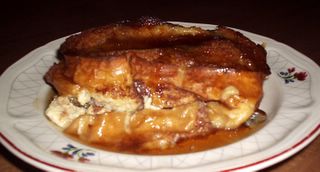
Sometimes when I know I will have a lot to do on the morrow, I take stale bread and soak several slices of it overnight in milk, sugar, a grating of nutmeg or cinnamon and a beaten egg in an oven dish. In the morning I put the dish into a slow oven to become a crusty, but moist, bread pudding for breakfast. Just slather on some butter, pour on some maple syrup and enjoy!
Thursday, October 27, 2005
Cornichons

Les cornichons sont des concombres qui n’ont pû profiter & parvenir à maturité. Onles confit sur la fin d’Aout & en Septembre de cette maniere; on les lave dans le l’eau fraîche,ou les essuye, on les pique avec un piquoir fin en plusieurs endroits; on les range dans un pot avec de bon vinaigre; assaisoné de sel & poivre concassé, & de quelque clous de girofle; qu’ils trempent aisément, & les tenir bien couverts. On confit aussi de gros concombres, mais tenders & avant que la graine y soit formée.
The gherkins are cucumbers which do not have to arrive at maturity to be useful. Pickle them at the end of August or September in this manner; one washes them in fresh water, or wipes them, one pricks them with a fine pricker in several places; one arranges them in a pot with good vinegar; seasoned salt & crushed pepper, & of some cloves; that they soak easily, & to hold them covered well. One pickles also large cucumbers, but [while they are still] tender & before the seed is formed there.
Page 448-9, Nouvelle instruction pour les confitures, les liqueurs et les fruits de Massialot
Wash and wipe your cucumbers, prick all over with a needle and layer as tightly as possible in a crock. Add salt, pepper and a couple of whole cloves to enough good vinegar to cover the cucumbers and bring to a boil in a non-reactive pan. Pour over cucumbers, cover and leave for two days. Drain vinegar and bring to a boil again and repour it over pickles in crock. Repeat at the end of two days; repeat one more time; then leave covered for two weeks [be certain vinegar mixture completely covers pickles at all time--weight with a piece of crockery, if necessary]. Cornichons will be crisp and sour--just right to serve with richly seasoned meat preparations.
I grew Parisian Pickling cucumbers, a rare, tiny variety, especially grown for cornichons. The weather here has been somewhat mild for so late in the fall. At the beginning of October, I pulled up my cucumber vines and picked through them to find the smallest cucumbers to preserve as cornichons to use with patés.
Wednesday, October 26, 2005
Treacle Baked Beans

Moira "sent" some black treacle, a rich molasses that is just right for baking with beans.
Molasses Baked Beans
2 cups dried navy beans
1/2 cup molasses
1/4 cup brown sugar
1 teaspoon salt
1/4 teaspoon freshly ground black pepper
1 Tablespoon prepared mustard
2 medium onions, diced
1/4 cup butter or smoked meat grease
Soak beans as least 8 hours. Drain, add to a kettle with 2 quarts fresh water; cover and put to slow fire until soft (1-2 hours). Drain liquid, but reserve. Place beans and other ingredients in a bean pot or marmite, covert and cook slowly in the coals, adding reserved liquid as needed, for 6-8 hours, until beans are dark, rich and have absorbed all liquid.
Monday, October 24, 2005
Just in on the last canoe - EBBP2
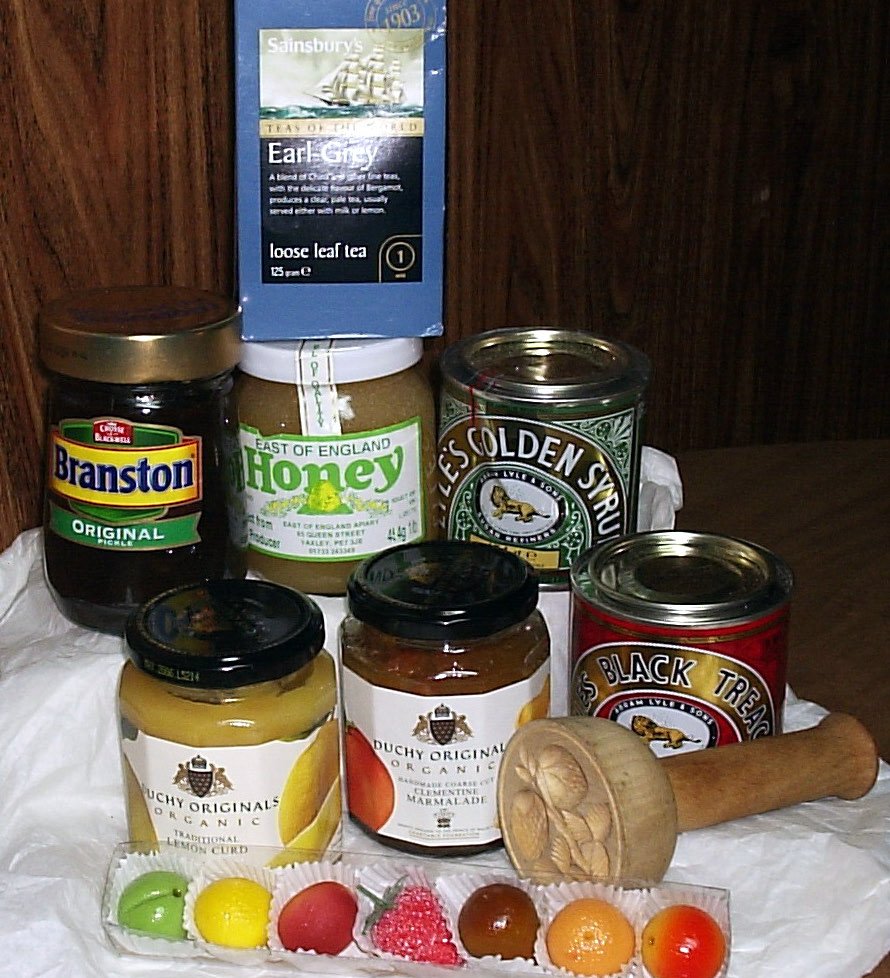
In September I received an invitation from Andrew to participate in Euro Blogging by Post, a "secret blogger" kind of event in which bloggers send local, seasonal products and secret items from their cupboards to another who then must create a recipe using one of the items received. I sent my package to Christina.
Each time a canoe put into port, I sent my husband down to the lakeshore to see if I had received any packages. Each time he came home empty handed--until today. On the last canoe arriving before freezeup, I received a wonderfully heavy package, brimful with delights from England. Moira had sent me products that are next to impossible to get--sometimes packages are lost in canoe upsets or portages or through the knavery of the those wily boatment--marvelous marzipan, treacle and confitures and a lovely antique butter stamp, pickle and tea.
Thank you, Moira. I plan to use the black treacle to make baked beans.
Search Tags: ebbp food & drink euro blogging by post
Friday, October 21, 2005
Massepains de Chocolat - Chocolate Marzipan
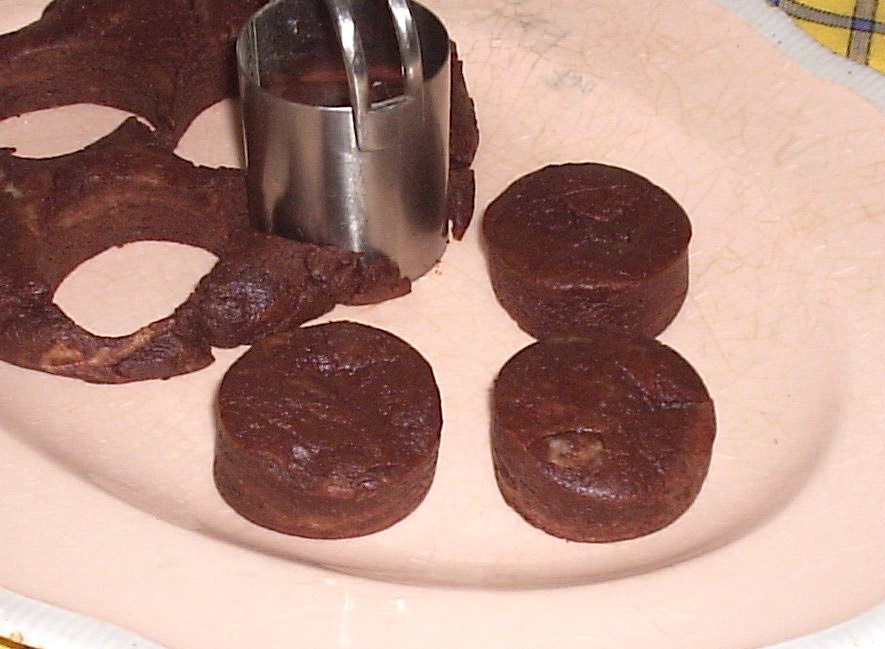
A royal treat for this month's Sugar High Friday . . . Dark Chocolate
Massepains de Chocolat
Echaudez deux livres d’almandes douces, lavez le dans de l’eau fraîche, pilez les bien dans un mortier; faites cuire une livre de sucre à la plume, mettez les amandes dedans; desiechez la pâte à petitfeu, tirez la de la poële, and la mettez refroidir, and quand elle sera froide, vous y mettrez trios onces de chocolat pilé and passé au tamis, and un blanc d’œuf, que vous manierez le tout ensemble; vous pourrez former une a baisse d’une partie de ladite pâte, and la découperez avec des moules de fer-blanc, and en passer aussi a la seringue: ceux qui seront découpez, vous les pourrez glacer d’une glace Royale, comme ceux ci-dessus. Le Massepain de Canelle se fait de même.
Massialot, François. “Massepains de Chocolat.” NOUVELLE INSTRUCTION POUR LES CONFITURES, LES LIQUEURS ET LES FRUITS. Trans. Carolyn Smith-Kizer. Chez Claude Prudhomme, Paris, 1716, pp. 205-6.
Chocolate Marzipan
Scald two pounds of sweet almonds; wash them in fresh [cold] water [this should make the brown skins slip off when you rub them with your hands or a clean towel]; crush them well in a mortar; cook a pound of sugar to the feather [stage] (Hess* identifies the temperature as 232ºF, Recipe S6, "grand soufflé or feather."); put almonds inside [add to sugar]; desiccate the paste with a small fire, withdraw from the stove, and put it to cool [pouring onto a marble slab is best], and when it is cold, you will put [mix] in three ounces of crushed, sifted chocolate, and an egg white; that you will handle the whole together [knead on your marble slab]; you will be able to form the aforesaid paste into one mass, and will cut it out with tinplate moulds, and to also pass some to the syringe [extrude shapes from a pastry bag with tips]: those which will be cut out, you will be able to frost them with a Royal icing, like those above [massepains de pistache]. The Cinnamon Marzipan cake is done in the same way.
*Karen Hess(Martha Washington's Booke of Cookery)
Tuesday, October 18, 2005
Thon en sauce à poivre - Tuna in Pepper Sauce
Attendez jusqu'à ce que vos poivres soient rouges et bien mûrs ; suspendez chacun sur une fourchette au-dessus des charbons jusqu'à ce que la peau tourne le noir et ait boursouflé. Placez dans une cuvette et une couverture pendant plusieurs minutes jusqu'à ce que vous puissiez effacer la peau ou l'éplucher au loin. Ouvrez les poivres et enlevez les graines et les membranes intérieures et découpez la chair. Employez un poivre par personne à servir.
Font sauter un oignon doux, découpé et un ail de clou de girofle, haché en huile d'olive jusqu'à ce que translucide au-dessus d'une flamme lente. Ajoutez les poivres découpés et fermentez doucement jusqu'à ce que vous prenniez une sauce épaisse et riche. Réservation, chaude.
Le sel et poivrent votre bifteck de thon et dessèchent en beurre clarifié des deux côtés jusqu'à fait à votre goût. Service avec de la sauce chaude à poivre ; arrosez avec le lard ou la saucisse fini gauche emietté de boeuf.
* * * * *
This edition of Blog Appetit focuses on tuna and peppers.
Wait until your peppers are red and fully ripe; suspend each on a fork over the coals until the skin turns black and blistered. Place in a bowl and cover for several minutes until you can rub the skin off or peel it off. Open the peppers and remove seeds and inner membranes and dice the flesh. Use one pepper per person to be served.
Saute one sweet onion, diced and one clove garlic, minced in olive oil until translucent over a slow flame. Add diced peppers and gently simmer until you have a thick, rich sauce. Reserve, warm.
Salt and pepper your tuna steak and sear in clarified butter on both sides until done to your taste. Serve with warm pepper sauce; sprinkle with crumbled left over beef bacon or sausage
Font sauter un oignon doux, découpé et un ail de clou de girofle, haché en huile d'olive jusqu'à ce que translucide au-dessus d'une flamme lente. Ajoutez les poivres découpés et fermentez doucement jusqu'à ce que vous prenniez une sauce épaisse et riche. Réservation, chaude.
Le sel et poivrent votre bifteck de thon et dessèchent en beurre clarifié des deux côtés jusqu'à fait à votre goût. Service avec de la sauce chaude à poivre ; arrosez avec le lard ou la saucisse fini gauche emietté de boeuf.
This edition of Blog Appetit focuses on tuna and peppers.
Wait until your peppers are red and fully ripe; suspend each on a fork over the coals until the skin turns black and blistered. Place in a bowl and cover for several minutes until you can rub the skin off or peel it off. Open the peppers and remove seeds and inner membranes and dice the flesh. Use one pepper per person to be served.
Saute one sweet onion, diced and one clove garlic, minced in olive oil until translucent over a slow flame. Add diced peppers and gently simmer until you have a thick, rich sauce. Reserve, warm.
Salt and pepper your tuna steak and sear in clarified butter on both sides until done to your taste. Serve with warm pepper sauce; sprinkle with crumbled left over beef bacon or sausage
Thursday, October 06, 2005
Kitchen Invitation
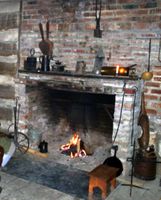
I was tagged by Andrew to ask you into my kitchen. Come in and warm yourself by the fire; have a seat and I'll put the kettle on for chocolat.
My kitchen, a place of warmth and cheer.
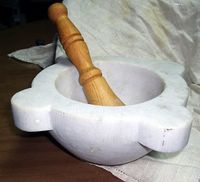
My favorite appliance--it requires lots of elbow grease!
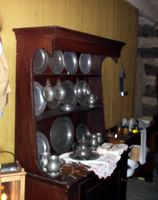
My one and only cupboard which holds my pewter dishes.
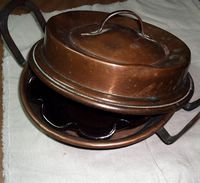
My favorite cooking pan--my tourtiere--I can keep ashes out of my pies and yet brown them beautifully.
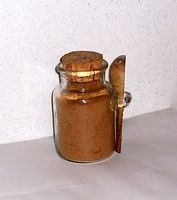
My favorite ingredient--a spice mixture I use in many meat and savory dishes.
I would like to tag Danno to carry on this meme with the following rules:
1) Show us your kitchen ( a picture) and tell us what is it about this place that reflects your own personnality.
2) Open a cupboard (the one you feel to open), take a picture and tell us what we see.
3) Present us your favorite kitchen-based electrodomestic tool.
4) Take out the ingredients you like the most, the ones you always keep stored.
5) My little steel friend: present us to your favorite cooking/baking receipient.
My kitchen, a place of warmth and cheer.
My favorite appliance--it requires lots of elbow grease!
My one and only cupboard which holds my pewter dishes.
My favorite cooking pan--my tourtiere--I can keep ashes out of my pies and yet brown them beautifully.
My favorite ingredient--a spice mixture I use in many meat and savory dishes.
I would like to tag Danno to carry on this meme with the following rules:
1) Show us your kitchen ( a picture) and tell us what is it about this place that reflects your own personnality.
2) Open a cupboard (the one you feel to open), take a picture and tell us what we see.
3) Present us your favorite kitchen-based electrodomestic tool.
4) Take out the ingredients you like the most, the ones you always keep stored.
5) My little steel friend: present us to your favorite cooking/baking receipient.
Sunday, September 18, 2005
Farced Eggs

Wood platter Old Bedford Mercers
One of the ways that La Varenne uses eggs for an entree is to farce them.
"Take some hard eggs, cut them into halfes, across or in length, and take out the yolks, and mince them with your farce" (in this case, I used mayonnaise), and "put to it a little nutmeg."
Also consider sautéing the minced (mashed) yolks in a little browned butter instead of mayonnaise--in which case, the nutmeg may be more in line with our current tastes. Nutmeg is not a spice we ordinarily think of in use with eggs, but it is an interesting flavor.
The French Cook, François Pierre La Varenne, Englished in 1653.
Wednesday, September 07, 2005
French Chocolate Cake
Clothilde hosts Wine Blogging Wednesday today and has chosen a wine that will taste great with chocolate. Here is my recipe for a rich, decadent chocolate cake. I often serve this cake or pots de crème when I'm out to impress as the end of a five-course meal . I always preface this dessert with a green salad dressed with vinaigrette to cleanse the pallate and to prepare for the intense enjoyment of chocolate and raspberry wine.
French Chocolate Cake
8 squares (8 oz) bittersweet chocolate, chopped into small pieces
2 sticks butter, cut into small pieces
1/2 cup sugar
2 tablespoons Armagnac
4 eggs
1 tablespoon flour
Powdered Sugar and a lacy doily
Crème fraîche for serving
Preheat your oven to medium heat (350F). Grease a 9' spring form pan with butter. Line the base with waxed paper and grease the paper. Wrap the bottom of the pan with foil to keep water from seeping in.
Melt butter, chocolate and sugar together over low heat. Remove from heat and stir in the Armagnac.
Beat eggs for 50 strokes. Beat in flour, then slowly fold in the chocolate mixture. Pour into your prepared pan.
Place the springform pan into a larger pan and place it into the oven. Pour enough boiling water around the springform pan to come more than halfway up the sides. Bake about 30 minutes, or until a broom straw inserted in the middle comes out clean. Remove the cake pan and set it on a rack to cool. The center may sink or crack--it's okay.
When the cake is almost cold, turn it out and over onto a serving plate and carefully peel back the paper. The bottom is now the top, so any cracks or sinking will be disguised.
At serving time, place a doily on top and sift powdered sugar through the lace. Cut into slices and serve with crème fraîche.

Frambrosia Oregon Raspberry wine takes the category of "berry wine" to a new height. Fine wine shops and restaurants seek out this wine for its pure, concentrated depth of flavor, and its ability to match exquisitely with a wide range of desserts. As an alternative to late harvest wine, port, or sherry -- Frambrosia is a delight to anyone who enjoys the true essence of this marvelous fruit." This wine was brought by a guest one evening--he had called before coming to ask if he could bring a wine that would go with dessert--he couldn't have made a better choice.
French Chocolate Cake
8 squares (8 oz) bittersweet chocolate, chopped into small pieces
2 sticks butter, cut into small pieces
1/2 cup sugar
2 tablespoons Armagnac
4 eggs
1 tablespoon flour
Powdered Sugar and a lacy doily
Crème fraîche for serving
Preheat your oven to medium heat (350F). Grease a 9' spring form pan with butter. Line the base with waxed paper and grease the paper. Wrap the bottom of the pan with foil to keep water from seeping in.
Melt butter, chocolate and sugar together over low heat. Remove from heat and stir in the Armagnac.
Beat eggs for 50 strokes. Beat in flour, then slowly fold in the chocolate mixture. Pour into your prepared pan.
Place the springform pan into a larger pan and place it into the oven. Pour enough boiling water around the springform pan to come more than halfway up the sides. Bake about 30 minutes, or until a broom straw inserted in the middle comes out clean. Remove the cake pan and set it on a rack to cool. The center may sink or crack--it's okay.
When the cake is almost cold, turn it out and over onto a serving plate and carefully peel back the paper. The bottom is now the top, so any cracks or sinking will be disguised.
At serving time, place a doily on top and sift powdered sugar through the lace. Cut into slices and serve with crème fraîche.
Frambrosia Oregon Raspberry wine takes the category of "berry wine" to a new height. Fine wine shops and restaurants seek out this wine for its pure, concentrated depth of flavor, and its ability to match exquisitely with a wide range of desserts. As an alternative to late harvest wine, port, or sherry -- Frambrosia is a delight to anyone who enjoys the true essence of this marvelous fruit." This wine was brought by a guest one evening--he had called before coming to ask if he could bring a wine that would go with dessert--he couldn't have made a better choice.
Subscribe to:
Posts (Atom)
