Marinade.
Est une sausse dans laquelle on met tremper les choses aux quelles on veut relever la saveur, & les rendre plu agréables au goût. On met differentes choses en Marinade, ou pour garnir d'autres plats, ou pour en faire de cela même. On garnit des Fricassées de Poulets, d'autres Poulets en Marinade: la Marinade de Veau sert à garnir des Poitrines de Veau farcies, ou Longes de Veau rôties; & ainsi du reste, comme Pigeons, Perdrix, & autres, dont on peut aussi faire des plats separez pour Entrèes. Parcourons de qu'il y a à observer là-dessus.
Marinade.
Is a sauce in which one puts to soak to increase flavor, & to tenderize. One puts various things in Marinade, depending upon the desired result. Used with Chicken fricassèes, & other Chickens in Marinade: the Veal Marinade is used with the stuffed breast of veal, or roast Veal Loin; also used with Pigeons, Partridge, & others, including vegetables or salads.
Le Cuisinier Nouveau Royal et Bourgeois, Massialot, François. Chez Prudhomme, Paris 1734, Vol I.
Etymology: French, from Marinate to pickle, marinate, probably from Italian marinare
Date: 1725, usually a savory acidic sauce in which meat, fish, or a vegetable is soaked to flavor or tenderize it.
Mariner: se dit des viandes, ou poissons aux quels on donne un goût de marine; par cette préparation, en les mettant dans l'huile ou le vinaigre, avec des herbes fortes, on les conserve quelque tems. On marine des huitres & des champignons, &c.
To marinate: said of meats, or fish; used to give a taste of marinade; by using this preparation, putting them in oil or the vinegar, with strong herbs, one preserves them some time. One marinates oysters, mushrooms, &c.
Marinade: espece de préparation qu’on fait aux viandes, en les laissant tremper quelque tems dans une sauce de vinaigre, avec sel, poivre & épices, cloux, citrons, oranges, oignons, romarins, sauge, &c. pour en relever la saveur, & leur donner plus de relief au goût.
Marinade: type of preparation used with the meats, by letting them soak some time in a vinegar sauce, with salt, pepper & spices, cloves, lemons, oranges, onions, rosemary, sage, etc., & to highly season or to enhance the taste.
Dictionnaire Portatif de Cuisine, d'Office, et de Distillation. Chez Vincent, Paris 1767

Friday, February 12, 2010

Saturday, November 28, 2009
Crackling Crust for Marmelade and Cheese

 Crackling crust another way used to form a rustic tart baked on paper and filled with a jar of very old plum jam I couldn't bear to throw away. I seasoned it with a few grinds of black pepper to cut the cloying taste of the jam. As you can see from the crumbs on the plate, my husband had more than one piece. Pepper with sweets is an old taste, but a very interesting one and very good. The crust was so delicious that I tried it with sweetened cheese, as well. Superb with coffee for breakfast or dessert!
Wednesday, November 18, 2009
Preparing for treize (13) desserts …
 Image Source
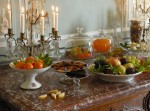
Groaning holiday tables, after le «gros souper», reflect the special treats, a little something for everyone, known as treize (13) desserts, one for each of the 12 apostles and Christ. Now is the time to begin to gather the ingredients for the preparation of items such as pâte de coigns, nougats, calissons, dried fruits and nuts. Fresh fruits known as winter (meaning their flavor and texture will improve with storage) apples, pears and melons can be sat back in special boxes and nets to bring out at the last minute. Fondant stuffed dates and nutmeat farced figs and an assortment of nuts can be cured in paper-lined boxes with bay leaves which can then be used to dress they plate when serving these sweetmeats. Chocolates and fresh citrus fruits will round out the menu.
Thursday, November 12, 2009
Raifort - voyez Rave
Horseradish was used in Alsace in many ways and was taken to New France. Grated fresh it is used as a preventive against food poisoning, scruvy, tuberculosis and colic; cooked it's used in sauces with meats and soups. It is considered a bitter herb and has been used medicinally for centuries. Depending upon how young your horseradish patch is, it is best gathered in Spring. If your patch is old, dig the roots in Fall, and process only the smallest and most tender. Disburbing the patch will result in smaller and more numerous roots for next Spring.*** Dictionnaire Portatif de Cuisine, d'Office, et de Distillation. Chez Vincent, Paris 1767, p. 275. ***** RAVE: on en distingue de plusiers sortes, sçavoir, celle qu'on appelle communément rave, ou petit rave; le grand & le petit raifort, & autres. On ne mange guère de ces trois especes, que celle qu'on appelle raves & radis. Le printems est le tems où el es sont meilleures: il faut les choisir tendres, bien nourries & faciles à rompre. Lorsqu'il fait chaud, elles deviennent trop piquantes.
OBSERVATION MÉDECINALE.
La rave est stomachique, apéitive, anti-scorbutique; mais comme elle se mange crue, elle ne convient qu'aux estomacs, & à ceux qui la mâchent bien.
OBSERVATION MÉDECINALE.
La rave est stomachique, apéitive, anti-scorbutique; mais comme elle se mange crue, elle ne convient qu'aux estomacs, & à ceux qui la mâchent bien.
Tuesday, November 10, 2009
Raifort - Horseradish
 Cool, brisk weather means it's time to dig the raifort - horseradish roots to grind and preserve in white wine vinegar. After several weeks, the vinegar makes a wonderful liquid to deglaze fond and to flavor vinaigrette. The root itself flavors soups, sauces and roast meats.
Scrub and peel the roots; grind and store in a jar covered with vinegar--lasts virtually forever!
Thursday, October 15, 2009
Calville Rouge d'Automne
 Well, I finally harvested the one apple that has been hanging on my little tree. The tag said just Calville when I planted it early in 2008. This spring the flowers were double and white, not pink as the print suggests. The skin is pale red with a tinge of yellow. Its taste is sweet, slightly strawberry or tart in flavor; its flesh crisp and juicy. Its texture would make great baked apples.
  There were several small bumps or ribs on its blossom end. There is only one problem--I asked for a Calville Blanc d'Hiver (1598), not Rouge d'Automne (1670), from the nursery. I shall have to reorder a Calville Blanc.
Saturday, October 03, 2009

Thursday, October 01, 2009
… in the hands of the cook …
«The strength of the nation is in the hands of the cook. Feed a man well, he will work well, he will fight well.» Handwritten inscription, Célestine Eustis, 1911, from Cooking in old Créole days. La cuisine créole à l'usage des petits ménages. Eustis, Célestine.
Thursday, September 24, 2009
When You Can't Have the Real Thing …

One of the first faience patterns produced in the French town of Luneville c. 1728 by Jacques Chambrette was «Old Strasbourg», a brilliant polychrome made possible by the pure white of the tin glaze. I have a few pieces, but not enough to set a table for more than one--and my husband shudders every time I take them to a reenactment. But the pattern was so popular that it has been copied by Spode with variations; and also by Royal Doulton, now Minton, known as «Arcadia».

As you can see, I have a few pieces of Arcadia; it was, indeed, the pattern I chose as my wedding china.

Imagine my delight when that wonderful carrier pigeon, eBay, procured Arcopal «Provincial» in milk glass from France. Now I can serve a table of ten with several courses. Now to get to those French recipes again to grace these lovely dishes!
Friday, September 18, 2009
Doll House Kitchens -Mon Plaisir, Arnstadt (1666-1751)
«Mon plaisir (My pleasure) is a miniature city of the princess Augusta Dorothea of Schwarzburg Arnstadt (1666-1751) for dolls. Thereby the reproduction of the reality at that time with aristocracy, middle class and farmer was aimed at. Is populated the doll city of over 400 dolls, which were made by the yard state of the princess in manual work. Since 1932 the entire plant is in the possession of the museum donation.»
A wonderful YouTube video of this exquisite creation. From the flamestitch tapestries to the kitchen pots and pans you are presented with intricate tableaux of 18thC life … enjoy!.
A wonderful YouTube video of this exquisite creation. From the flamestitch tapestries to the kitchen pots and pans you are presented with intricate tableaux of 18thC life … enjoy!.
Monday, July 27, 2009
The Amadeus Award for Taste & Excellence

18thC Cuisine is among the first to be awarded the coveted Amadeus Award for Taste & Excellence, a privilege to be cherished and a great responsibility to further its continuance by nominating my own favorite 18thC blogs.
Isaac Walters, a fellow reenactor and friend whom I first met at Fort de Chartres, is a historian and teacher who is furthering living history by reenacting with his young family.
18th-Century History of American Women and her companion blogs about gardening and women of other American centuries is Barbara's marvelous contribution to the Age of Enlightenment.
Mme. du Jards Atelier is a delightful site for embroidered garments and frolics à la 18thC.
Les Portraits au Pastel du XVIIIe is Jean Paul's lovely site where portraits that might not otherwise be seen are freely shared.
Colonial Women is not a blog, but a portal into living history in the vast French Colonial interior of our wonderful country. Carol, almost single-handedly, has done much to raise the barre of women's interpretations in the Pays Illinois.
Now it is time for these wonderful sites to send us further down the road to 18thC excellence.
Tuesday, June 30, 2009
Poulpette à l’Italienne
 Add a drop of Peau d’Espagne to either a bit of warm, freshly brewed tea or spirits and pour over dried Grapes of Corinth to plump them up. Make a farce of finely chopped meat to which you add grated Parmesan, pinions and your plumped raisins and any leftover liquid. Mix well and shape into flat, boat shaped poulpettes [meatballs]; flour and brown in butter. Arrange in a baking dish and pour over a coulis of Partridge [I used browned chicken broth and used it to deglaze the fond from the pan used to brown the poulpettes]. Bake until hot and bubbly and serve immediately.
The Peau d’Espagne will embue your kitchen with aromas redolent of eastern bazaars—heady and delicious!
Poulpette à l’Italienne.
Vous faites une farce cuite à l'ordinaire, point trop fine, & liée d'œufs, de bon goût; vous mettez dedans Parmesan rapé, pignons, raisins de Corinthe entiers; vous mélez bien le tout, & vous roulez vos Poulpettes comme des croquettes, mais plates, & le farinez; vous avez une tourtiere, vous mettez du beurre dedans, & le faites fondre, & arrangez les Poulpettes dedans, & les faites cuire des deux côtés vous faites un bord au plat de la même farce, & le faites cuire; & étant cuit, vous arrangez vos Poulpettes dedans, & vous avez un appareil de peau d'Espagne à l'ordinaire avec un coulis de Perdrix passé à l'Italienne, vous plissez votre plat & les mettez prendre au four, étant cuits, servez chaud; une demie heure au four.
Le Cuisinier Gascon. A Amsterdam. 1740, p.29.
Sunday, June 28, 2009
Peau d'Espagne
 Peau d’Espagne is a combination of flower and spice oils that is used to impregnate leather with scent. To further enhance the exotic smell, civet (cat musk) and grain musk (obtained from the wild deer whose grain [gland] you see here) are added to gum (tragacanth) mucilage which is used to secure two pieces of leather together under pressure. The resulting Spanish Leather is then used to scent writing paper, ladies gloves & linens—the scent is reputed to last for years. However, the peau d’Espagne can also be used to add flavor to meat dishes.
In the kitchen, use a drop of oil in a carrier oil, such as olive, poured over a dish at the last minute prior to serving, much as one does orange or rose flower water—the heat of the dish will waft a delightfully exotic aroma. Or it can be added to warm tea or spirits used to plump up dried fruit before its inclusion in a receipt.
To scent one’s body, perhaps, is its best use today …
«This fragrance lingers on everything it touches like a rugged kiss from a cowboy soaked in campfire smoke and saddle leather sweat. It smells like the sexiest man you've ever seen in your life, taking a hot outdoor bath in a tin tub, smeared with sweet shaving lather and dust, steaming on a cold high-desert morning.»
«More specifically, according to Havelock Ellis:
“Peau d'Espagne may be mentioned as a highly complex and luxurious perfume, often the favorite scent of sensuous persons, which really owes a large part of its potency to the presence of the crude animal sexual odors of musk and civet. It consists of wash-leather steeped in ottos of neroli, rose, santal, lavender, verbena, bergamot, cloves, and cinnamon, subsequently smeared with civet and musk. It is said by some, probably with a certain degree of truth, that Peau d'Espagne is of all perfumes that which most nearly approaches the odor of a woman's skin; whether it also suggests the odor of leather is not so clear”.»
«1355. Peau d'Espagne, or Spanish Skin, is merely highly-perfumed leather. Take of oil of rose, neroli, and santal, each 1/2 ounce; oil of lavender, verbena, bergamot, each 1/4 ounce; oil of cloves and cinnamon, each 2 drachms; in this dissolve 2 ounces gum benzoin. In this steep good pieces of waste leather for a day or two, and dry it over a line. Prepare a paste by rubbing in a mortar, 1 drachm of civet with 1 drachm of grain musk, and enough gum-tragacanth mucilage to give a proper consistence. The leather is cut up into pieces about 4 inches square; two of these are pasted together with the above paste, placed between 2 pieces of paper, weighted or pressed until dry. It may then be inclosed in silk or satin. It gives off its odor for years; is much used for perfuming paper, envelopes, etc.; for which purpose 1 or 2 pieces of the perfumed leather, kept in the drawer or desk containing the paper, will impart to it a fine and durable perfume.»
Encyclopedia Of Practical Receipts And Processes, by William B. Dick.
Receipt de Cuisine:
Used in Poulpette à l’Italienne – Italian Meatballs
Saturday, June 27, 2009
Exotic Ingredients - Their Receipts & Lores
Today, with our often times bland tastebud experiences, the idea of eating a dish with exotic ingredients, e.g., tastes that we associate with perfumery, may seem off-putting. With this post, I will be creating a sidebar to include exotic ingredients, their receipts for manufacture, lore and links to 18thC recipes in which they were included.
Friday, June 26, 2009
Greens of Summer

Subscribe to:
Posts (Atom)
