Saturday, February 24, 2007

Darioles

Whereas before mid-17thC the pastrycooks seldom revealed the trade secrets of the paste [pastry], the pastissier François reveals them all: including the fine paste which is used for pies and the tarts. However, the medieval pie of the can type [raised] remains, even if its decline starts. Darioles are of this raised pie type.

Raised pies usually used a heavy crust formed around a mold which was removed, allowing the pie crust to stand in the shape desired. It was filled and brushed with an egg wash that not only helped to act as a glue to keep the crust together but also results in the name, dorage or doré—gilded crust, dariole being a small, almost bite-sized version. But as you can see from the second recipe, dated 1767, the dariole crust was being seen as heavy and was not being eaten, hence the distinctive molds to shape and cook the custards as we see today.

Darioles
Break in a pot [bowl] seven to eight fresh eggs, & whip them well with a quart of your best white flour, add a little salt with discretion; you may add caster sugar if you wish: when that is well stirred, pour milk little-by-little stirring after each addition the quantity that is necessary, as if you want to make [pudding]: when it is well stirred, cook it on a fire like [custard pudding]: cook and stir it [until it is thickened], pour it in[to] another pot [to cool so it won’t separate], then make a fine paste [pastry crust], form the darioles any size you wish [over the outside of a mold or pinch them with your fingers as in a pinch-pot-- the pastissier François says they are to be no more than two fingers-width high], & leave them to dry & harden in the air on a shelf; when they are well dried, you will fill them with the cooked [pudding] an inch deep, & will spread it also everywhere [into the corners of the crust]; add a little piece of fresh butter on top & will bake them in the oven on greased paper or on a dusting of flour; one needs only one quarter hour to cook them: once cooked, withdraw them from the oven, powder them with sugar, & put a small drop of orange-or rose-flower water on top.

La nouvelle maison rustique, ou, Économie generale de tous les biens de campagne: la manière de les entretenir & de les multiplier : donée ci-devant au public / par le Sieur Louis Liger. Paris : Saugrain, 1755, Tome II, IV. Part. LIV. IV. Chap. I. La Cuisine. B., p. 860.

Darioles
Cassez dans une terrine sept à huit œufs frais, & les délayez bien avec un litron de fleur de farine, mettez-y du sel menu à discretion; vous pou-vey y mettre du sucre en poudre si vous souhaitez: quand cela sera bien délayé, versez-y peu-à-peu du lait la quantité qu’il en faut, comme si vous vouliez faire de la bouillie: le tout étant bien délayé, faites le cuire sur le feu aussi comme de la bouillie: étant cuite, tirez-la & la versez dans une autre terrine, puis faites une pâte fine, formez les darioles de la grandeur que vous souhaitez, & les laissez ressuyer & raffermir à l’air sur une planche; quand elles seront bien ressuyées, vous les garnirez de la farce cuite de l’épaisseur d’un pouce, & l’étnedrez également par-tout; vous mettez dessus un peu de beurre frais par petits morceaux & les ferez cuire au four sur du papier graissé de beurre ou poudré de farine; il ne faut qu’un quart-d’heure pour les cuire: étant cuites, tirez-les, poudrez-les de sucre, & mettez-y une petite goutte d’eau de fleur d’ornage ou d’eau rose.

* * * * *

Darioles a small piece of pastry.
Put in a pot a quart of flour; break two fresh eggs there; beat with a spoon, & pour there, for better softening, little-by-little some milk, salt & [sweet] butter, which you consider suitable [this preamble of stirring a dense mass helps to break up any lumps prior to stirring in the rest of the liquid]. Once it’s well softened [no lumps], still add a pint of milk, or similar quantity of almond milk; but then one needs a little more flour. When that is in consistency of cream [smooth], one fills some small tart shells made of fine paste, but well wiped & closed undercrusts [tightly formed pastry brushed with egg wash so that the filling will not leak]; cook the darioles in the oven. When they are cooked, one puts on each one a small piece of butter, powders them with sugar, & puts a little orange flower water on top. This pastry shell and all the ingredients which make it up are very healthy naturally.

Dictionnaire Portatif de Cuisine, d'Office, et de Distillation. Chez Vincent, Paris 1767, p. 213.

Darioles - Petite piece de patisserie.
Mettez dans une terrine le quart d’un litron de fleur de farine; cassez-y deux œufs frais; délayez avec une cuillere, & versez-y, pour mieux détremper, du lait petit-à-petit; du sel & beurre frais, ce que vous jugez convenable. Le tout bien détrempé, ajoûtez encore une chopine de lait, ou pareille quantité de lait d’amandes; mais alors il faut un peu plus de farine. Quand cela est en consisstance de crême, on en remplit de petites abaisses faites de pâte à tartes, mais bien essuyées & fermées; on met les darioles au four. Quand elles sont cuites, on met sur chacune un petit morceau de beurre; on les poudre de sucre, & on y met un peu d’eau de fleurs d’orange. Cetre patisserie paroît d’autant plus faine, que tous les ingrediens qui la composent sont très – sains de leur nature.

Tuesday, February 13, 2007

Rissoles

Take whitemeat [breast] of poultry or fillet of veal cooked, chop it on a table [cutting board] with a little parsley & Welsh onion [scallions], add a little bacon & some small mushrooms; after it’s well chopped together, crush it in the mortar while adding egg yolks to bind the forcemeat, season it well. Cut small undercrusts of fine paste [squares or triangles], & wrap each undercrust around a small nut [tablespoon] of forcemeat, & when your rissoles all are prepared, fry in lard or [graisse] which is hot like making fritters: when the crust turns golden on one side, turn the rissoles on other side with a small stick without bursting them, & when they are well [colored] on both sides, withdraw them from the fat with a skimmer, & serve warm.
On fast days, fill [rissoles] with a fish farce, & fry them in butter [fish and butter are not considered meat or meat grease, which is not allowed on a fast day].

La nouvelle maison rustique, ou, Économie generale de tous les biens de campagne: la manière de les entretenir & de les multiplier : donée ci-devant au public / par le Sieur Louis Liger. Paris : Saugrain, 1755, Tome II, IV. Part. LIV. IV. Chap. I. La Cuisine. B., p. 845.

RissolesPrenez du blanc de volaille ou de la rouelle de veau cuite, hachez-la sur une table avec un peu de persil & de ciboule, mettez-y un peu de lard & quelques petits champignons; le tout bien haché, pilez-le encore dans le mortier, mettez-y des juanes d’œufs, le tout bien assaisonné, faites de petites abaisses de pâte fine bien minces, & enveloppez dans chaque abaisse gros comme une petite noix de farce, & lorsque vos rissoles seront toutes façonnées, il faudra les frire dans du sain-doux qui soit chaud comme pour faire des beignets: quand la croûte paroîtra juane d’un côté dans le sain-doux, vous tournerez les rissoles de l’autre côté avec un petit baton sans les crever, & quand elles seront bien rissoles des deux côtés, il faudra les tirer à sec avec une écumoire, & les server chaudement.
On en peut faire en maigre avec une farce de poisson, & les frire dans du beurre.

Sunday, February 11, 2007

Tourte of foie gras

Make an undercrust of fine paste & put it in a tart plate, put grated bacon on the bottom, season it with salt and pepper & a little sweet herbs, arrange the livers next & finish with tips of mushrooms, morels, will foams & truffles; season like the lower part, & cover the whole with very thin veal slices & bacon slices, cover the tourte with a second crust, gild it with eggs & put it to bake in the oven; once cooked, take it out and remove the top section of crust [carefully], remove the sections of veal & the slices of bacon [save these for hash or a farce], degrease it & add a little ham essence, replace the upper crust, reheat it & serve.

La nouvelle maison rustique, ou, Économie generale de tous les biens de campagne: la manière de les entretenir & de les multiplier : donée ci-devant au public / par le Sieur Louis Liger. Paris : Saugrain, 1755, Tome II, IV. Part. LIV. IV. Chap. I. La Cuisine. B., p. 849.

Tourte de foies gras
Dressez une abaisse de pâte fine & la mettez dans une tourtiere, mettez dessus du lard rapé, l’assaisonnez de sel, de poivre & un peu de fines herbes, rangez les foies dessus & garnissez de crêtes, de champignons, morilles, mousserons & truffes assasisonnés comme le dessous, & couvrez le tout de tranches de veau bien minces & bardes de lard, couvrez la tourte de l’autre abaisse, dorez-la d’œufs & la mettez cuire au four; étant cuite, tirez-la & la découvrez, ôtez-en les tranches de veau & les bardes de lard, dégraissez-la & y mettez un peu d’essence de jambon, recouvrez-la & la servez chaudement.

Thursday, February 01, 2007

Middle-class Soups - Potages Bourgeois

Cover a good piece of beef [a haunch or a slice], with water in a cooking pot, & when the pot boils half an hour, after skimming the foam, add mutton, a knuckle of veal, & poultry as much as you want; also add salt & three cloves, & let it boil [again until meats are tender]. One hour or half an hour before serving, add herbs with a few cucumbers or root vegetables according to the season, & [some] verjuice: *[ladle] soup onto croutons or [slices or pieces] of dried bread in a serving bowl, simmer on embers [slowly re-warm], & add bouillon as it is consumed [the bread absorbs it].

*Before adding soup to bread, one can add to [hot] soup two egg yolks [beaten] with half-glass of verjuice & a little bouillon, stirring them in well to set the egg.

The title of this soup, middle-class or Bourgeois, infers that there is a difference in the soup of the lower class. This is, indeed, true. This soup has meat, in fact, more than one type of meat. Although this soup would be usual at the table of the gentry living in the country (as the title of the book implies [The New Country House]), the servants or the lower class would most likely not have meat(s) in their soups, but simple fare of vegetables and grains. Notice though that the gentry also sop up the last drop of broth with bread, using bread as an integral part of the soup. Waste not, want not.

La nouvelle maison rustique, ou, Économie generale de tous les biens de campagne: la manière de les entretenir & de les multiplier : donée ci-devant au public / par le Sieur Louis Liger. Paris : Saugrain, 1755, Tome II, IV. Part. LIV. IV. Chap. I. La Cuisine. B., p. 840.

Potages Bourgeois
Mettez de l’eau dans une marmite avec un bon morceau de bœuf de cimier ou de tranche, faites-la écumer, & quand le pot aura bouilli une demi-heure, mettez-y du mouton, un jarret de veau, & une volaille se vous en voulez; ajoutez-y du sel & trios clous de girofle, & le laissez bouillir. Une heure ou demi-heure avant que de dresser, vous mettrez des herbes avec un peu de concombres ou de raciness suivant la saison, & du verjus en grain: ayant dressé le potage sur des croutons ou du pain séché, faites-le mitonner sur de la braise, & mettez du bouillon à mesure qu’il sera consommé. On peut ajouter au potage deux jaunes d’œufs délayés avec demi-verre du verjus & un peu de bouillon, les ayant fait un peu blanchir auparavant sur le feu, & les verser sur le potage.

Thursday, January 25, 2007

Chocolat - From Bean to Confection

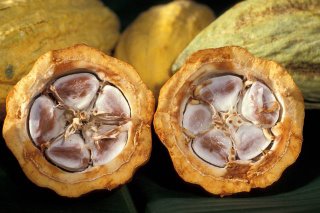
US Department of Agriculture photo
Chocolate is dry paste, made with cocoa beans, & sugar, to which vanilla or an infinity of ingredients that the inventive Americans add. One makes and stores tablettes [of prepared chocolate] in the [pantry]; one drinks it; one employs it to make creams. The chocolate cannot succeed, if one did not choose mature cocoa pods; the best known pods are of gall color [ripe and brown; inside the pod are beans both brown color & dark crimson; those which are red are not worth anything: they are the hard & bitter chocolate; but the quality of the cocoa will only be known after it is roasted; because then it is seen whether there are many of these red grains]. It is necessary that the cocoa is roasted in order to find the taste & the color of chocolate you desire.

To roast the chocolate to the appropriate color, put it [chocolate beans removed from the pulp] in a pan of copper or iron, or in an unglazed terracotta pot, and put it on the fire & stir it up constantly until it is black on the outside, like roasted chestnuts; for this first time, one cannot brown too much; then the cocoa should be peeled, & winnowed well [to remove the outsides of the seeds]; to see if it is roasted enough, it is best to make a test of it; take one ounce of cocoa, & an half-ounce of sugar, which you reduce to a paste to better distinguish the taste & the color; because if it is not brown enough, & if it does not feel roasted enough, one shouldn’t fear to roast it once again, but carefully, because once its bark is removed, it is burned easily; & takes a malicious taste.

When one reaches the proper color, smell and taste, one crushes it with the mortar, so that it is a rather tiny grained masse when some is put on a plate. When the paste of the chocolate approaches this fine grain, it is necessary to add to it vanilla*, & a little powdered cinnamon[or other spice and flavor]; the quantity depends on the will. The whole being mixed together, you add to it three quarters or a pound sugar, for a pound of cocoa; mix your sugar in well and put the mixture back into your mortar, and put it back in the mortar or put it on the stone [metate] or the iron pan heated below with a chafing dish or small fire; also get the roller [mano]: then reduce this compound powder until very fine, a paste will develop with pressure and heat; pass the roller above little-by-little, until it is fine when it does not crunch on the teeth; then tablettes of one ounce are formed, or rolls of a quarter or of half-pound.

*It is necessary to choose strong vanilla, not too dry, nor too fatty; because they are often mixed with oil of balsam [to preserve them], pare them to make sure they are good & fresh: they are very difficult to reduce to a powder; but after having cut them in small pieces with scissors, pulverize them & pass them by the sieve [before adding to the mortar].

Dictionnaire Portatif de Cuisine, d'Office, et de Distillation. Chez Vincent, Paris 1767, p. 156-158.

Sunday, January 21, 2007

Casserole [Stuffed Bread]

An interesting dish--I suppose it would depend upon the shape of your loaf of bread and whether you had a casserole or skillet to fit it--an oval or round dish would seem to work best.


Casserole [Stuffed Bread]
Take a [loaf of] soft bread whose crust is browned [implied here is a tough, chewy well-colored crust], & cut off the very bottom of the loaf and remove the soft insides, & reserve the crust [shell]: then mince [chop not shred] roast chicken or a fattened poulet [female or hen], with another kind of cooked meat; heat it [meats] in the pan, with [a little] good gravy & good seasoning, as if it were to prepare minced meat [in other words, a dry mixture, not soupy]: once it is heated through, carefully spoon some into the breadcrust [shell] which you will have dried completely on the inside by placing it in an oven & continue to put a little of this mince, layered with some of the soft bread insides torn in pieces and also dried in the oven, & completely fill with this mince & small crusts, then close [cover] it with the same part that you have removed by slicing off the bottom of it to remove the crumb of it. Take then a pan which is not larger than your bread, put on the bottom bacon bards [a slice of fatty meat or very well butter or grease the pan], & then the bread on the side which it was stuffed [turn right side up so the top of the filled bread is now uppermost], simmer in this manner with good gravy, made so that it cooks slowly and does not simmer [boil] too much, so that it is all entire [bread crust or what is now a bread bowl within the pan] and does not come apart, keeping it well covered [with gravy]. A little before serving, pour it onto a [serving] dish or platter, remove the bards [if used], drain off any grease & cover [pour over] your bread [garnish the plate] with a good ragout of calf sweetbreads, artichoke bottoms, truffles & asparagus tips around, according to the season.

Casserole au fromage
[Cheese Stuffed Bread]
It is prepared just as above, in the stuffed bread one puts a little grated Parmesan or other cheeses [layered with torn bits of bread instead of the minced meats]; & when the bread is cooked [in good gravy] & placed on its serving platter, one still powders [sprinkles over] it some of the same cheese of which one [stuffed it], & one makes him take a little color in the furnace [pass a red hot fire shovel over it or put it under the broiler], & when one is ready to serve, one puts the ragout around & one serves it warmly.

La nouvelle maison rustique, ou, Économie generale de tous les biens de campagne: la manière de les entretenir & de les multiplier : donée ci-devant au public / par le Sieur Louis Liger. Paris : Saugrain, 1755, Tome II, IV. Part. LIV. IV. Chap. I. La Cuisine. B., p. 806-7.


Casserole
Prenez un pain mollet dont la croûte soit dorée, & ne le chapelez point dessus, percez-le par dessous, & en ôtez la mie: ensuite ayez un bon hachis de poulets rôtis ou de poulardes, au autre sorte de viande cuite; passez-le à la casserole, avec bon jus & bon assaisonnement, comme si c’étoit pour faire un hachis: étant passé, il faut, avec une cuiller en mettre dans le pain que vous aurez fait sécher à l’air du feu du côté de la mie; & après y avoir mis un peu de ce hachis, vous y mettrez quelques petites croûtes de pain par morceaux, & l’acheverez de remplir de ce hachis & de petites croûtes, puis vous le fermerez de la même piéce que vous avez ôtez en le perçant pour en ôter la mie. Prenez ensuite une casserole qui ne soit pas plus grande que votre pain, mettez au fond des bares de lard, & ensuite le pain du côté qu’il a été farci, faites-le mitonner de cette maniere avec de bon jus, faites en sorte qu’il ne soit pas trop pressé ni trop mitonné, de façon qu’il soit tout entire, le tout bien couvert. Un peu auparavant que de server, versez-le sur un plat avec adresse, ôtez les bardes, égouttez un peu la graisse & couvrez votre pain d’un bon ragout de ris de veau, culs d’artichauts, truffes & pointes d’asperges autour, selon la saison.

Casserole au fromage
On l’apprête de même que ci-dessus, hors que dans le pain farci on y met un peu parmesan rapé ou d’autres fromages; & quand le pain est cuit & qu’on l’a dressé dans son plat, on le poudre encore du même fromage dont on s’est servi, & on lui fait prendre un peu de couleur dans le four, & lorsqu’on est prêt à server, on met le ragout autour & on le sert chaudement.

Saturday, January 13, 2007

Boudin of foie gras

A delicious way of using up those broken bits and pieces derived from preparing your foie gras.

Boudin of foie gras. Finely cut a quarter pound of pig fat, chop a pound of foie gras & as much of flesh of capon, season the whole of fine herbes [tarragon, chervil, parsley & burnet or chives], salt, pepper, crushed cloves [nutmeg is an option], six raw egg yolks & two pints of cream, fill of the bowels of pig, sheep or lamb, & simmer your boudin in milk [can use aromatics to flavor milk {carrots, onions, bouquet garni}]: once cooked, drain and roast [in the oven] on paper [directly on the floor of the oven] with a moderate fire for fear they do not burst, or fry in a little lard or another grease [to give it an appetizing color], & serve warm.

La nouvelle maison rustique, ou, Économie generale de tous les biens de campagne: la manière de les entretenir & de les multiplier : donée ci-devant au public / par le Sieur Louis Liger. Paris : Saugrain, 1755, Tome II, IV. Part. LIV. IV. Chap. I. La Cuisine. B., p. 803.

Boudin de foie gras. Coupez menu un quarteron de panne de porc, hachez une livre de foie gras & autant de chair de chapon, assaisonnez le tout de fine herbes, sel, poivre, clous pilés, six jaunes d’œufs cruds & deux pintes de crême, remplissez-en des boyaux de porc, de mouton ou d’agneau, & faites cuire votre boudin dans du lait: étant cuit, vous le mettrez griller sur du papier avec un feu médiocre de peur qu’ils ne crevent, y mettre un peu de sain-doux ou autre graisse, & servir chaudement.

Sunday, January 07, 2007

Chocolate Pots in Faïence

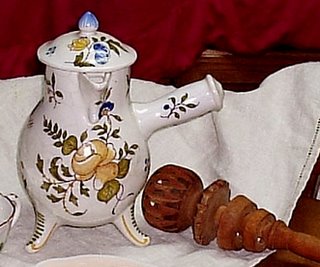
Savoring the Past, the French Kitchen and Table from 1300 to 1789, by Barbara Ketcham Wheaton p. 89 . . . "As a beverage, chocolate was usually prepared with water, though sometimes with milk. It was frothed with a chocolate stick--a stick with a carved knob and often rings, which was moved rapidly up and down in the mixture to produce a rich foam. They are still used in Spanish-speaking parts of the world (see your local Mexican import shop--they're called molenillos). chocolate pot with sparrow-billed spout and bulbous body, displayed with a molenillo: in this case, the molenillo is used without having a hole in the lidOrdinarily one chocolate tablet [my recipe for chocolate tablets] is used to a (four-ounce) cup, but the proportion is ten cups to the pound; so take as many tablets as you wish cups; melt the plain (unsweetened) chocolate in a coffeepot in which you have put water to the amount that you want to make; boil it and let it simmer a little over hot coals; when it is melted . . . mix the yolk of an egg with some (previously prepared) chocolate and put it in your coffeepot. Put it back over a gentle fire and stir well with the chocolate stick. It must not be allowed to boil at all after you have put the egg yolk in; the number of egg yolks nust be in proportion to the number of cups you make. You need one for four or five cups."

Another recipe for hot chocolate, this time the way it would have been prepared in Mexico before coming to Europe. The addition of chilis would make it even more authentic.

The following is my paraphrased summary of chocolate pots from thesis: Blanchette, Jean-Francois (Ph.D.: Anthropology, 1979, Brown University) Title: The role of artifacts in the study of foodways in New France, 1720-1760 : two case studies based on the analysis of ceramic artifacts.

"The chocolate pot [displayed with French Moulinets] is a pouring pot with a bulbous body and a horizontal handle. In 1690 Furetière described a chocolate pot as follows:
  • “a coquemart-silver or copper vessel in which chocolate is mixed with a twirl and cooked. Savary des Bruslons (1759) described the chocolate pot as follows:
  • “A type of pot, or coquemart with handle, and lid with holes in the centre, in which chocolate is melted and cooked. Most of the chocolate pots were copper; and others, silver.
Diderot does not mention the chocolate pot. However, the Supplement to the Encyclopédie in 1776-77 describes the chocolate pot as follows:
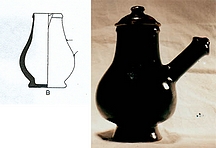
  •CHOCOLATE POT, (Domestic Economy),type of pot used for preparing the liquid food known as chocolate. Chocolate pots are made of silver, tin-plated copper, tin and earthenware. The latter are unsuitable, because once they are heated they continue to boil for a long time, which tends to evaporate the most exquisite flavour in the chocolate. Silver or copper ones have the disadvantages of being rounded at the bottom and a large quantity of the chocolate is not touched by the twirl. A truncated cone shape is the ideal shape for a chocolate pot. … The lid of the chocolate pot is pierced in the centre to give access to the handle of the twirl (the French style is called a moulinet). Faience brun chocolat pot egoiste from Michel Nichol, Potter, QuebecThis text is more detailed than the previous ones. Its author was somewhat confused, however, about the shape of the chocolate pot [and moulinets], which was sometimes bulb-shaped, sometimes in the shape of the truncated cone similar to the brown faïence coffeepot which Diderot illustrates in 1765."

Michel Nichol's reproduction 18thC pottery.

Sunday, December 31, 2006

Everyday Pouring Pots of Faïence


Blanchette, p. 59.

The following is my paraphrased summary of pouring pots from thesis: Blanchette, Jean-Francois (Ph.D.: Anthropology, 1979, Brown University) Title: The role of artifacts in the study of foodways in New France, 1720-1760 : two case studies based on the analysis of ceramic artifacts.

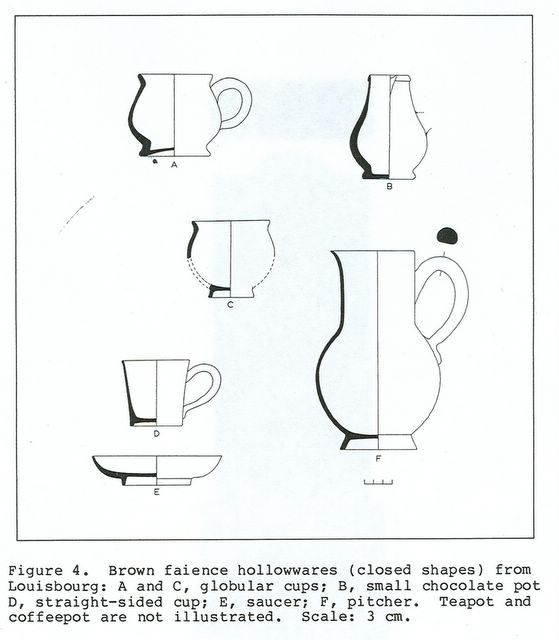
"The shapes of ceramic objects are generally divided into two categories: hollowware (creux) and flatware (platerie). Brown faïence hollowware comprises pitchers, coffeepots, chocolate pots, teapots, soup tureens, huguenotes, pâtés, deep platters or saladiers, large bowls, porringers and cups.
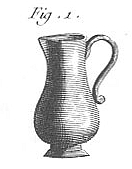
PitcherThe pitcher is a pot with a slight pouring lid and a handle. Its neck is long, straight and vertical; its body is globular.

a brown faïence coffeepot suitable for heating all kinds of liquids, Encyclopédie, Recueil de planches . . . Fayancerie, 1765The coffeepot is a pouring pot in which the walls are uniform and slanted toward the bottom and the handle is horizontal and straight “used for heating all type of beverages” (Encyclopédie 1765: Fayancerie, PL I: 4) The author does not make a distinction between the coffeepot,marabout

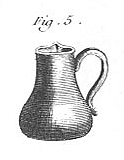
the marabout (round-bodied hot water jug [Fig. 5])


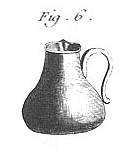
Coquemartand the coquemart [Fig. 6] (see text of the encyclopedia). Furetière 1970, however, says that the “coffee pot” is a “small coquemart-shaped vessel in which coffee is prepared.”


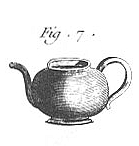
The teapot is a pouring pot with a bulbous body, narrow opening and long cylindrical and sometimes curved spout. tea pot It has a handle, and the spout is separate from the pot’s opening. The teapot usually stands lower than other pots of normal size. In the Recueil de plances (1765 in Encyclopédie: Fayancerie I:7), it states “A tea pot to be used with a tray (name given to a platter carrying a number of coffee cups), usually made to contain coffee.”Although this pot is used to make coffee, it looks like an 18thC teapot
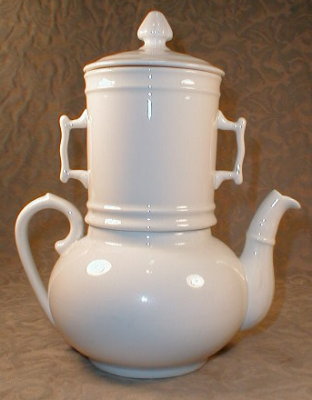
Today's coffeepot with filtre drip This text is probably another indication that tea was not widely used.

It is only in the text of the Encyclopédie itself that the teapot is described as a pot to be used for tea: “Tea pot (Faïence manufacturer’s terminology), slightly bulbous vessel with handle and spout, in which tea is brewed with boiling water and used as a beverage. Tea pots come in all shapes and sizes, and may hold from one to ten cups; Chinese and Japanese tea pots are perhaps among the most beautiful."

From these texts, it would appear that the function of the pouring pot(s) must have varied according to the needs of the people."

This post links to Feathered Nest Friday

Thursday, December 28, 2006

Porringers in Nouvelle France


Blanchette 1979:64

The following is my paraphrased summary of porringers from thesis: Blanchette, Jean-Francois (Ph.D.: Anthropology, 1979, Brown University) Title: The role of artifacts in the study of foodways in New France, 1720-1760 : two case studies based on the analysis of ceramic artifacts.

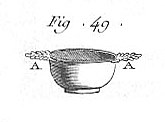
“Porringers are: hollow bowls with steep walls; a table utensil; small rimless platter normally used for serving bouillon, or preparing soup for a particular person; vessels for individual consumption. The porringers found in Louisbourg have two long shell-shaped handles and a vertical footring.

Because porringers are considered to be a “wet dish” service item, Blanchette emphasizes the porringer, which in certain areas of France such as La Marche, Le Limousin and Le Maconnais, had a distinct personal character. In these regions, a porringer was bestowed upon each newborn infant to be used solely by that individual until death. When the person died, the porringer was buried alongside the body as a funeral offering. This is a material manifestation of the personality. Encyclopédie, Recueil de planches, Fayancerie III:49 [Today, babies often receive silver porringers with their name engraved.] In the Compagnie franches de la marine stationed at Fort Beauséjour, the brown faïence porringer may have been the symbol of each officer’s individuality, and this aspect would merit examination, along with porringers of other materials. Although Place Royale is the same type of site as Louisbourg, the same shapes of brown faïence are found there with the exceptions of the teapot, the pâté, the small pouring pot and the porringer. The lack of the brown faïence porringer is quite surprising since this was a common shape elsewhere in New France; however, coarse earthenware porringers are found there and may have served the same function. Another point in support in our explanation of the sociotechnic functions of the porringer is the almost total absence of porringers in the public areas such as inns and cabarets in Louisbourg.

It is also noteworthy that military sites revealed only those brown faience shapes relating to liquids and hot wet dishes. This is certainly related to the food customs of military officers at the time, whose main dishes were soup, porridge, stews, bread and beverages. It is believed that these faïence objects were used by the officers. Subalterns to the officers used coarse earthenware, metal, or wooden objects, or ate directly from the cooking pot or a common bowl [trencher].”

Wednesday, December 27, 2006

Bread for Sop or Soup


The baker’s shop, engraving, from Paul Jacques Malouin, Description des arts et métiers (Paris, 1967).

“‘Soup, in fact, derives from ‘sop’ or ‘sup,’ meaning the slice of bread on which broth was poured. Until bread was invented, the only kind of thick soup was a concoction of grains, or of plants or meat cooked in a pot. Gruel or porridge was thus a basic food, a staple form of nourishment, and long held that place in Western countries, for in practice bread was a luxury eaten only in towns.’” p. 177

“‘. . . soup which was to become a staple item of the European diet from the Dark Ages onwards: a slice of bread at the bottom of a bowl, with broth or soup made in a pot poured on to it. The word suppa, from Frankish, was used in Low Latin and has kept its original sense in Dutch sopen, to soak, cognate with English ‘sop.’ Soup poured over pieces of bread is popular in France: garbure, made of cabbage, bacon and preserved goose is one such example, so is French onion soup.’” p. 229. Quotations from History of Food, Toussaint-Samat, Maguelonne, translated by Anthea Bell. . Blackwell Publishers, 1992.


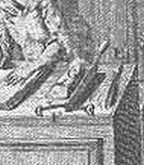
 Detail from "the bread shop." The girl at the right is chipping the crusts from rolls; the chippings were sold "to the poor and country people" to put in their soup.
 Detail from "the bread shop." The baker's wife behind the counter is working on her accounts; at her left is a bread-slicer similar to those still used in neighborhood restaurants in Paris. 

Tuesday, December 26, 2006

Archaeology of Brown Faïence
Ceramics in Nouvelle France


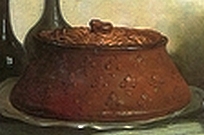
The Pâté, Jean-Baptiste Oudry, 1738

The following is my paraphrased summary through chapter one of thesis: Blanchette, Jean-Francois (Ph.D.: Anthropology, 1979, Brown University) Title: The role of artifacts in the study of foodways in New France, 1720-1760 : two case studies based on the analysis of ceramic artifacts.

The study of brown faïence is a well-defined ethnic type, being manufactured only in France. Its presence or absence on any site occupied by the French during the French regime should reveal preferences for culinary equipment and, undoubtedly, particular alimentary orientations related to status. In fact, the beginning of the 18thC was a period when the ceramic arts, particularly faïence, flourished. At this time Louis XIV ordered the silver and gold table services to be sent to the mint to pay for the excessive expenses incurred by foreign wars. These table services were replaced by faïence.

Although brown faïence was invented during a period of liberalism in the industry, the limited supply of wood fuel for kilns caused stipulations that production must be for either white or brown faïence. The exclusive production of brown faïence, or brown with white interior, made it possible for numerous Rouen factories to exist until well after 1786, even though cheaper, prettier English pottery which had the appeal of a foreign product was preferred, brown faïence continued to persist as both kitchen- and tableware.

For many centuries, meals had been composed of either potages or stews, made thick by the addition of bread. Meals, in which meats, spices, and other rare products could be found, were for well-to-do people—the common people were eating plain and frugal fare, which seldom included meats, except for special social or religious activities. Meals of the lower class tended to remain the same, but meals of the upper class went through a revolutionary change as evidenced by their cookbooks (Bonnefons 1651; L.S.R. 1674; La Varenne 1699; Liger 1700, 1755; La Chapelle 1735; Lemery 1745; Marin 1775). The change in haute cuisine was that of cooking food slowly, in its own juices: meats were cooked individually, spices selected and vegetables prepared separately, to say nothing of the diversity of pastries and desserts. Ceramic vessels became the preference for slow cooking, metallic ones when a fiercer fire was needed. The variety of brown faïence vessels corresponds to the needs of the new cuisine. Marin summarizes numerous details about the ways of preparing meals, the quantities for necessary ingredients, cooking time, necessary vessels for preparation—glazed earthenware pots, terrines, tripode huguenote, form also seen as a copper tourtiere huguenotes (tripod cooking pot), earthenware or copper pans and kettles, water kettles, silver and faïence platters. In fact, the first book addressing itself to the bourgeoisie in addition to the nobility and the clergy was Menon’s La cuisinière bourgeoise published in 1746.

It was toward a refinement and a tasting of individual food that the kitchen of the French nobility was aiming. A significant element of Bonnefons’ Les délices de la campagne concerned the cooking and preparation of root vegetables, such as carrots, parsnips, white salsify, beets, rapes, turnips and Jerusalem artichokes. Usually considered food in times of famine and bad harvests, Bonnefons brought these foods to the table of the leisure class. Sugar now played an important role and was used for many things, including decoration. Sauce was thickened with flour and heat rather than with soddened bread. Three elements of this cuisine are: wet dishes—stews, potages and sauces; dry dishes—cooking in undercrusts, the use of waxed paper for cooking, the practice of multiple cooking using two different techniques; and liquids—coffee, tea and chocolate.

Wet dishes include creams, eggs, and other side dishes which were partially or totally prepared in hollow platters or on dishes over a gentle fire. Cooking was slow and meat was often left to cook on a gentle fire to extract its juice. Braising was another technique.

Pâtés were dry dishes, meats cooked in undercrusts which were either puffed pastries made of wheat flour for fine dishes, or a combination (bise) of wheat and rye flour for large cuts of meat. These undercrusts were sometimes decorated with fleurs-de-lis made of paste (Liger 1755). No vessel was needed to cook the pâté because the solid crust replaced it. The pâtés could also be cooked directly on the sole, (oven floor) or on a piece of waxed paper in the oven, as was the case for meat preparations that held their shape. This method of cooking was expensive because the paste hardens during cooking and was later discarded. Numerous meats, fishes and other dishes were often cooked twice. They were first cooked on a spit or cooked slowly in a pan or platter. The second time they were arranged on a serving platter of silver or faïence and covered with grated cheese, cream or other decorations and set in the oven or on weak embers, thus producing a glaze. This method of cooking was a new refinement not found in recipe books from the preceding century. Blanchette 1979:120Brown faïence dishes, called pâtés after the food, made it possible to cook these dishes without undercrusts which were expensive for those who did not have large quantities of grains for flour in storage. The food was put in pottery pâtés and placed in a bain-marie so that the water in the bain-marie would replace the humidity otherwise supplied by the undercrust containing the pâté. Detail from The Pâté  Blanchette suggests using brown faïence pâtés to eliminate the need for undercrusts was very economical and the pâtés were decorated with fleurs-de-lis, like the undercrusts. The tops of the faïence pâtés were often decorated with rabbits and feathered game to suggest the type of meat used.

a brown faïence coffeepot suitable for heating all kinds of liquids, Encyclopédie, Recueil de planches . . . Fayancerie, 1765Liquids, like wine, were often suggested to prepare meats and fishes. Wine was also used for the preparation of hot and cold drinks. Tea, coffee and chocolate were not mentioned in recipe books before the 18thC. Liger (1755) specifies that coffee grains are roasted in glazed earthenware vessels so that they won’t burn and all their taste is preserved. He also says that water for tea boils in a cafétière (coffeepot).Glass of Water and a Coffee Pot, Chardin 1760 In fact, authors of cookbooks never use the term théière (teapot) in any of the books analyzed, although the teapot shape is found archaeologically in 18thC sites and mentioned in documents at mid-century. The pitcher, coffeepot, chocolate pot, teapot, small pouring pot, globular cup and straight-sided cups are all brown faïence shapes related to beverages and relative consumption seems to correspond to relative occurrence in New France archaeological sites.

Development of the new cuisine in France coincided with the development of brown faïence, and the shapes of this ceramic type correspond well to the preparation-service-consumption of the foods previously noted. Thus it would seem that brown faïence was manufactured for the preparation and service of dishes found in the new recipe books, since the diverse specialized shapes correspond so well to the foods. In effect, the development of foodways follows the general progress of French society as seen in standards of living, demography, the bourgeoisie and colonial commercial activity. This general frame of reference should be kept in mind in understanding the role and position of brown faïence in culinary innovations of the 18thC.

Monday, December 25, 2006

Serving and Eating Foie Gras


My foie gras cooking trials are over and it's time to enjoy the results.

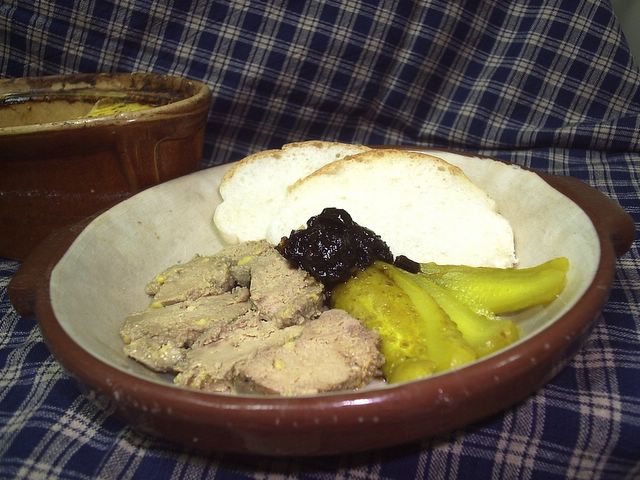
My first recipe is from Emeril, Foie Gras Terrine, in which I used my own Vin Noix or green walnut wine instead of port. I served this terrine with cornichons, toast and onion marmalade and a glass of vin noix. Results--earthy, unctious and rich.

Another terrine involved the use of spices, and I turned again to my favorite blend, menues espices, which today is known as quatre-épices. Because of the richness of the spices, I served this terrine with a sweet white wine and plain toast--the flavor on the top of the tongue reminds me of the best smells in a deli.

During my discussions on foie gras several of my readers have offered tips for serving this delicious treat.
  • Jean-Luc Odeyer of Grenoble, France, "I prepare the green nut chutney, it is a delight! It is good with the raclette, the foie gras, the grills and the skewers, cheese, the cold meats and the charcuterie, on toasts…"
  • Don wrote "The pan juices and lemon are what truly makes foie gras with ham superb. Very delicious with a squeeze of lemon."
  • David Lebovitz recommends serving très bon Sauternes
  • One offered another recipe with ways to serve the terrine in a casual or more fancy manner.
  • and Pascal has a lovely picture of a simple foie gras presentation

Elsewhere on the net are sites for tasting, preparation and cooking.

Foie gras is a holiday food, a simple food. It lends itself to many styles of serving and eating. Whether you use some of my 18thC recipes or these modern ones, do enjoy your liver--it can be a harbinger of good things to come.


 Enjoy Foie Gras, Enjoy Life! Foie gras and
other French delicacies from Mirepoix, USA

Wednesday, December 20, 2006

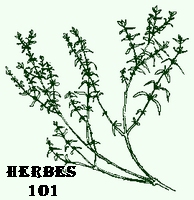
Herbes 101


Plain food can be enhanced by any number of herbes, which are the leaves and stems of plants [usually roots and fruits and nuts of plants are considered spices]. Fresh herbes should be bruised or twisted before being added to cooking foods, the exception being herbe bundles or bouquet garni which is often tied together and suspended from the handle of the cooking pot to aid in its removal prior to serving.

Some herbes, bay [laurel] leaves in particular, benefit from being bruised and "fried" in a little oil, graisse or butter, which releases the oils of the herbe and intensifies its flavor. There may be times when you do not want to intensify the herbe--adding it at later stages in cooking may give a more elusive flavor.

Dried herbes should be crushed in the hand before adding to the pot. This will release more flavor, as will toasting in a dry pan or frying in the oils and fats at the beginning of the preparation of the dish.

Adding herbes at the very end of the cooking process is necessary when using herbes like basils, which darken with cooking and can spoil the looks of the dish.

National cuisines use different combinations of herbes--begin to experiment with not only local herbes, but be sure and lay in a supply of unusual herbes from your traveling merchants when given the chance. Bon appétit!

Wednesday, November 29, 2006

Before Prudhomme's Turducken - There Was Goose Pye


Dead Duck with a Pie, Porcelain Bowl and Jar of Olives, Chardin 1764

Chef Paul Prudhomme is credited with creating turducken, a boned chicken stuffed in a boned duck stuffed in a boned turkey, all layers surrounded by forcemeat [farce], usually served at holiday times when some cooks yearn to bring something splendid to the table. But Hannah Glasse beat him to the table, as did other 18thC cooks.

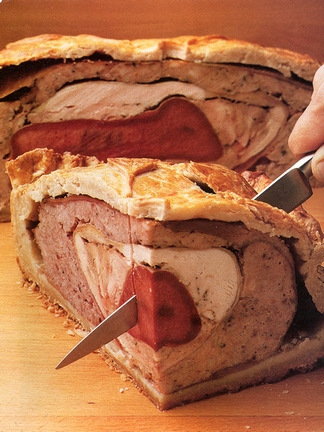
Once you have fattened your holiday goose, removed its foie gras, and it hangs cooling on the meat hook in the office [cold kitchen], it’s time to think of goose pye, a corned [pickled] tongue surrounded by farce stuffed in a marinated, boned chicken, surrounded by farce, stuffed in a boned and marinated well-hung [term used to connote ternderizing] goose baked in a crust—perfect for today’s holiday meals, but a means of preserving in the past.

The spices [today's French four-spice or quatre-epice] used in the farce and in the marinating process serve to preserve the meat once it is cooked and cooled, allowing the pye to be kept in the cool room and sliced for serving as needed—time here also serves to ripen or develop the many flavors in this dish.


Goose Pye, photo from Terrines, Pâtés & Galantines. Time-Life, 1982, p. 52.

Here is Glasse's recipe for goose pye.

I highly recomend both Time-Life's Terrines [which also uses Glasse's recipe and is accompanied by marvelous step-by-step photos] and Glasse's book, also known as First Catch Your Hare. Terrines is edited by the late inimitable Richard Olney. Glasse's book served as the take off for many following books and incorporates about a hundred years of previous cooking knowledge--still a great book after two and half centuries!


Related Posts Plugin for WordPress, Blogger...